The Raspberry Pi RP2350 dual-core Arm/RISC-V has gotten a new version – A4 stepping – addressing bugs and security vulnerabilities, notably the infamous E9 GPIO erratum and glitching bugs in the A2 stepping identified by the 2024 Hacking Challenge. Both RP2350A and RP2350B variants will benefit from the new stepping and be marked RP2350A0A4 and RP2350B0A4, respectively. The company also announced the availability of the 2MB flash variants, the RP2354A and RP2354B (unveiled in March 2025), that do not require flash on the board. RP2350 A4 stepping highlights: Fixes Glitching bugs identified in the 2024 Hacking Challenge. Exploits required physical access to the chip. The E9 GPIO erratum related to GPIO pull-ups. A4 stepping is a drop-in replacement for the earlier A2 stepping. 5V-tolerant GPIOs; Note: the chip must remain powered while 5V IOs are used (See updated datasheet for details) RP2354A and RP2354B variants with 2MB of stacked-in-package QSPI […]
TermDriver 2 is a USB-to-serial adapter with a built-in color display (Crowdfunding)
USB-to-serial debug boards are commonly used for board bring-up, checking for issues when a board does not boot, or accessing the serial console in systems without networking or video output. You’d just connect GND, Tx, and Rx wires to the target board, and a USB cable to the host, before running a terminal program like Putty, Minicom, or Bootterm with the correct parameters, and you should be good to go. That’s the theory, but sometimes Tx and Rx may be inverted, the baudrate is not advertised, and so on. So Excamera Labs decided to make the TermDriver 2, an improved USB-to-serial with a small built-in display to more easily debug those issues. It can also be used in standalone mode, showing the serial console output on the tiny screen without having to connect it to a host. TermDriver 2 specifications: MCU – Raspberry Pi RP2040 dual-core Arm Cortex-M0+ MCU @ […]
Embedr Arduino IDE features Gemini-powered AI assistant with local code completion
Embedr is an AI-powered Arduino-like IDE designed to simplify development for Arduino-compatible microcontrollers. It looks very similar to the Cursor code editor and uses Microsoft’s Monaco Editor and Arduino CLI tools to enable features such as intelligent code suggestions, project skeleton generation, and visual debugging. Embedr has all the Arduino features that you are familiar with, and on top of that, you can add other LLMs and experiment just by adding the required plugin and connecting them via API keys. We’ve previously seen Arduino release their Claude-based Arduino Cloud Editor, which runs in the browser for context-aware coding assistance. But the problem with that is, if you don’t have internet, you can’t use the IDE. Embedr runs locally and uses Google’s Gemini 2.5 Flash LLM, meaning you can compile and debug your code offline without needing a constant internet connection. Additionally, Embedr gives you greater control and privacy compared to […]
SATURN NITRO – A Microchip PIC32MK development board with Arduino Nano form factor
While Microchip regularly releases PIC32 microcontrollers and evaluation kits, we don’t see that many PIC32 development boards from third parties. The SATURN NITRO is an exception, and the Arduino Nano-inspired development board is equipped with a 120 MHz PIC32MK general-purpose and motor control 32-bit MIPS microcontroller with 256KB SRAM, 1024KB flash, and 4KB EEPROM. The board closely follows the design of the official Arduino Nano board and can be seen as a beefed-up version with a much more powerful microcontroller delivering 198 DMIPS compared to the Microchip ATmega328P 8-bit microcontroller @ 16 MHz with just 2KB SRAM, 32 KB flash, and 1KB EEPROM, and a less capable I/Os. SATURN NITRO specifications: MCU – Microchip PIC32MK1024MCM064 Core – MIPS32 microAptiv MCU core @ 120 MHz with FPU; up to 198 DMIPS Memory – 256 KB SRAM Storage – 1MB flash, 4KB EEPROM USB – 1x Micro USB OTG port also used […]
Adafruit Metro RP2350 development board follows Arduino UNO form factor, features HSTX DVI output
The Adafruit Metro RP2350 is a Raspberry Pi RP2350 development board that closely follows the Arduino UNO form factor for compatibility with existing Arduino shields. Key features include 37 GPIOs, a microSD card slot, a 5V buck converter (6–17V input), an onboard RGB NeoPixel, a Stemma QT port for I2C peripherals, a 22-pin HSTX port for DVI video output, and a USB Type-C port for power and data. It also provides a Pico Probe debug port, an RX/TX switch for UART flexibility, and a UF2 bootloader for easy firmware updates. Target applications include IoT projects, embedded system development, hardware prototyping, and educational purposes. Adafruit Metro RP2350 specifications SoC – Raspberry Pi RP2350 CPU Dual-core Arm Cortex-M33 @ 150 MHz with Arm Trust zone, Secure boot Dual-core RISC-V Hazard3 @ 150 MHz Up to two cores can be used at any given time Memory – 520 KB on-chip SRAM Security 8KB of […]
CPico RP2350 is another Raspberry Pi Pico 2 alternative with USB-C, 8MB flash, 2MB PSRAM, BConnect I2C & debug ports
iLabs CPico RP2350 is a Raspberry Pi Pico 2 alternative with the same form factor, still based on the Raspberry Pi RP2350 microcontroller but equipped with a USB-C port, 8MB flash, 2MB PSRAM, a Reset button, and Bconnect I2C and debug ports. Apart from that, the CPico RP2350 retains the other features of the Raspberry Pi Pico 2 including the two 20-pin PGIO headers, and BOOT button. It joins other Raspberry Pi Pico 2 alternatives like the Waveshare RP2350-Plus adding battery support. CPico RP2350 specifications: SoC – Raspberry Pi RP2350 CPU Dual-core Arm Cortex-M33 @ 150 MHz with Arm Trustzone, Secure boot Dual-core RISC-V Hazard3 @ 150 MHz Up two cores can be used at any given time Memory – 520 KB on-chip SRAM Security 8KB of anti-fuse OTP for key storage Secure boot (Arm only) SHA-256 acceleration Hardware TRNG Fast glitch detectors Package – QFN-60 Memory – 2 MP […]
USB-C and Lightning tester features an LCD display showing the voltage of each pin
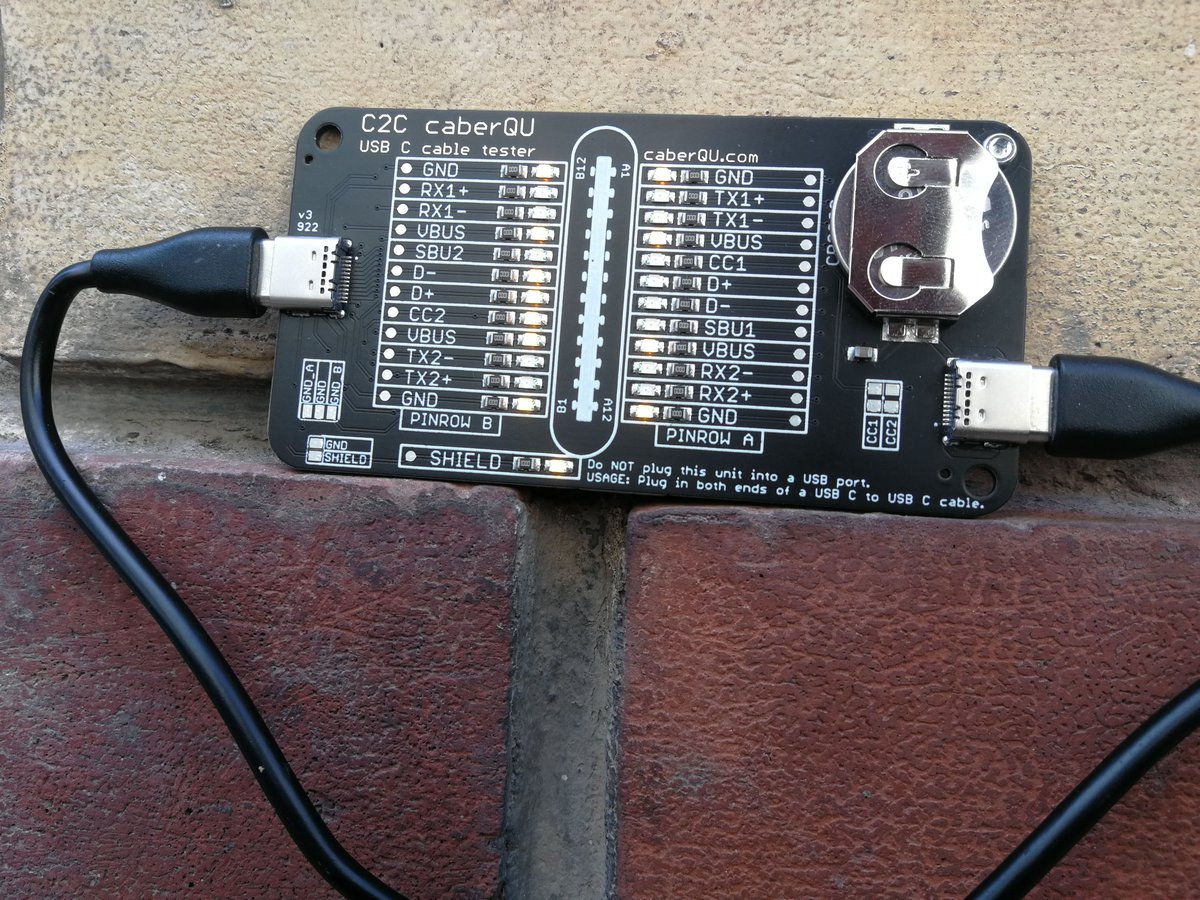
VBEST’s Tail Insert Detector is a USB-C and Lightning cable/device tester that reports “real-time” current and voltage of each pin on its built-in display for easy debugging and testing. VBEST Tail Insert Detector highlights and specifications: Port compatibility – USB Type-C male and Lightning male ports Display – Color LCD display Features – Real-time current and voltage detection Misc – Push switch for power and display mode Power 5V via USB-C female port (on the side) Built-in battery Dimensions – 52 x 35 (estimated) x 14mm Sadly, there’s not much in the way of documentation, so it’s unclear how many display modes there are. I’m also confused by the “real-time” voltage and current reporting, because we’re also told it takes 5 seconds to detect “abnormal pins”. The VBEST’s device is very similar to the A2C caberQU and C2C caberQU boards used to respectively test USB-A to USB-C and USB-C to […]
CapibaraZero firmware enables low-cost Flipper Zero alternatives based on ESP32-S3 hardware
CapibaraZero open-source firmware aims to offer a low-cost alternative to Flipper Zero for ESP32-S3-based hardware platforms and soon other gizmos with ESP32 wireless microcontrollers, notably the LilyGO T-Embed CC1101, similar to the original T-Embed with ESP32-S3 WiSoC, but also featuring a Texas Instruments CC1101 Sub-GHz microcontroller and an NXP PN532 NFC/RFID module. The Flipper Zero is a popular portable multi-tool for pentesters and hardware hackers based on STMicro STM32WB55 Bluetooth 5 LE & 802.15.4 wireless microcontroller and a TI CC1101 Sub-Ghz MCU that got involved in controversies such as a ban proposal in Canada last year due to its (dubious) potential use for car theft. Since then we’ve seen several alternatives such as Monstatek M1 (that’s yet to be delivered to backers…) and HackBat open-source hardware with Raspberry Pi RP2040, ESP8266 WiFi module, and the CC1101 RF transceiver. The CapibaraZero firmware offers another way to create your own cheap Flipper […]