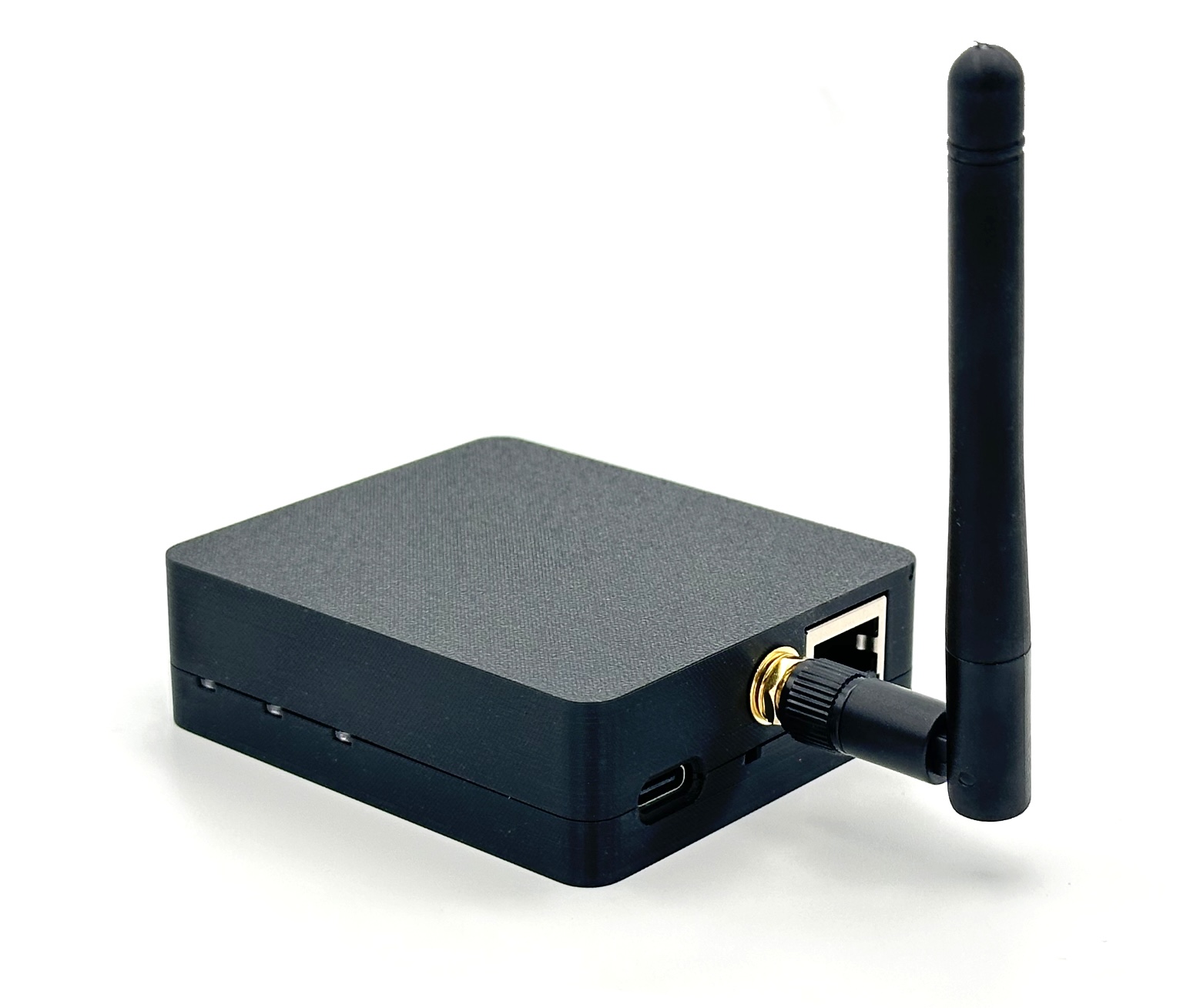
SCINTIX P4 is an ESP32-P4 RISC-V Compute Module with an ESP32-C6 for wireless connectivity that’s compatible with Raspberry Pi CM4/CM5 carrier boards, at least partially. It should be the first MCU-based system-on-module in Raspberry Pi CM4/CM5 form factor, and RELOC says the SCINTIX P4 gives access to displays, cameras, Ethernet, USB, and all the peripherals the ESP32-P4 exposes when connected to a carrier board. It can also be programmed in standalone mode through its built-in USB Type-C port. SCINTIX P4 (RM-CMP4) specifications: SoC – Espressif Systems ESP32-P4NRW32X CPU Dual-core RISC-V @ 400 MHz with AI instruction extensions and single-precision FPU Single-core RISC-V LP (low-power) MCU @ up to 40 MHz GPU – 2D Pixel Processing Accelerator (PPA) VPU – H.264 and JPEG codecs support Memory – 768 KB HP L2MEM, 32 KB LP SRAM, 8 KB TCM, 32MB PSRAM Storage – 128 KB HP ROM, 16 KB LP ROM Storage […]
Espressif ESP32-E22 WiFi 6E module gets Wi-Fi CERTIFIED certificate, open-source WiFi and Bluetooth Linux drivers
The ESP32-E22 tri-band Wi-Fi 6E and Bluetooth 5.4 module has received a Wi-Fi CERTIFIED certificate from the Wi-Fi Alliance, and Espressif has also released WiFi and Bluetooth Linux drivers for the chip. The ESP32-E22 was first unveiled at CES 2026 with a dual-core RISC-V processor clocked at up to 500 MHz, 1MB RAM, tri-band WiFi 6E tested up to 2.1 Gbps with iperf, and dual-mode Bluetooth 5.4/6.0. While it also features 41 GPIO pins, it’s not mainly designed for IoT projects, but instead targets host-based wireless systems needing WiFi 6E / Bluetooth 5.4 connectivity through PCIe 2.0 or SDIO interfaces. In other words, the ESP32-E22 will likely show on M.2 modules, competing against similar products from MediaTek and Intel. Espressif has not said which module was tested for the Wi-Fi CERTIFIED certificate, but I suspect it should be the upcoming ESP32-E22-M2-1 M.2 module listed on the company’s website. From the certificate, […]
M5Stack Capsule Kit v1.1- A Battery-powered ESP32-S3 IoT controller with IMU sensor, MEMS microphone, and IR transmitter
M5Stack Capsule v1.1 is a Stamp-S3A-based IoT controller with a microSD card slot, several sensors (6-axis IMU, microphone), an IR transmitter, a built-in 250 mAh battery, a few buttons, a buzzer, an RTC, and expansion capabilities through GPIO headers and a Grove connector. It’s an upgrade to the earlier Capsule based on the Stamp-S3 module. The new version still features an ESP32-S3 WiFi and Bluetooth microcontroller, 8MB flash, a USB-C port, and a few GPIOs, but benefits from the Stamp-S3A improvements, including an optimized antenna design and lower power consumption. We never had a look at the Capsule before, so let’s do it now. M5Stack Capsule v1.1 specifications: M5Stack Stamp-S3A module WiSoC – Espressif Systems ESP32-S3FN8 CPU Dual-core 32-bit Xtensa LX7 microcontroller with AI vector instructions up to 240MHz RISC-V ULP co-processor Memory – 512KB SRAM Storage – 8MB flash Wireless – 2.4GHz WiFi 4 (802.11b/g/n), Bluetooth 5.0 LE + […]
$7.99 Seeed Studio Wio-S3 WiFi, Bluetooth LE, and LoRa IoT module combines ESP32-S3 and SX1262 RF transceiver
Seeed Studio Wio-S3 is a compact (21.6 x 16.5 x 3.3 mm) wireless module that combines an ESP32-S3R8 dual-core WiFi 4 and Bluetooth LE MCU and a Semtech SX1262 LoRa transceiver. The module includes 16MB Flash and 8MB PSRAM, and supports LoRa (EU868/US915) with up to +20.9 dBm transmit power and -137 dBm sensitivity. It also supports Wi-Fi 4 and BLE 5.0, and comes with two IPEX connectors for external antennas. With interfaces such as UART, I2C, SPI, ADC, and USB, and support for -40°C to 85°C operation, it is designed for remote monitoring, industrial automation, smart agriculture, and IoT data logging. Seeed Studio Wio-S3 module specifications: SoC – Espressif ESP32-S3R8 CPU – Dual-core Tensilica LX7 microcontroller up to 240 MHz with vector instructions for AI acceleration Memory – 8MB PSRAM Wireless – 2.4 GHz 802.11b/g/n WiFi 4 and Bluetooth 5.0 LE + Mesh connectivity Storage – 16MB external SPI flash […]
Bare-metal MSX2+ Emulator for ESP32-S3 offers custom LCD_CAM VGA implementation & Z80 optimizations
Ivan Svarkovsky’s S3-MSX-PC open-source project implements a bare-metal MSX2+ emulator running on an ESP32-S3 microcontroller and outputting 64-color VGA via a simple R-2R resistor ladder. It’s a fork of the Retro-Go emulator for ODROID-GO and other ESP32 devices, but with various optimizations. It was tested on an off-the-shelf ESP32-S3 board with one core handling the game logic and the other video and audio output. VGA is implemented through a clever resistor network that converts digital data into an analog signal that any old monitor understands, while audio relies on Sigma-Delta modulation with a multi-stage PDM filter. The USB host port on the board allows for the connection of a keyboard. S3-MSX-PC firmware highlights: Emulation Core – fMSX 6.0 — Full MSX1 / MSX2 / MSX2+ support Video Output VGA 640×480@60Hz, 16-bit parallel RGB via LCD_CAM Color Depth – 64 colors (2 bits per channel: R, G, B) Audio – PDM Stereo […]
Docker for Microcontrollers? AkiraOS combines Zephyr RTOS with WebAssembly (WASM) applications
AkiraOS is a Zephyr-based embedded OS that runs sandboxed WebAssembly applications on microcontrollers and lets users deploy and update firmware OTA without reflashing. In other words, it’s similar to Docker containers, but for microcontrollers. The open-source embedded platform separates the OS from the application. That means the firmware stays stable, while apps are independent .wasm binaries deployable over-the-air without touching the OS, and portable so a single binary works on ESP32-S3, nRF5x, or STM32 MCU boards. AkiraOS highlights: User space Up to 8 wasm apps can be installed Up to two apps can run at the same time Footprint: 50KB to 200KB per app Akiraz runtime – Custom WASM runtime App Manager UI Framework with 32 widgets Shell/console 18 API modules WebAssembly Micro Runtime (WAMR) – Two options: Interpreter or Ahead-Of-Time (AOT) compilation with 10 to 50x higher performance RTOS – Zephyr RTOS Scheduler Network stack HTTP for OTA updates […]
Erqos EQSP32CE – An industrial IoT ESP32-S3 PLC with Ethernet, RS232, RS485, CAN Bus, DIN Rail support
Erqos EQSP32CE is a DIN rail-mountable industrial IoT PLC based on an ESP32-S3 WiFi and Bluetooth SoC and offering Ethernet, RS-485, RS-232, and CAN bus industrial communication interfaces. The IIoT logic controller also features several protected digital (16x) and analog (8x) inputs, eight current inputs, eight “special mode” analog inputs, and sixteen digital outputs with PWM support. A USB-C port is used for firmware flashing and monitoring, and the PLC takes a wide 7V – 26V DC input voltage and outputs 5V/1A for I/O expansion modules. Erqos EQSP32CE specifications: SoC – Espressif ESP32-S3 dual-core LX7 processor @ 240 MHz with 8MB Flash, 512kB RAM, wireless connectivity (so probably ESP32-S3FN8) Communication interfaces 10/100 Mbps Ethernet RJ45 port Wi-Fi + Bluetooth Low Energy (on ESP32-S3) with internal antenna RS232 (protected) and RS485 half-duplex (protected) with support for Modbus RTU, DMX512, and custom serial protocols CAN Bus (protected) USB – 1x USB-C power for […]
EKOS – An ESP32-S3 ePaper dashboard housed in an oak-aluminum enclosure (Crowdfunding)
Designed by StillFixing in Normandy (France), the EKOS is a local-first, low-power ePaper dashboard built around an ESP32-S3 SoC. It operates without any cloud dependency, subscriptions, or external accounts, offering full privacy, faster response times, and direct local control. The device comes in two variants: the EKOS Pure is a minimalist, non-touch version with two physical buttons for basic control, and the EKOS Sense adds a capacitive touch layer for smart home control, such as toggling devices, triggering scenes, or managing tasks. Both models feature a repair-friendly design with no adhesives, using four screws for assembly and a user-replaceable lithium-polymer battery. Additionally, the dashboard can be updated entirely over your home network without needing the internet. You can push data to the screen using a local API from a phone or PC, link it straight to Home Assistant, or use it to control other ESPHome devices around your house. EKOS […]