laptop News - CNX Software - Embedded Systems News

AweSun Cloud KVM Q1 Review – An ultra-compact, low-cost KVM over IP solution tested with Windows 11 and Android clients

AweSun Q1 Pironman 5 Pro Max

AweSun has sent me a sample of their “Cloud KVM Q1” 4K KVM over IP solution for review. It’s a compact device with the minimum number of ports for a connected KVM: USB-C for keyboard and mouse emulation, HDMI input for video, and Ethernet for connectivity to the host. Like other such KVMs, it enables hardware-level remote access even in the BIOS, and the company advertised remote access to server, computer, and mobile phone targets, with the latter requiring an additional USB-C dock for HDMI input. I’ll start the review by going through the specifications, performing an unboxing and a teardown, and testing both mobile and desktop clients with targets like a Raspberry Pi 5 and an Android mobile phone. AweSun Cloud KVM Q1 specifications Here are the specifications from the company: Video Input HDMI port Resolution – Up to 2560 x 1600 with 15 FPS framerate Networking 100Mbps RJ45 […]

Qualcomm Snapdragon C to power cheaper, entry-level Arm Windows laptops selling for $300 and up

Qualcomm Snapdragon C

The Qualcomm Snapdragon C (Compute) Arm SoC is designed for entry-level Arm Windows laptops, or “mobile PCs” in marketing speak, with prices starting at $300, which should compete against entry-level laptops using Intel Alder Lake-N or Twin Lake processors. The company didn’t provide many technical details, but we do know the Snapdragon C comes with an NPU for AI acceleration, and said it’s based on Kryo mobile cores rather than the more recent Oryon cores at a media event. Qualcomm still promises all-day battery life, smooth web browsing, video streaming, and productivity for students, families, and small businesses. I’m not sure what kind of announcement that is, as Qualcomm didn’t provide any specifications. However, they did mention Acer, HP, and Lenovo will offer Snapdragon C laptops, and we have some specifications for the upcoming Acer Aspire Go 15 (AG15-Q31P). SoC – Qualcomm Snapdragon C CPU – Unknown number of Kryo […]

SpacemiT K3-powered DC-ROMA RISC-V motherboard III is made for the Framework Laptop 13

Framework Laptop 13 SpacemiT K3 mainboard

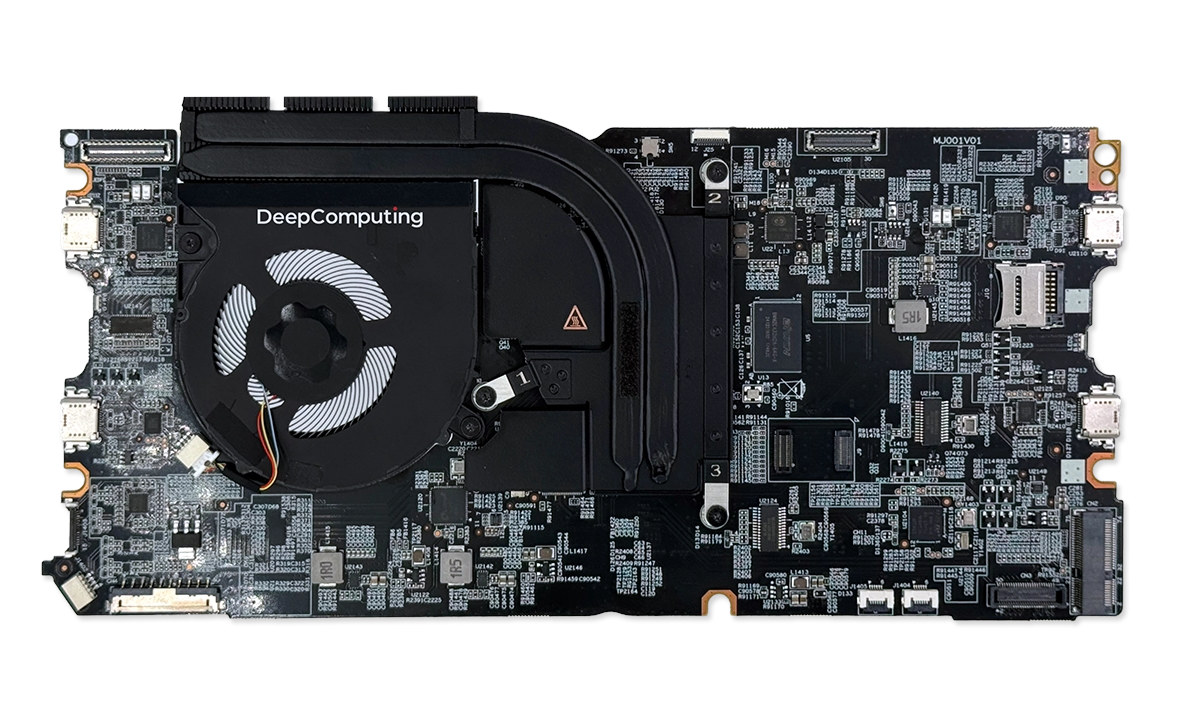
Another day, another SpacemiT K3 device is released, namely Deep Computing DC-ROMA RISC-V Mainboard III for Framework Laptop 13, following the K3 Pico-ITX SBC and K3-CoM260 (and related Jupiter 2 and Banana Pi BPI-SM10) on Monday, and the Firefly AIBOX-K3 on Tuesday. Initially launched with Intel processors, the Framework Laptop 13 repairable and modular laptop had already got a RISC-V motherboard with the StarFive JH7110-based “DC-ROMA RISC-V Mainboard” in 2024, followed by an ESWIN EIC7702X variant the next year. The third RISC-V mainboard features the octa-core K3 64-bit RISC-V SoC with up to 60 TOPS (Sparse) of AI performance, up to 32GB RAM, and an optional 1TB NVMe SSD. Specifications of the Framework Laptop 13 with DC-ROMA RISC-V Mainboard III: SoC – SpacemiT K3 CPU 8x 64-bit RISC-V X100 “big” cores clocked up to 2.4 GHz, RVA23 compliance; 130 KDMIPS performance (similar to RK3588) 8x RISC-V A100 AI Cores with […]

Mind xPlay display and keyboard review using Khadas Mind and Mind 2 mini PCs

Khadas xPlay connected to Crowview USB C display

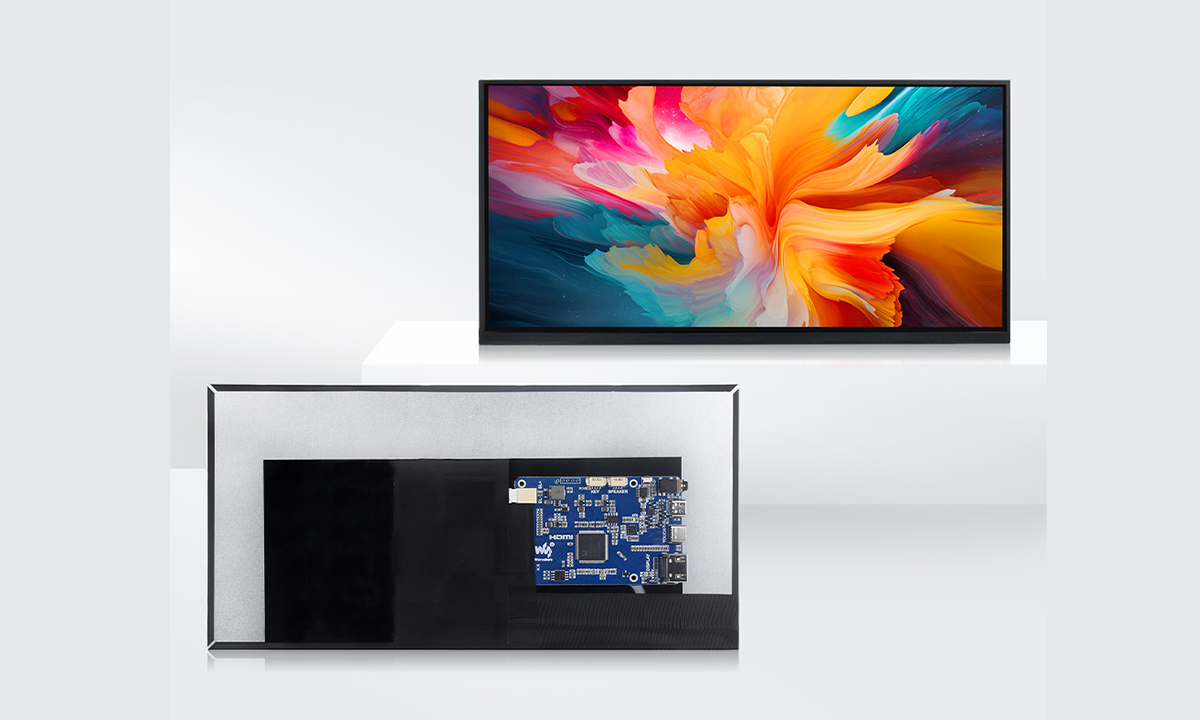
In this review, I’ll report my experience with the Khadas Mind xPlay display and keyboard using the Mind and Mind 2 mini PCs, as well as a CHUWI CoreBook Air Plus 16 laptop to test it as a standard external display. Using Mind xPlay with the Mind 2 mini PC I received the Mind xPlay with the Mind 2 Meteor Lake mini PC, and I already showed how to connect it and get started in the first part of the review. So I’ll continue the review with it initially. I used the EIZO monitor test website to evaluate the display panel itself. I went through all 13 tests, including dead pixel and gradients tests. The pattern above looks fine too, so I compare the Mind xPlay monitor to the 16-inch display of the ASUS Vivobook 16 to find differences. Both were set to maximum brightness. The xPlay delivers noticeably more […]

Intel Core Series 3 “Wildcat Lake” processor family launched for entry-level laptops and Edge AI systems

Intel Core Series 3 launch

After several leaks, the Intel Core Series 3 “Wildcat Lake” entry-level processor family is now official. Intel describes it as the first “hybrid AI-ready Core Series processor”.  As expected, the “Computer & CPU tile” comes with up to six cores (2x P cores + 4x LPE cores), up to 2-core Intel Xe 3 graphics, up to 40 TOPS of combined AI performance, and LPDDR5x/DDR5 memory interfaces. The “Platform controller tile” integrates six PCIe Gen4 lanes, two Thunderbolt 4 interfaces, two USB 3.2 and eight USB 2.0 interfaces, as well as WiFi 7 and Bluetooth 6.0 connectivity. The Computer & GPU tile is manufactured using an Intel 18A process, while the Platform controller tile is manufactured with another “External” process (TSMC?). Single-channel memory is confirmed, and it looks like eMMC flash will be replaced with UFS 3.0 memory for edge systems with soldered-on memory, although many systems will make use of […]

Linux 7.0 Release – Main changes, Arm, RISC-V, and MIPS architectures

Linux 7.0

Linus Torvalds has just released Linux 7.0 on LKML: The last week of the release continued the same “lots of small fixes” trend, but it all really does seem pretty benign, so I’ve tagged the final 7.0 and pushed it out. I suspect it’s a lot of AI tool use that will keep finding corner cases for us for a while, so this may be the “new normal” at least for a while. Only time will tell. Anyway, this last week was a little bit of everything: networking (core and drivers), arch fixes, tooling and selftests, and various random fixes all over the place. Let’s keep testing, and obviously tomorrow the merge window for 7.1 opens. I already have four dozen pull requests pending – thank you to all the early people. Linus This follows the Linux 6.19 release about two months ago, which brought us PCIe link encryption and […]

ASUS Zenbook A16 – A $1699 Qualcomm Snapdragon X2 Elite Extreme CoPilot+ laptop

Snapdragon X2 Elite Extreme laptop

ASUS Zenbook A16 is one of the first Copilot+ PCs/laptops based on the Qualcomm Snapdragon X2 Elite Extreme 18-core Armv9 SoC and is now available for $1,699 on BestBuy or $1,999 on the ASUS website. The laptop features a 16-inch “3K” OLED with touchscreen, 48GB of RAM, a 1TB NVMe SSD, HDMI 2.1 video output, WiFi 7 and Bluetooth connectivity, and a few Thunderbolt and USB ports. ASUS Zenbook A16 (UX3607) specifications: SoC – Snapdragon X2 Elite Extreme (X2E-96-100) CPU – 18x Armv9 cores with 12 Prime cores up to 5.0 GHz (single/dual core) / 4.4 GHz (multicore), and 6 Efficiency cores up to 3.6 GHz GPU – Adreno X2-90 @ 1.85 GHz with support for DirectX 12.2 Ultimate, Vulkan 1.4, OpenCL 3.0 VPU Encode: HEVC, AVC: Dual 8K UHD @ 30 FPS, AV1: 8K UHD @ 15 FPS, UHD @ 60 FPS Decode: AV1, HEVC, AVC: Dual 8K @ 60 […]

Checking out the actual AMD Ryzen SoC used on CHUWI CoreBook Air Plus 16 laptop

AMD Ryzen 5 6600H

I’ve just completed the review of the CHUWI CoreBook Air Plus 16, a laptop based on an AMD Ryzen 5 6600H SoC. All software testing on Windows 11 Pro and Ubuntu 25.10 confirmed that the laptop was based on an AMD Ryzen 5 6600H SoC, but I was asked to confirm that the actual CPU on the motherboard was indeed the advertised chip, for reasons I’ll explain below. Let’s do that right now. I had already done a teardown of the laptop, but since the AMD Ryzen processor was covered by copper pipes for cooling, I could not read the markings on the chip. So earlier today, I removed the bottom cover of the laptop again and loosened the three screws holding the pipes on top of the CPU, so I could check the markings on the processor. It’s an AMD Ryzen 5, a good sign, but there’s nothing that […]