M5Stack CoreS3 Lite is a cost-optimized ESP32-S3-based IoT Vision AI controller providing a cheaper version of the CoreS3 with a magnetic backplate and 200mAh battery instead of a DIN Rail backplate and 500mAh battery. The CoreS3-Lite still features a 2-inch capacitive IPS touchscreen, a VGA camera, a microSD card for storage, a few sensors like a 6-axis IMU, a 3-axis magnetometer, and a proximity sensor, as well as a dual microphone array and an RTC for time keeping. M5Stack CoreS3 Lite specifications: Wireless MCU – Espressif Systems ESP32-S3FN16R8 CPU – Dual-core 32-bit Xtensa LX7 microcontroller with AI vector instructions up to 240MHz, RISC-V ULP co-processor Memory – 512KB SRAM, 8MB PSRAM Storage – 16MB flash Wireless – 2.4GHz WiFi 4 (802.11b/g/n), Bluetooth 5.0 BLE + Mesh, 16MB flash Antenna – Internal 3D antenna Storage – MicroSD card slot Display – 2-inch display with 320×240 resolution via ILI9342C driver, capacitive touch […]
M5Stack Stamp-S3A WiFi and BLE IoT module benefits from optimized antenna design, lower power consumption
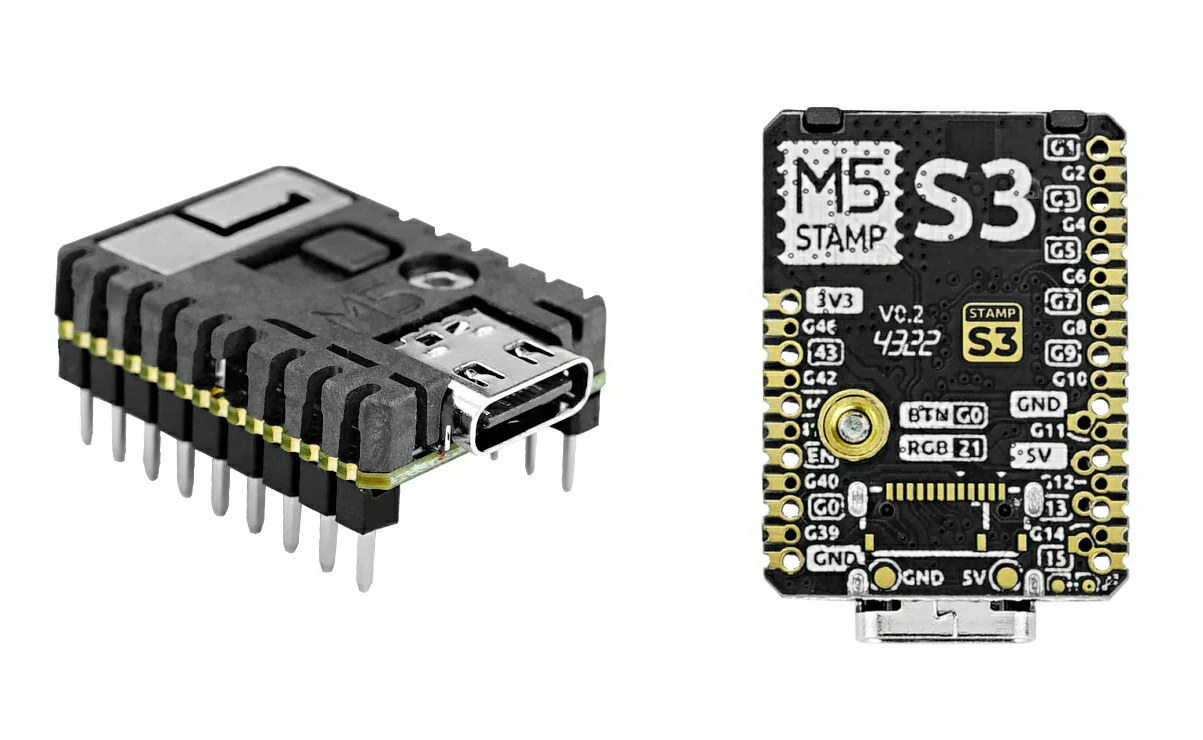
M5Stack Stamp-S3A, also known as M5StampS3A, is an update to the M5Stamp S3 ESP32-S3 module introduced in 2023 with an optimized antenna design, lower power consumption, a larger user button, and a different logic for the RGB LED control. Other features remain the same with 8MB Flash, RGB LED, input button, and 23 GPIOs all in a tiny 26 x 18mm form factor. Two versions are available: the Stamp-S3A without pre-soldered headers and the Stamp-S3A PIN1.27 with headers soldered on the board and an orange heat-resistant cover. M5Stamp-S3A specifications: WiSoC – Espressif Systems ESP32-S3FN8 CPU Dual-core 32-bit Xtensa LX7 microcontroller with AI vector instructions up to 240MHz RISC-V ULP co-processor Memory – 512KB SRAM Storage – 8MB flash Wireless – 2.4GHz WiFi 4 (802.11b/g/n), Bluetooth 5.0 LE + Mesh Connectivity 2.4 GHz WiFi 4, 20 MHz and 40 MHz bandwidth, IEEE 802.11 b/g/n protocol, up to 150 Mbps Bluetooth 5, […]
M5Stack Tab5 Review – Part 2: Getting started with ESP32-P4 firmware development using the ESP-IDF Framework and Arduino IDE
In the first part of the review, we checked out the hardware of the M5Stack Tab5 ESP32-P4 IoT development kit and tried the demo firmware, whose user interface allows the user to quickly experiment with the camera, microphone, speaker, WiFi, power consumption, GPIOs, RS485, and more. Since there’s no user application for the Tab5 at this stage, I decided to look into software development resources for the ESP32-P4 devkit in the second part of the review. I’ll first follow the instructions to build the demo firmware from source using the ESP-IDF framework, then analyze key aspects of the source and make some small modifications. After that, I’ll have a look at ESP32-P4 Arduino support via M5Unified and M5GFX library. ESP-IDF 5.4.1 installation and ESP32-P4 Hello World program The first step is to get the ESP-IDF 5.4.1 and configure ESP32-P4 following the instructions on the Espressif website, before testing it with […]
M5Stack Tab5 Review – Part 1: Unboxing, teardown, and first try of the ESP32-P4 and ESP32-C6 5-inch IoT devkit
I’ve just received a review sample of the M5Stack Tab5 ESP32-P4 IoT development kit, which looks like a small tablet with a 5-inch touchscreen display, a 2MP front-facing camera, an ESP32-C6 WiFi 6, Bluetooth, and 802.15.4 wireless module, and various expansion interfaces. Today, I’ll go through an unboxing, a (partial) teardown, and have a quick try with the default firmware and GUI, before checking out how to program the device in the second part of the review. M5Stack Tab5 unboxing I received the Tab5 in its retail package along with an M5Stack-branded transparent sticky tape roll. Not sure why, but thanks M5Stack, sticky tape is always useful, so appreciated! The bottom side of the package has all the key features and specifications that we already covered in our article about the Tab5. The package contains the Tab5 itself, a 2,000mAh/14.8Wh battery, and a cable with six wires for the ExtPort2 […]
M5Stack Tab5 is a tablet-like ESP32-P4 IoT development kit with a 5-inch touchscreen display and front-facing camera
The M5Stack Tab5 may look like a small tablet, but it’s an ESP32-P4 IoT development kit with a 5-inch touchscreen display, a 2MP front-facing camera, an ESP32-C6 WiFi 6, Bluetooth, and 802.15.4 wireless module, and a range of interfaces. Those include USB Type-A and Type-C ports, an RS485 interface, a STAMP pad to connect an LTE Cat M/NB-IoT or LoRaWAN module, and expansion connectors including a Grove module, a 30-pin M5Bus header, and a GPIO_EXT connector. The Tab5 is also equipped with a built-in speaker and dual-microphone array, and the ESP32-P4 development kit is powered by a removable battery with charging support. M5Stack Tab5 specifications: Microcontroller – Espressif Systems ESP32-P4NRW32 CPU Dual-core 32-bit RISC-V HP (High-performance) CPU @ up to 400 MHz with AI instructions extension and single-precision FPU Single-RISC-V LP (Low-power) MCU core @ up to 40 MHz with 8KB of zero-wait TCM RAM Memory 768 KB HP L2MEM […]
M5Stack StamPLC – An ESP32-S3-based PLC with opto-isolated inputs, relay ouputs, RS485, CAN Bus, and more
“M5Stamp PLC Controller with M5StampS3” or just “M5Stack StamPLC” is a programmable logic controller (PLC) based on the StampS3A ESP32-S3 wireless module and offering 8 opto-isolated digital inputs, 4 relay outputs supporting both AC and DC loads, plus RS485 and CAN Bus interfaces. The DIN Rail IoT controller also features a 1.14-inch color display, a RESET/BOOT button, 3 user buttons, and a buzzer or user interaction. The M5Stack StamPLC also integrates an LM75 temperature sensor and an INA226 voltage/current sensor, as well as a microSD card slot for data storage, and it can take a wide voltage input between 6 and 36V DC. M5Stack StamPLC specfications: Control Module – StampS3A (similar to M5Stamp S3) SoC – Espressif Systems ESP32-S3FN8 CPU – Dual-core 32-bit Xtensa LX7 microcontroller with AI vector instructions up to 240MHz, RISC-V ULP co-processor Memory – 512KB SRAM Storage- 8MB flash Wireless – 2.4GHz WiFi 4 (802.11b/g/n), Bluetooth […]
M5Stack Unit Gateway H2 – A tiny ESP32-H2 Thread/Zigbee gateway selling for $6.50
M5Stack’s Unit Gateway H2 is a small Thread/Zigbee gateway powered by the ESP32-H2-MINI-1 module with an 802.15.4 radio for Zigbee 3.0, Thread 1.3, and Matter connectivity. The Unit Gateway H2, also known as Gateway H2 Unit…, can operate as a gateway (e.g. a Thread Board Router) or a terminal device that communicates with a M5Stack device via serial/UART through the Grove interface. It also features a USB-C port for power, firmware flash, and debugging. M5Stack says it’s suitable for smart homes, environmental monitoring, sensor networks, and low-power wireless communication nodes. M5Stack Gateway H2 Unit specifications: Wireless module – ESP32-H2-MINI-1-N2 SoC – Espressif Systems ESP32-H2 CPU – 32-bit RISC-V SoC clocked at up to 96 MHz RAM and storage – 320 KB SRAM, 128 KB ROM, 4 KB LP memory Wireless – 802.15.4 radio with Zigbee 3.0, Thread 1.3, and Matter support. (Note: the ESP32-H2 also supports Bluetooth 5.2 LE/Mesh, […]
Solar-powered LLM over Meshtastic solution may provide live-saving instructions during disasters and emergencies
People are trying to run LLMs on all sorts of low-end hardware with often limited usefulness, and when I saw a solar LLM over Meshtastic demo on X, I first laughed. I did not see the reason for it and LoRa hardware is usually really low-end with Meshtastic open-source firmware typically used for off-grid messaging and GPS location sharing. But after thinking more about it, it could prove useful to receive information through mobile devices during disasters where power and internet connectivity can not be taken for granted. Let’s check Colonel Panic’s solution first. The short post only mentions it’s a solar LLM over Meshtastic using M5Stack hardware. On the left, we must have a power bank charge over USB (through a USB solar panel?) with two USB outputs powering a controller and a board on the right. The main controller with a small display and enclosure is an ESP32-powered […]