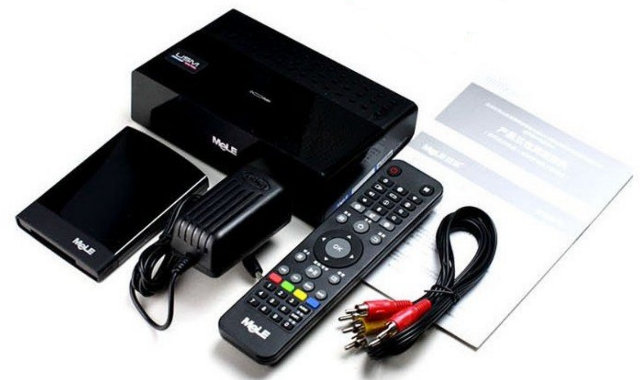
Mele A1000 Android set-top box based on AllWinner A10 is one the best platform to play with Linux on ARM, thanks to its low cost, numerous features, hackability, and the work of the developers’ community on arm-netbook mailing list, and now in sunxi-linux. I like it so much it’s the first item in my short list of hackable gadgets. However, the hardware specifications of the original Mele A1000 may be too weak for some of today’s applications. So I’m pleased the announce that Mele A1000G Quad is now available (for pre-order) with AllWinner A31 quad core Cortex A7 SoC, 2GB RAM and 8GB Flash. Here are the specifications for Mele A1000 Quad STB: SoC – AllWinner A31 quad core Cortex A7 @ 1.5GHz + PowerVR SGX544MP2 GPU System Memory – 2GB DDR3 RAM Storage 8GB Flash SD card slot SATA connector (most probably via a USB to SATA chipset) Video […]
Cloudsto AllWinner A20 Android 4.2 mini PC and Set-top Boxes
AllWinner A20 is a dual core Cortex A7 processor destined to provide an easy pin-to-pin compatible upgrade for AllWinner A10 devices, and the first devices start to appear on the market with several Cloudsto offerings running the latest Android 4.2 Jelly Bean: A20 Media Stick – AllWinner A20 mini PC with 1GB RAM, 4GB Flash, HDMI output, 2x USB Ports and IR receiver. Price: 59.99 GBP ($90.88 US) A20 Media PC – AllWinner A20 set-top box with 1GB RAM, 4GB NAND Flash, onboard Ethernet, HDMI + RCA Video output, Optical output, and 2 x USB Ports. Price: 84.99 GBP ($128.77 US) Cloudsto Media PC PRO DRIVEDOCK – AllWinner A20 set-top box with 1GB RAM, 4 GB Flash, a 2.5″ SATA Hard Drive Bay, HDMI, VGA, and RCA video output and more. Price: 94.99 GBP ($143.92 US) The Media PC PRO DRIVESTOCK is the star of the show, and just looks […]
Final Release of Fedora 18 for AllWinner A10 & A13 Powered Devices
A few months ago, Hans de Goede, currently working at Red Hat and a Fedora contributor, started to show up on linux-sunxi mailing list, and sent a lot of kernel patches for linux-sunxi kernel. Last week-end, he announced “Fedora 18 Final for Allwinner A10 and A13 based devices” on linux-sunxi community mailing list. To install it, first download the image:
|
1 |
wget http://scotland.proximity.on.ca/contrib-images/hansg/Fedora-18-a10-armhfp-r1.img.xz |
And write it to an SD card (all data will be wiped out):
|
1 |
xzcat Fedora-18-a10-armhfp-r1.img.xz > /dev/mmcblk0 |
You may have to replace “/dev/mmcblk0” by your own SD card device, e.g. “/dev/sdc”. AllWinner based devices can share the same kernel, but u-boot is board/products specific, so you’ll have to install u-boot for your board. First remove the SD card, re-insert it in order to automatically mount the FAT partition, and run:
|
1 |
sh <uboot-part-mount>/select-board.sh |
This will show the list of supported boards and products. Then run the command again for your device. For example:
|
1 |
sudo sh <uboot-part-mount>/select-board.sh mk802 |
[…]
Top 10 Posts of 2012 on CNXSoft Blog
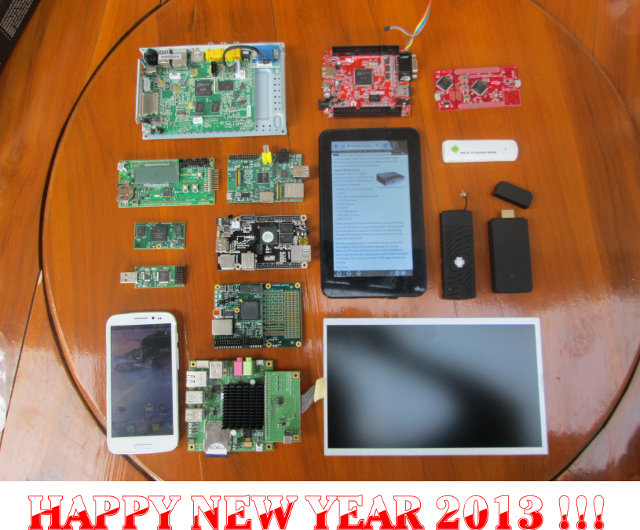
This is the last day of the year, so it’s probably a good time to look back and see what interested people on this blog. This has been a banner year for low cost ARM devices and boards starting with the Raspberry Pi, then MK802 and the new mini PCs / HDMI TV dongles / PCs-on-a-stick (whatever you want to call them) that came after, always cheaper and faster. Those low cost devices have in turn made people really interested in ARM Linux, and lots of development on those little devices and boards started. The top 10 posts of 2012, according to page views, reflect just those trends: 74 USD AllWinner A10 Android 4.0 Mini PC (May 2012) – MK802 started the whole “low cost mini PCs” craze, and drove the most traffic to this blog this year. People got excited about the price, form factor, and the possibility to […]
Cubieboard Unboxing and Quick Start Guide
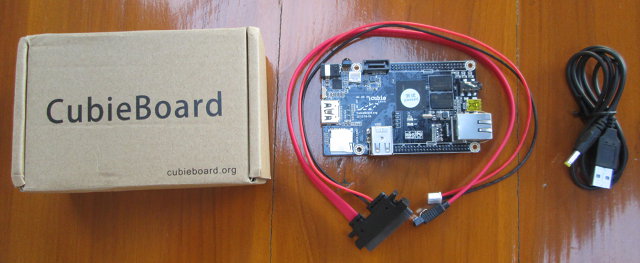
I’ve received another cool board this week with the Cubieboard development board. As a quick reminder, the Cubieboard is the only proper low cost AllWinner A10 development board available, and comes with 512MB/1GB RAM, 4GB NAND Flash, 10/100 MBit Ethernet, HDMI output, 2x USB Host port, 1x USB OTG port, a microSD socket, a SATA interface, an IR sensor and 2 headers to access extra pins such as GPIOs, I2C, SPI,VGA pins, CVBS pins etc… CubieTech had a successful Indiegogo campaign where the 1GB board was available for $59 including worldwide shipping (and as low as $19 for early birds), and you can now buy it from resellers. [Update: It’s now available with several cables, USB to TTL debug board, and an enclosure for $80 on dx.com] Cubieboard Unboxing The board comes with a SATA cable and a USB cable for power. There’s no power supply so you’ll need you […]
Xibo for Android on Mele A1000 Set-top Box & WM8850-MID Tablet
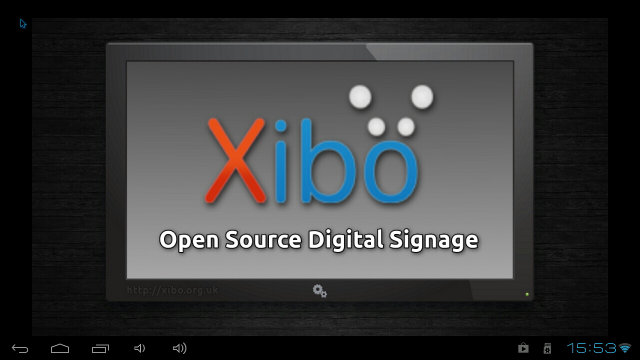
Earlier this month, Xibo developers announced the beta version Xibo for Android was available for testing. Contrary to the Linux & Windows clients and servers which are open source, Xibo for Android is developed by Spring Signage and will available commercially. This sponsorship will help finance the development of Xibo open source software: the 2 clients (.net in Windows, Python in Linux), the server and API. The current beta version supports the most important features of the Windows client, but lacks support for Adobe Flash, Microsoft PowerPoint, Datasets, Microblog, Stats, Counter Media, Socket Listener, Lift/Serial Interface Support, Offline Update via USB Drive, Full Compositing (overlapping regions) and Video Transparency. If you want to test the Xibo client for android, you can register for the private BETA and download an APK (Xibo_Android_Clientv1.0.12.apk) to install on your Android devices. Being part of the BETA program will also guarantee you a price of […]
XBMC for Linux on AllWinner A10 Devices? It Works! (Sort of)
Following the lack of support by AllWinner for the video engine libraries (CedarX), I had more or less given up on hope XBMC for Linux would ever run properly on AllWinner A10/A13 hardware. But recently, I found out some progress had been made using existing libs, and saw the Pengpod Tablet video showing XBMC running in Linux fairly smoothly. So I decided to cross-compile XBMC by following the instructions available at http://linux-sunxi.org/XBMC and trying to run it in Linaro ALIP 12.04 rootfs in my Mele A1000. Finally, I managed to cross-compile XBMC, but the performance was very poor in the GUI (6 to 12 fps) and I was unable to play videos and my serial console was flooded with messages like:
|
1 |
[DISP] not supported image0 pixel sequence:216 in img_sw_para_to_reg |
[Update: I managed to have XBMC Linux running & playing videos on Mele A1000 by using j1nx image (rootfs + kernel). I would first exhibit the exact same […]
$100 Mele A1000G / A2000G Android Media Players with 1GB RAM and 8GB Flash
I’ve been asked by several people when there would be a Mele with 1GB RAM, well the time is now, with the Mele A1000G and Mele A2000G. Both appear to be based on the previous Mele A1000 and Mele A2000 set-top boxes, but feature 1 GB RAM and 8 GB Flash instead of 512 MB RAM and 4 GB Flash. Here are Mele A1000G & Mele A2000G Specifications: SoC – AllWinner A10 Cortex A8 processor @ 1GHz System Memory – 1 GB DDR3 Storage: 8GB NAND Flash SD card slot (up to 32 GB) Connectivity: Wi-Fi – 802.11 b/g 10/100 MB Ethernet USB – 3 USB Host ports SATA Interface for 2.5″ HDD Video Output – HDMI, composite and VGA. Audio Output – RCA stereo output and optical out (SPDIF) Audio Formats – MP3 / WMA / WAV / OGG / FLAC / MKA Video Formats – TS / M2TS […]