Compex has been a Qualcomm Authorized Design Centre (ADC) since 2014, helping customers design specialized, high-specification Wi-Fi products for demanding and mission-critical applications. For Wi-Fi 7 (802.11be), Compex has introduced a family of standard modules for system designers who are looking for flexible module options that support different band combinations, form factors, and deployment scenarios. The Compex Wi-Fi 7 Dual-Band Dual-Concurrent Module family is designed to address these requirements by offering a versatile set of dual-band configurations across 2.4GHz, 5GHz, and 6GHz, delivering high performance and adaptability for a wide range of applications. Qualcomm-Powered Dual-Band Dual-Concurrent Modules Powered by Qualcomm’s QCN6224, QCN6274, and QCN9274 ‘Waikiki’ radio chipsets, the Compex Wi-Fi 7 Dual-Band Dual-Concurrent Module family features dual-band combinations across 2.4GHz, 5GHz, and 6GHz bands. These modules support advanced Wi-Fi 7 functions such as Multi-Link Operation (MLO), OFDMA, and 4096-QAM. These 2×2 MU-MIMO modules are available in standard MiniPCIe, M.2 E-Key, […]
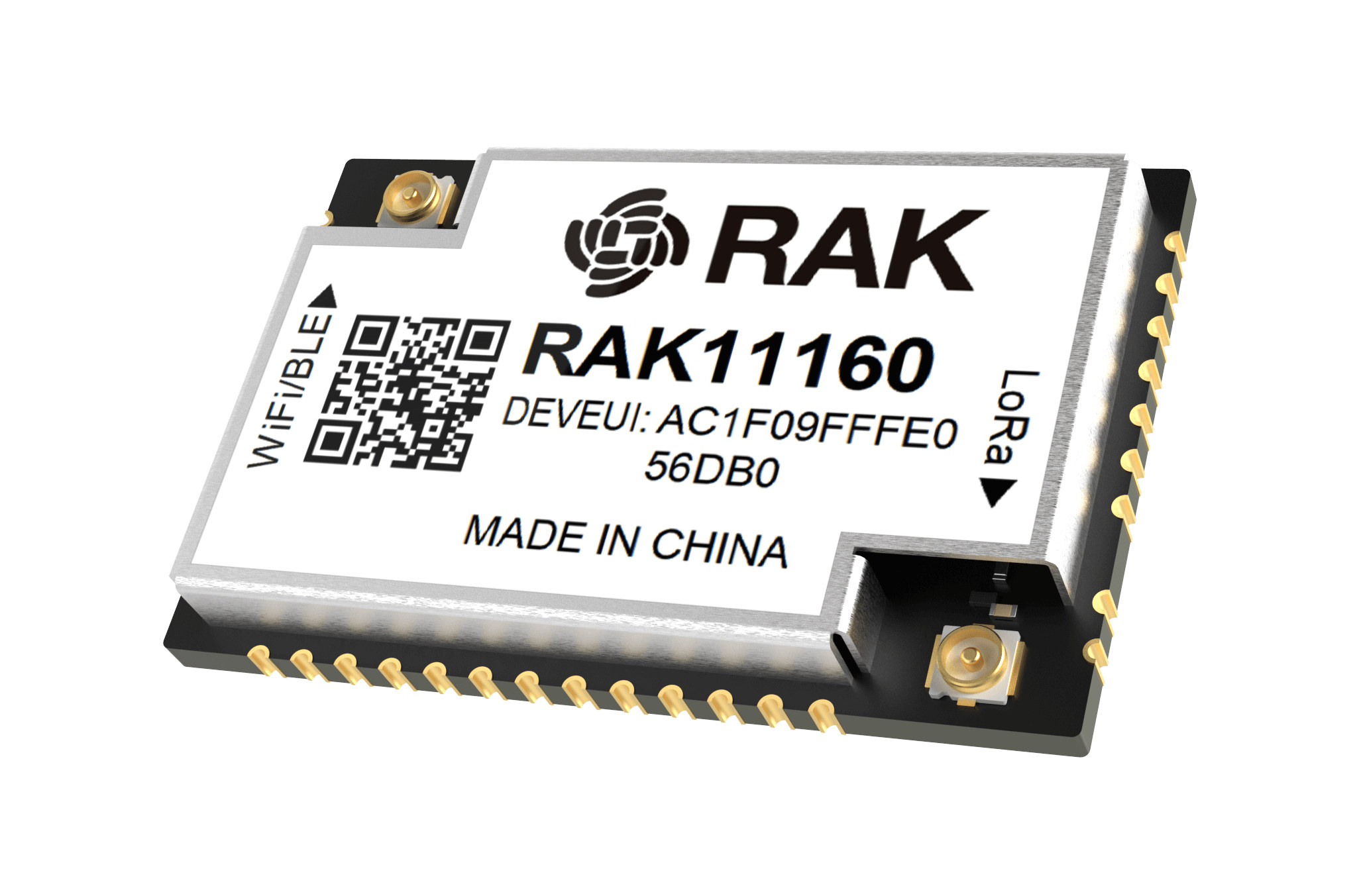
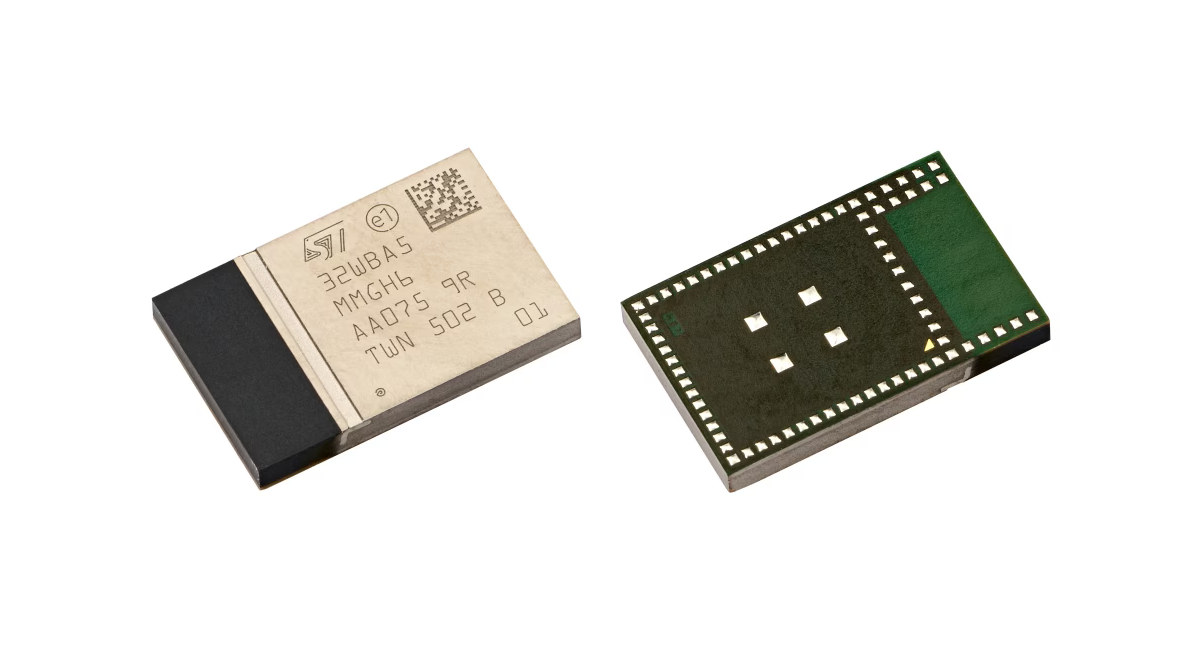
GigaDevice GD32VW553-UNIFI – A $2+ WiFi 6 and Bluetooth 5.2 LE wireless IoT module
GD32VW553-UNIFI is an inexpensive wireless IoT module based on GigaDevice GD32VW553 RISC-V microcontroller featuring 2.4 GHz WiFi 6 and Bluetooth 5.2 LE connectivity, and offered with a PCB antenna or IPEX antenna connector. The GD32VW553 MCU integrates 320KB SRAM and 4096KB on-chip flash, and supports link rates of up to 114.7 Mbps over WiFi and 2 Mbps over Bluetooth LE. The UNIFI module exposes 18 GPIOs from the microcontroller and is available in two different temperature ranges: -40 to +85°C or -40 to +105°C. GD32VW553-UNIFI specifications: SoC – GigaDevice GD32VW553 CPU – 32-bit RISC-V processor up to 160 MHz with RV32I/M/A/F/D/C/P/B instruction extensions Memory – 320KB (288 KB + 32KB shared) SRAM Storage – 4096 KB flash Wireless WiFi 802.11b/g/n/ax compatible 802.11i (WPA, WPA2, WPA3). Open, shared key, and pair-wise key authentication services Single antenna 1×1 stream in 20MHz channels upport of 802.11ax MCS up to MCS9 with a Max […]
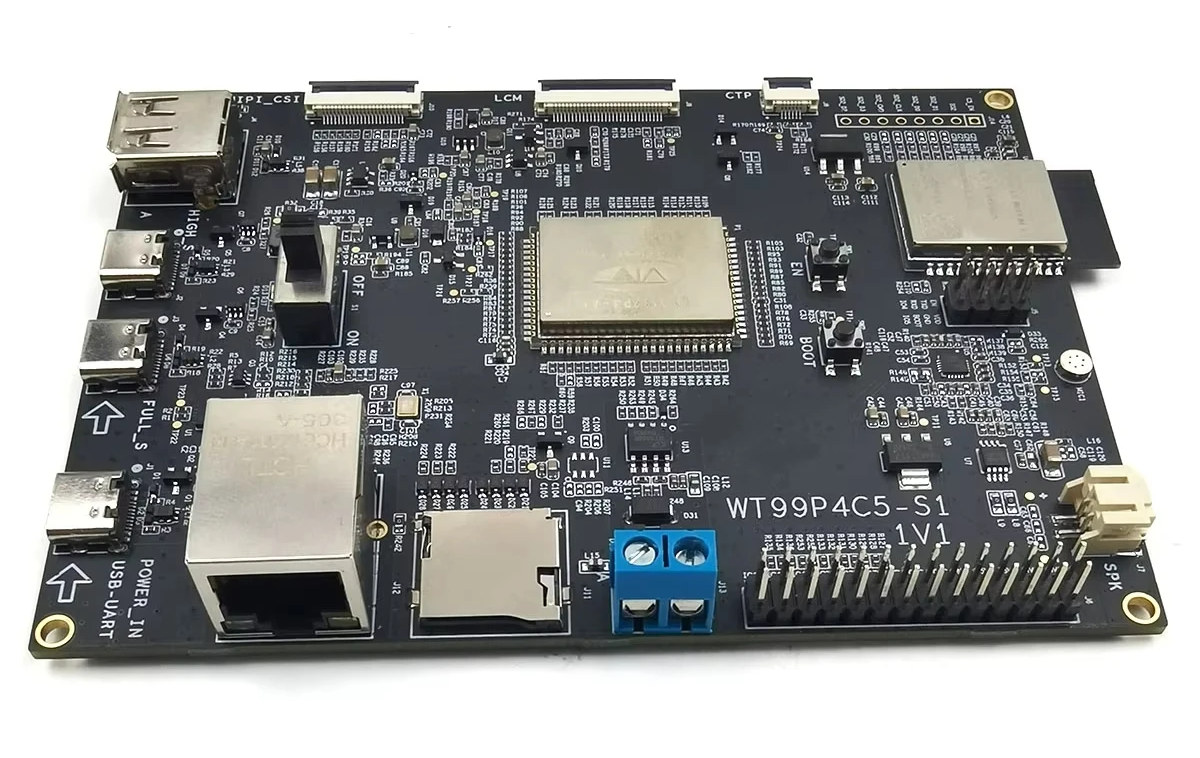
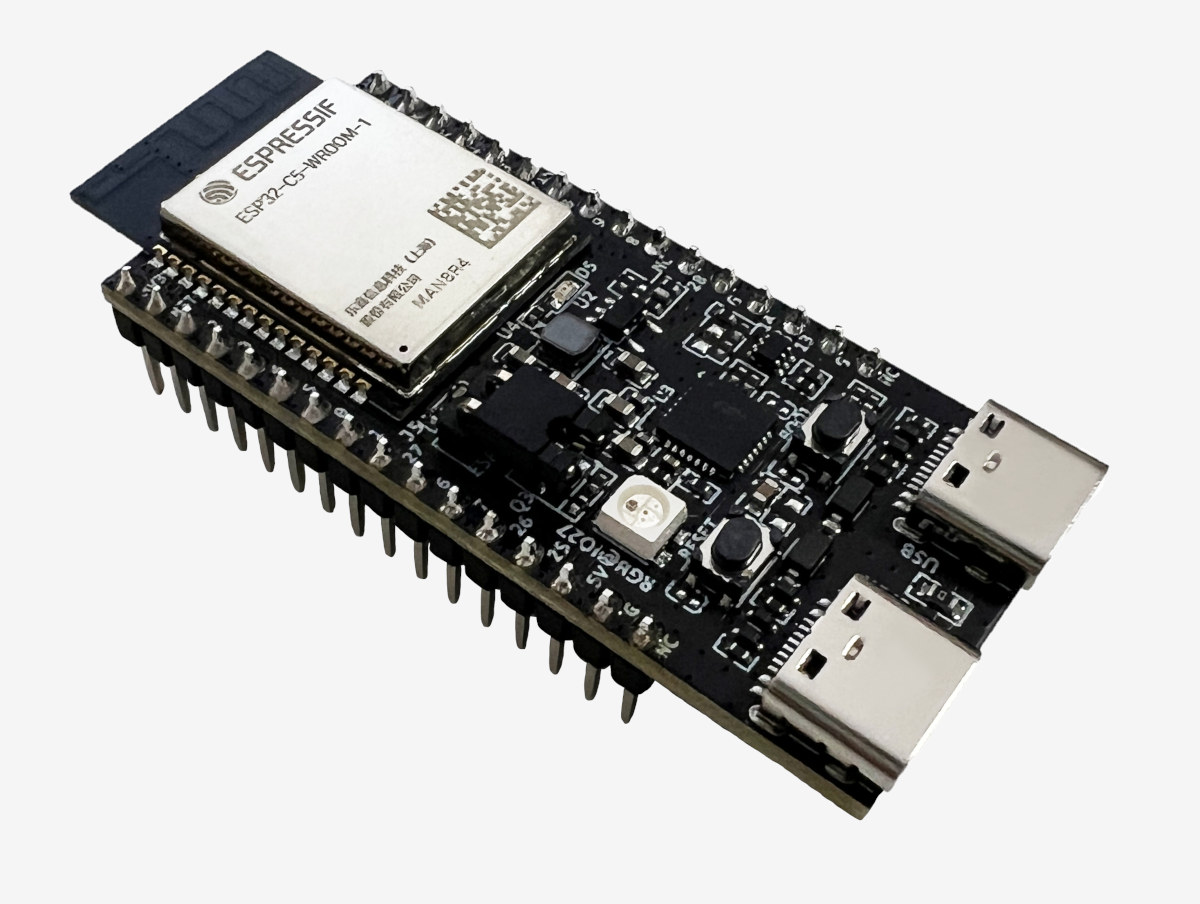
Compact development board features a single ESP32-P4 + ESP32-C5 dual-band Wi-Fi 6 module, MIPI display and camera interfaces
Just a few months back, Wireless-Tag released the WT99P4C5-S1, which combines the ESP32-P4 with an ESP32-C5 dual-band WiFi 6 module, instead of the more commonly used ESP32-C6 wireless module found on most ESP32-P4 development boards we’ve covered. The company has now released the WTDKP4C5-S1, a more compact development board built around the WT01P4C5-S1 ESP32-P4 and ESP32-C5 core module. The board supports MIPI-CSI and MIPI-DSI through the ESP32-P4, while the SDIO-connected ESP32-C5 provides dual-band Wi-Fi 6 (2.4/5 GHz) connectivity along with BLE 5, Zigbee, Thread, and Matter. Other features include a USB 2.0 Type-C OTG port, two UART debug interfaces, two 40-pin GPIO breakouts from both chips, and various power options via USB-C, a 12V DC input, or headers. The board is suitable for LVGL-based HMIs, data acquisition, industrial control, and Edge AI applications such as IPCs and smart displays. Wireless Tag WTDKP4C5-S1 specifications: Core module – Wireless Tag WT01P4C5-S1 Main […]
UltraBar X – A high-end modular desktop smart-hub with a 5:1 ultra-wide touch display, magnetic snap-on modules (Crowdfunding)
The UltraBar X is a modular desktop command center/smart-hub built around an ultra-wide “CoreBar” touch display with a system of magnetically attachable input modules. Designed as an intelligent hub for Windows, macOS, and Linux environments, it also works as a smart home controller. With a 45-degree ergonomic tilt, wireless PC wake, smart-home integration, and modular touch/mechanical inputs, it gives creators, gamers, and power users quick access to all key functions. The whole system is built around the CoreBar hub and modular add-ons like VivoCube, DotKey, SenseCube, and KnobKey, all of which use the QuantumLink magnetic protocol for instant attachment and auto-detection. The CoreBar hub features a 5:1 touch display, LineOS firmware, Bluetooth Mesh, USB/HID connectivity, and an AI-driven SceneShift engine that adapts UI layouts and macros to different workflows. The four optional modules add AMOLED touch controls, Cherry MX keys, rotary knobs, and multi-sensor environmental sensing (mmWave radar, light, temperature, humidity, […]
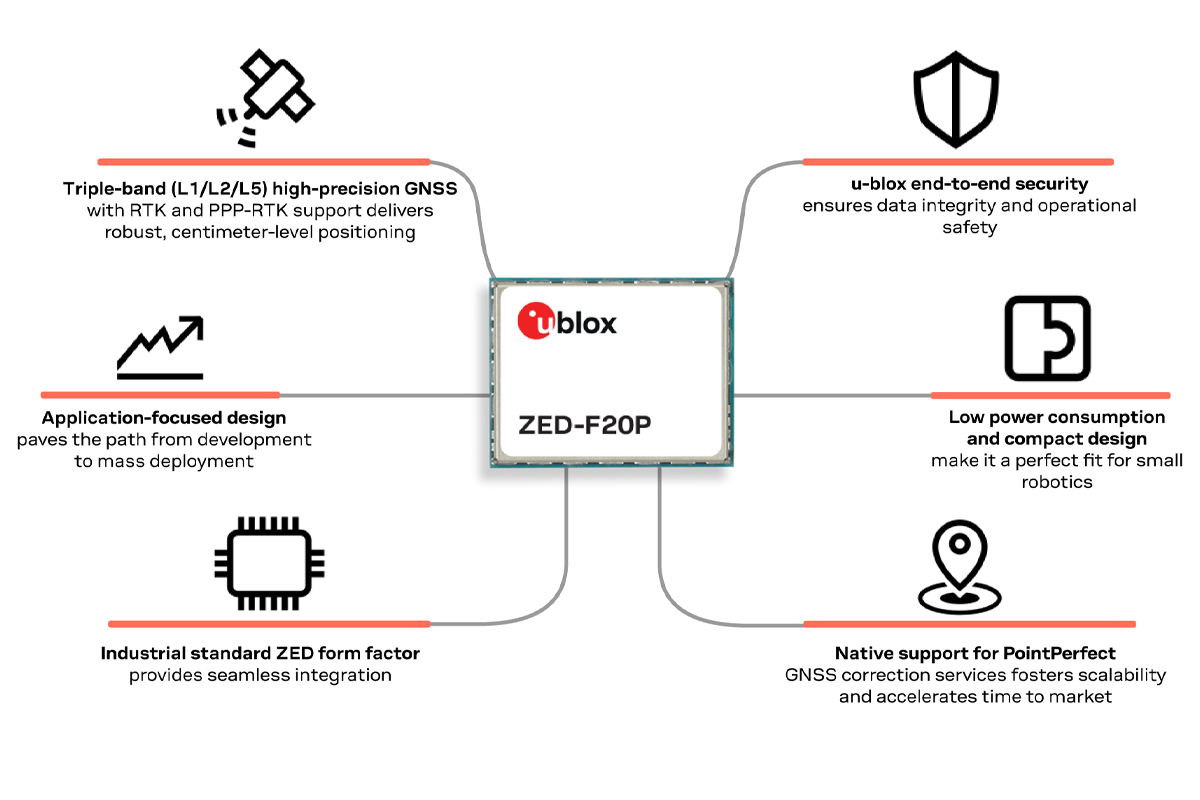
Low-cost LG290P quad-band GNSS RTK breakout board supports RTC battery for faster TTFF
Waveshare has launched a low-cost LG290P breakout board priced at about half the competing options. It supports L1/L2/L5/E6 quad-band GNSS with centimeter-level RTK positioning for robotics, surveying, precision agriculture, and other high-accuracy applications. The board supports GPS, BDS, Galileo, GLONASS, QZSS, and NavIC reception, along with SBAS systems such as WAAS, EGNOS, MSAS, BDSBAS, GAGAN, and SDCM. It offers RTK rover/base functionality with <5-second convergence, raw observation output, 10–20 Hz navigation rates, and strong anti-interference performance thanks to its integrated narrow-band jamming detection and cancellation. The module features a USB-C port for power and UART-to-USB communication, castellated pads for easy integration, an RTC battery connector for faster TTFF, and onboard status LEDs. Waveshare LG290P breakout board specifications: GNSS module – Quectel LG290P GNSS Frequency bands GPS – L1 C/A, L1C, L5, L2C GLONASS – L1, L2 Galileo – E1, E5a, E5b, E6 BDS – B1I, B1C, B2a, B2b, B2I, B3I QZSS […]
RP2350 Tiny and Tiny XL boards clone Solder Party’s RP2350 stamp layouts at nearly half the price
While searching Aliexpress, I stumbled upon the RP2350 Tiny and Tiny XL, both of which are RP2350-based low-cost stamp-size development boards that look exactly like the Solder Party’s “RP2350 Stamp” modules, but are available at nearly half the price. Both modules feature the Raspberry Pi RP2350 dual-core Arm Cortex-M33 microcontroller and an integrated LiPo charging circuitry. The RP2350 Tiny offers 30x GPIOs, while the larger RP2350 Tiny XL breaks out 48x GPIOs, adds PSRAM, and includes SWD/UART JST connectors. Key interfaces include USB host/device, UART, SPI, I²C, PWM, ADC, and PIO state machines, along with Secure Boot and Arm TrustZone. These features make this board suitable for rapid prototyping and testing with CircuitPython support. RP2350 Tiny and Tiny XL specifications: Microcontroller RP2350 Tiny – Raspberry Pi RP2350A MCU, QFN-60; 7×7 mm RP2350 Tiny XL – Raspberry Pi RP2350B MCU,QFN-80; 10×10 mm Memory – 520KB internal RAM, 8KB OTP storage Storage – 16MB […]
Easily add 80+ Mbps Ethernet to microcontrollers with WIZ630io QSPI RJ45 module
WIZnet WIZ630io is a small module featuring an RJ45 jack and a W6300 controller supporting up to 80+ Mbps Ethernet over QSPI @ 150 MHz. As a reminder, the W6300 features 64KB of SRAM for 8 sockets, each with a 4KB TX/RX buffer by default. It is notably found in the WIZnet W6300-EVB-Pico2 development board powered by a Raspberry Pi RP2350 MCU. The WIZ630io allows you to easily add Ethernet to any RP2350 board or other microcontroller with a SPI or QSPI interface. WIZnet WIZ630io specifications: W6300 QSPI Ethernet controller Host Interface – High-speed QSPI (MODE 0/3), system bus with 2 address signals & 8-bit data Internal 32KB SRAM for Tx/ Rx buffers (64KB in total) 8x independent sockets with 64KB Memory 10BaseT / 10BaseTe / 100BaseTX Ethernet PHY Integrated Auto negotiation (Full and half-duplex, 10 and 100-based) Auto-MDIX only on Auto-Negotiation Mode IP Fragmentation not supported Hardwired TCP/IP protocols […]
Compex “JustWiFi⁷™” driverless, Ethernet-connected Wi-Fi 7 module delivers up to 10 Gbps throughput (Sponsored)
Compex Systems (Compex) is redefining how wireless is integrated into modern embedded and industrial systems with the launch of JustWiFi⁷™, a one-of-a-kind, driverless, tri-band concurrent Wi-Fi 7 module that connects through Ethernet protocols. Designed to eliminate the complexity of traditional wireless integration, JustWiFi⁷™ makes high-performance Wi-Fi deployment faster, simpler, and smarter. Rethinking Wi-Fi Integration: No Drivers. No Hassle. JustWiFi⁷™ Most of the Wi-Fi modules today rely on PCIe, SDIO, or USB interfaces and are controlled through drivers. Developers will need to deal with the drivers’ compatibility with the host platform, particularly its OS and kernel version. The drivers for Wi-Fi 7 are particularly complex due to the standard’s advanced features. Many open-sourced drivers and sometimes the host CPU are not able to deliver the full capabilities of the Wi-Fi 7 chipset. These complications often unnecessarily slow down and add to the development time and effort. Engineered for speed, simplicity, and […]