Seeed Studio’s XIAO ePaper DIY Kit EE02 is an ESP32-S3 WiFi and Bluetooth board designed specifically for the 13.3-inch Spectra 6 color E-Ink display provided by the company. It’s based on a similar design as the XIAO ePaper DIY Kit-EE04 (ESP32-S3) and XIAO ePaper DIY Kit-EN04 (nRF52480) introduced last December, which are suitable for smaller 1.54 to 7.15-inch ePaper displays. Like the previous models, the new EE02 model also includes a battery connector with a power switch, a built-in charging IC, and comes with one reset and three user buttons. With support for a larger 13.3-inch color ePaper display, it’s especially well-suited for digital frames and information boards. XIAO ePart DIY kit – EE02 specifications: Wireless board – XIAO ESP32S3 Plus SoC – Espressif ESP32-S3R8 CPU – Dual-core Tensilica LX7 microcontroller up to 240 MHz with vector instructions for AI acceleration Memory – 8MB PSRAM Wireless – WiFi 4 and Bluetooth […]
ESP32-S3 AIoT Basic – A learning and prototyping kit with camera, audio, LCD, and sensors
The ESP32-S3 AIoT Basic is a low-cost, learning, and prototyping kit for the ESP32-S3. The board integrates common AIoT peripherals directly onto a single PCB, making the design part easy for beginners, classrooms, and rapid prototyping. Built around an ESP32-S3 board, the development platform integrates nine commonly used modules directly on the PCB, including a button, buzzer, LED indicator, light sensor, LCD, digital microphone, SD card slot, audio amplifier, and a camera. Most AI and IoT demos can be run without breadboards or jumper wires, while expansion is supported through standard pin headers and Grove connectors. The board supports 5V power via USB-C, and 6–12 V power input via Vin for driving additional devices. With various tutorials and sample projects, it is suitable for AIoT learning, STEM education, voice and vision demos, sensor-based projects, and quick proof-of-concept development. ESP32-S3 AIoT Basic Specifications: Main board – ESP32-S3 Core Board SoC – […]
reTerminal E1001/E1002 – ESP32-S3-powered monochrome/color ePaper displays for dashboards, digital signage
Seeed Studio’s reTerminal E1001 and E1002 are two ePaper displays featuring an ESP32-S3 WiFi and Bluetooth LE wireless microcontroller suitable for dashboards or digital signage applications. The only difference between the two reTerminal E-series displays is that the E1001 features a 7.5-inch monochrome display, while the E1002 integrates a 7.3-inch 6-color ePaper display. Both come with a 2,000 mAh battery offering up to 3 months of battery life, a 32MB SPI flash, a microSD card slot, a microphone and a buzzer, temperature and humidity sensors, an 8-pin GPIO header, and a few buttons and LEDs. reTerminal E1001/E1002 specifications: Wireless SoC – Espressif Systems ESP32-S3 dual-core microcontroller with 8MB PSRAM Storage 32MB SPI flash MicroSD card slot up to 32GB (FAT32 file system only) Display E1001 – 7.5-inch Monochrome ePaper display with 800×480 resolution E1002 – 7.3-inch “Full Color” (i.e., 6-color) ePaper display with 800×480 resolution Audio Microphone (3) for voice […]
XIAO Vision AI Camera combines ESP32-C3 and WiseEye2 HX6538 AI MCU with 5MP camera, supports SenseCraft no-code platform
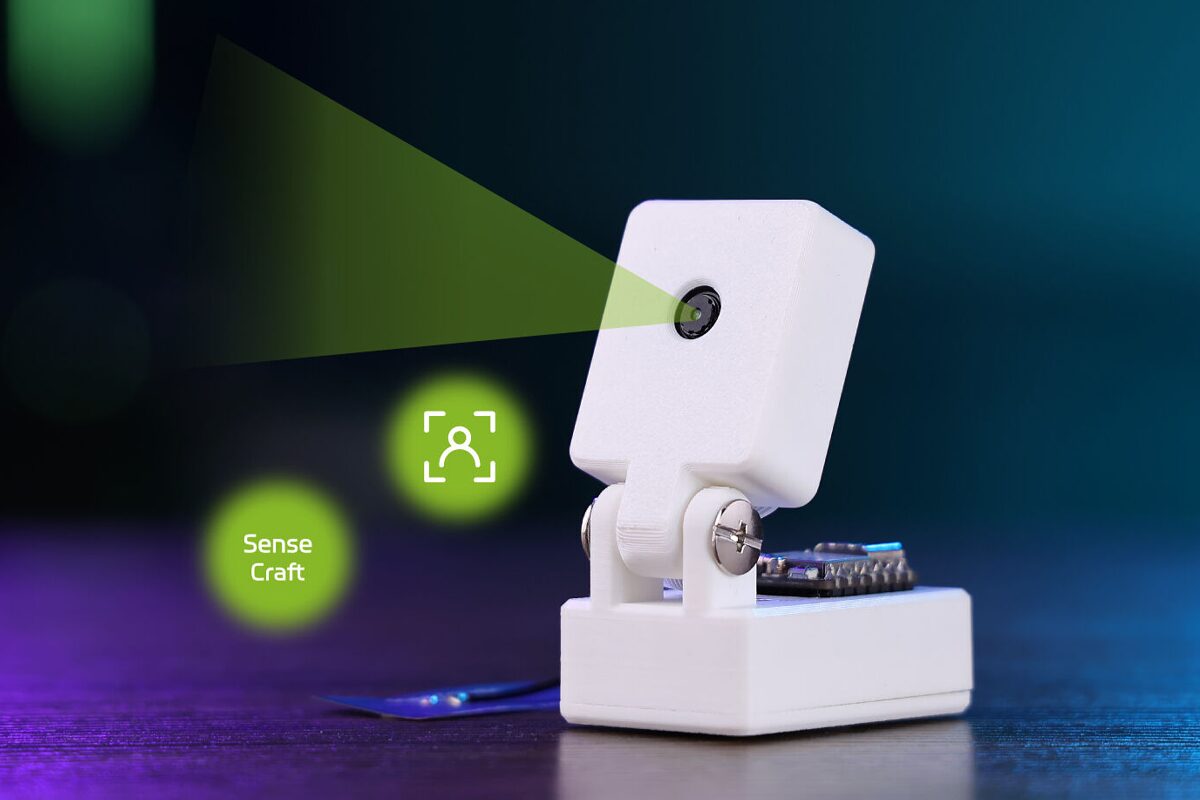
Seeed Studio has recently released the XIAO Vision AI Camera, a compact, open-source smart ESP32-C3 AI Camera that integrates the Grove Vision AI Module V2, a XIAO ESP32C3 module, and an OV5647 5MP camera in a custom 3D-printed PLA case. One of the key components of the camera module is the WiseEye2 HX6538 chip, which features dual-core Arm Cortex-M55 processors and an Ethos-U55 NPU for edge AI computing. It also comes with Wi-Fi connectivity, turning it into an intelligent IP camera that easily integrates with Home Assistant for closed-loop automation (e.g., object detection triggering lights or alerts). Its 5MP OV5647 camera can record 1080p@30fps video and has adjustable focus. These features make this camera useful for industrial automation, smart cities, transportation monitoring, intelligent agriculture, and mobile IoT devices. XIAO Vision AI Camera Specifications Main MCU module – XIAO ESP32C3 SoC – Expressif Systems ESP32-C3 CPU – Single-core RISC-V microcontroller @ […]
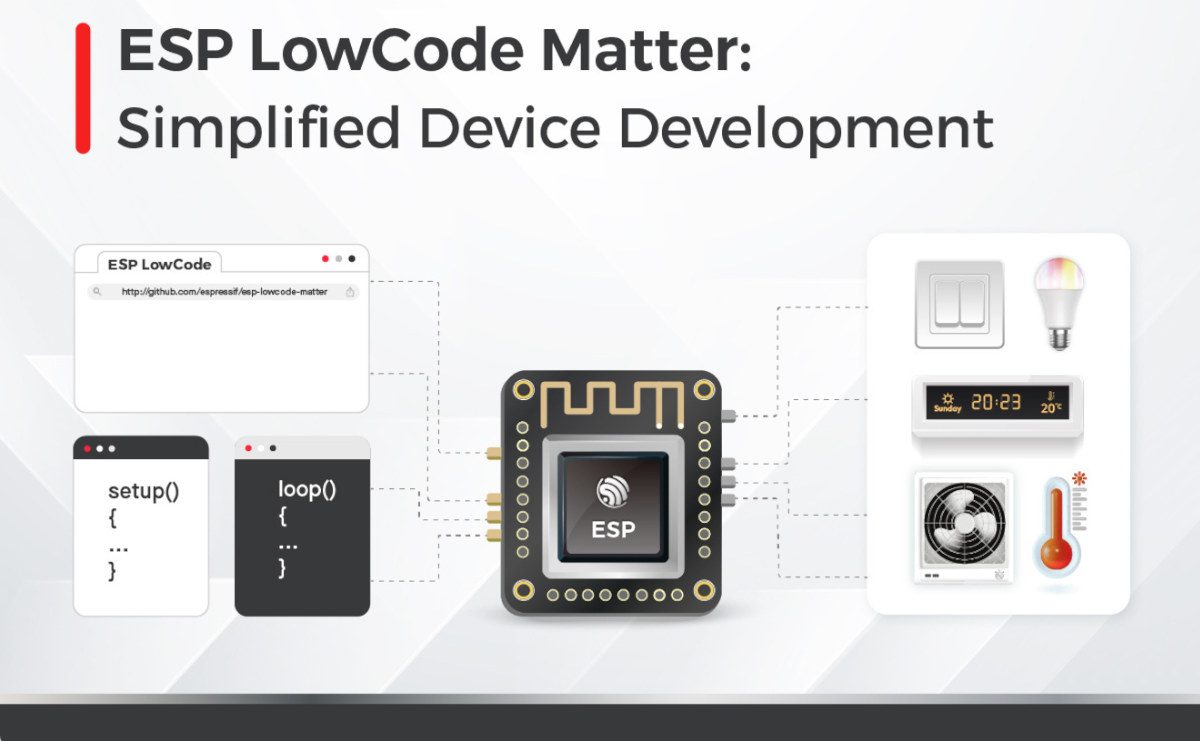
ESP LowCode Matter splits system and application firmware for simpler ESP32 device development
Espressif released the ESP ZeroCode web application in the summer of 2023 to create custom Matter-certifiable firmware for ESP32 targets. However, if your application requires some more customization, but you don’t have the budget or need for a software engineering team, the company has now launched ESP LowCode Matter. It retains most of the simplicity of ESP ZeroCode, but also provides the ability to further customize the application without having to use the ESP Matter SDK, which requires more advanced coding skills to build your own firmware. The ESP LowCode Matter divides firmware into two components to simplify the development, maintenance, and certification process: System Firmware – Managed by Espressif, handling the Matter protocol, wireless stacks, OTA updates, and security management. Application Firmware – Developed by device makers, focusing on hardware interfacing, event and state indication, and user interaction. Development is done right in the web browser thanks to VS […]
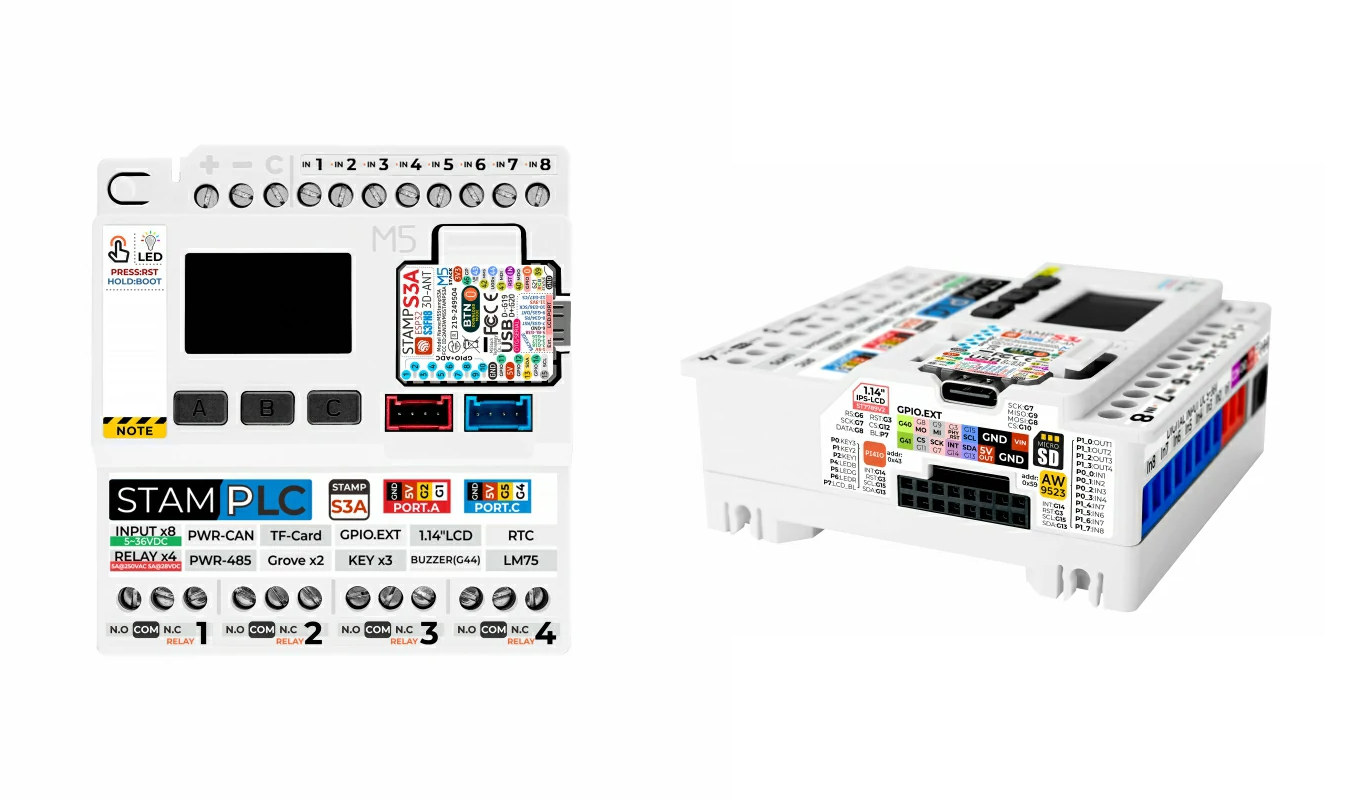
M5Stack StamPLC – An ESP32-S3-based PLC with opto-isolated inputs, relay ouputs, RS485, CAN Bus, and more
“M5Stamp PLC Controller with M5StampS3” or just “M5Stack StamPLC” is a programmable logic controller (PLC) based on the StampS3A ESP32-S3 wireless module and offering 8 opto-isolated digital inputs, 4 relay outputs supporting both AC and DC loads, plus RS485 and CAN Bus interfaces. The DIN Rail IoT controller also features a 1.14-inch color display, a RESET/BOOT button, 3 user buttons, and a buzzer or user interaction. The M5Stack StamPLC also integrates an LM75 temperature sensor and an INA226 voltage/current sensor, as well as a microSD card slot for data storage, and it can take a wide voltage input between 6 and 36V DC. M5Stack StamPLC specfications: Control Module – StampS3A (similar to M5Stamp S3) SoC – Espressif Systems ESP32-S3FN8 CPU – Dual-core 32-bit Xtensa LX7 microcontroller with AI vector instructions up to 240MHz, RISC-V ULP co-processor Memory – 512KB SRAM Storage- 8MB flash Wireless – 2.4GHz WiFi 4 (802.11b/g/n), Bluetooth […]
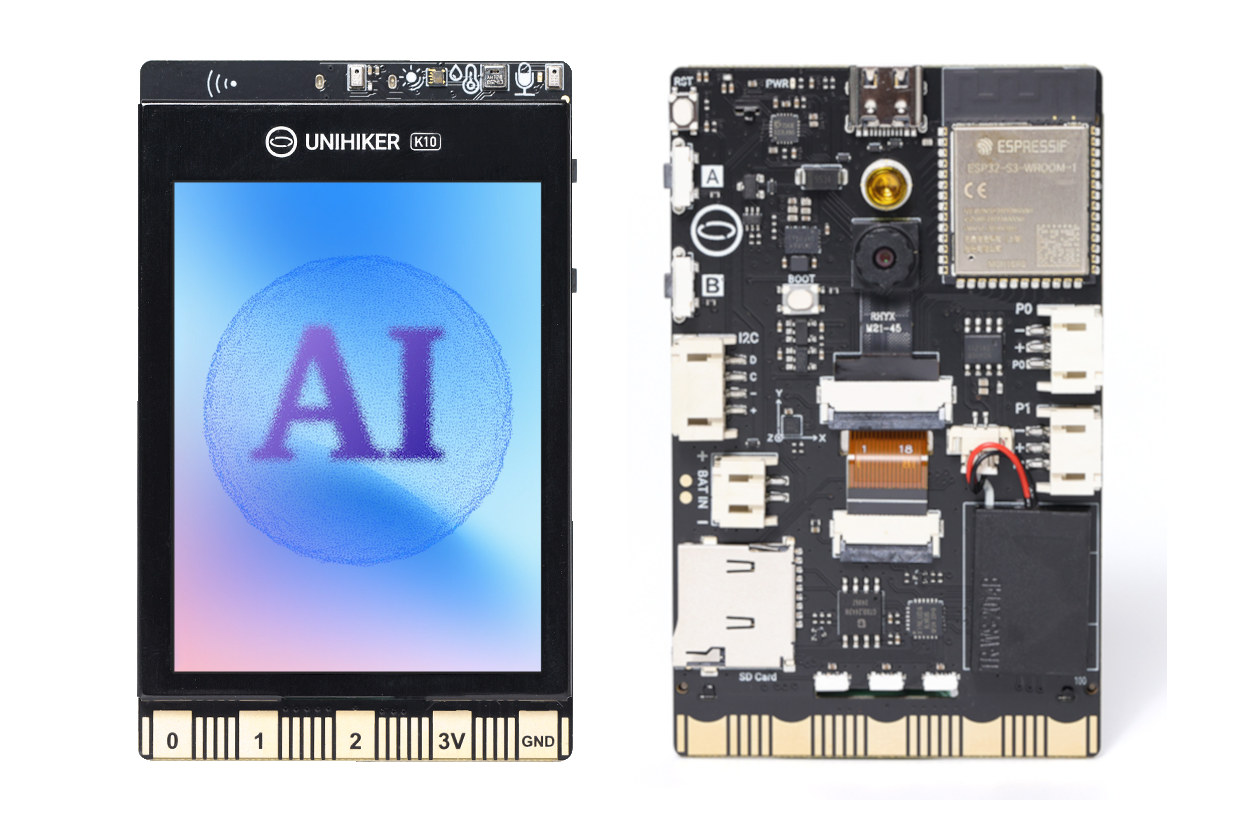
UNIHIKER K10 low-cost TinyML education platform supports image detection and voice recognition
UNIHIKER K10 is a low-cost STEM education platform for TinyML applications that leverages the ESP32-S3 wireless microcontroller with vector extensions for workloads such as image detection or voice recognition. The UNIHIKER K10 also features a built-in 2.8-inch color display, a camera, a speaker, a 2-microphone array, a few sensors, a microSD card, and a BBC Micro:bit-like edge connector for power signals and GPIOs. It’s a cost-optimized version of its Linux-based big brother – the UNIHIKER M10 – first unveiled in 2022. Arnon also reviewed the UNIHIKER in 2023, showing how to configure it, use the SIoT platform with MQTT message, and program it with Jupyter Notebook, Python, or Visual Studio Code. Let’s have a closer look at the new ESP32-S3 variant. UNIHIKER K10 specifications: Core module – ESP32-S3-WROOM-1 MCU – ESP32-S3N16R8 dual-core Tensilica LX7 up to 240 MHz with 512KB SRAM, 8MB PSRAM, 16MB flash Wireless – WiFi 4 and […]
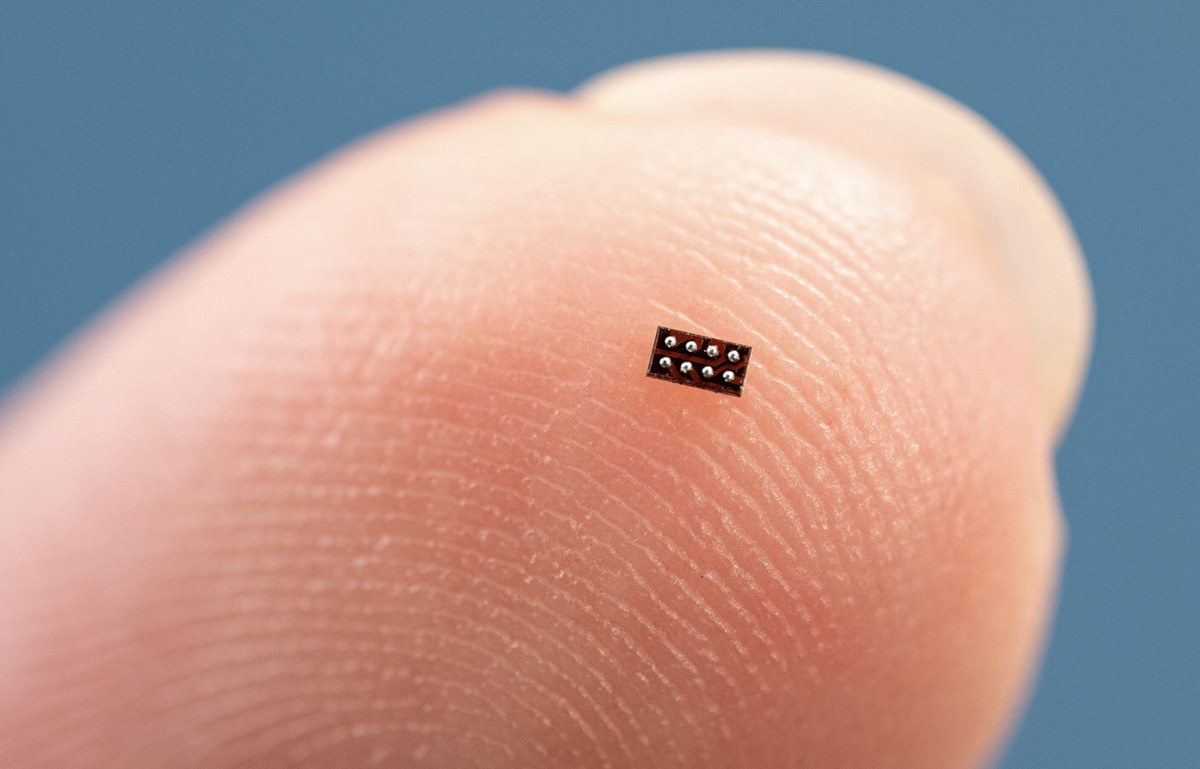
Texas Instruments MSPM0C1104 is the world’s smallest microcontroller with a size of 1.38mm2
Texas Instruments (TI) has expanded the MSPM0 Arm Cortex-M0+ MCU family with the MSPM0C1104 which is the world’s smallest microcontroller measuring just 1.38mm2 in its WCSP package, or about the size of a black pepper flake. Equipped with up to 16KB flash, 1KB SRAM, I/Os such as GPIO, I2C, UART, SPI, and a 12-bit analog-to-digital converter (ADC), the MSPM0C1104 is optimized for space-constrained applications such as medical wearables and personal electronics. TI MSPM0C1104 specifications: MCU Core – 32-bit Arm Cortex-M0+ CPU clocked at up to 24MHz Memory – 1KB of SRAM Storage – Up to 16KB of flash Peripherals Up to 18x GPIO (5V tolerant) 1x UART, 1 I2C, 1x SPI Analog 1x Analog-to-digital converter (ADC) with up to 10 total external channels, 1.7Msps at 10 bit or 1.5Msps at 12 bit with VDD as the voltage reference Configurable 1.4V or 2.5V internal ADC voltage reference (VREF) Integrated temperature sensor […]