Turris Omnia NG Wi-Fi 7 router features dual 10GbE SFP+, mini PCIe slot for 4G LTE/5G, runs OpenWrt-based Turris OS

Turris Omnia NG Wi Fi 7 router

The Turris Omnia NG is a high-performance Wi-Fi 7 router with a mini PCIe slot for 4G/5G modems, two 10GbE SFP+ cages, a 240×240 px color display, and a D-Pad button, running OpenWrt-based Turris OS, and designed for advanced home users, small businesses, and lab environments. Built around a 2.2 GHz Qualcomm IPQ9574 quad-core 64-bit Arm Cortex-A73 CPU, the Omnia NG supports Wi-Fi 7/6 tri-band connectivity. Additionally, it features four 2.5Gbps Ethernet ports, two USB 3.0 ports, NVMe storage support, and includes a 90 W power supply for attached peripherals. Other hardware highlights include rack-mount supports, a metal chassis, and antenna arrays for 4×4 MIMO operation. It comes 10 years after the original Turris Omnia open-source router was launched on Indiegogo. Turris Omnia NG Router specifications: CPU – Qualcomm IPQ9574 quad-core Arm Cortex-A73 processor @ 2.2GHz processor Memory – 2 GB RAM Storage 8 GB eMMC storage M.2 socket for […]

Raspberry Pi 500+ mechanical keyboard PC review with Raspberry Pi OS “Trixie”

Raspberry Pi 500+ mechanical keyboard PC review

Today, we’ll review the Raspberry Pi 500+ mechanical keyboard PC using the recently released Raspberry Pi OS “Trixie” based on Debian 13.  It’s quite similar to the earlier Raspberry Pi 500 keyboard PC, but comes with more memory (16GB vs 8GB), a 256GB NVMe SSD, and a proper mechanical keyboard with replaceable caps and RGB LED lighting, so we’ll focus on these aspects during our tests, after going through the usual unboxing and teardown process. Raspberry Pi 500+ unboxing We received an early prototype of the Raspberry Pi 500+ keyboard PC with a UK layout, white design in a retail package. The bottom side of the package includes a list of features and confirmation that it’s indeed a UK layout keyboard. Not ideal for Thai users (we usually rely on the US layout), but that was probably the only layout available when Raspberry Pi sent us a sample in mid-September. […]

Orange Pi 6 Plus – CIX P1 SBC offers up to 64GB LPDDR5 memory, 45 TOPS of AI performance

Orange Pi 6 Plus Heatsink fan cooling solution

We wrote about the Orion O6N Nano-ITX SBC yesterday, mentioning that the Orange Pi 6 Plus was in the works. The good news is that the CIX P1 (CD8180/CD8180) single board from Orange Pi is now available on AliExpress for $223.90 with 16GB RAM and $268.89 with 32GB RAM, including a heatsink with fan, and a 100W USB-C port adapter. It’s the smallest CIX P1 board we’ve covered so far, but it still packs of lot of features including up to 64GB LPDDR5, two M.2 Key-M sockets for storage and/or AI accelerators, one M.2 Key-E socket for WiFi and Bluetooth, dual 5GbE networking, five displays interfaces via HDMI, DP, USB-C, and eDP, two 4-lane camera interfaces, and more. Orange Pi 6 Plus specifications: SoC – Cix P1 (Codename: CD8180 or CD8160) 12-core DynamIQ processor 4x Cortex‑A720 big cores @ up to 2.6 GHz 4x Cortex‑A720 medium cores @ up to […]

Radxa Orion O6N – A smaller, cheaper 12-core Armv9 Nano-ITX SBC based on CIX P1 (CD8160) SoC

Orion O6N Nano-ITX SBC

Radxa Orion O6N is a Nano-ITX SBC powered by CIX P1 (CD8160 variant) 12-core Cortex-A720/A50 processor with a 30/45 TOPS AI accelerator, up to 64GB LPDDR5, support for UFS and M.2 NVMe storage, and plenty of interfaces. It’s a smaller and cheaper version of the Orion O6 mini-ITX motherboard introduced at the end of last year. It offers most of the same features, but is equipped with a CD8160 SoC instead of a CD8180 with a slightly lower CPU frequency for the Cortex-A720 big cores (2.6 vs 2.8 GHz), more storage options, fewer display interfaces, no dedicated audio port, 2.5GbE networking instead of 5GbE, and a few other differences you can see in the specifications below. Radxa Orion O6N specifications (highlights in bold and strikethrough show differences against Orion O6): SoC – Cix P1 (Codename: CD8160) 12-core DynamIQ processor 4x Cortex‑A720 big cores @ up to 2.6 GHz 4x Cortex‑A720 […]

Raspberry Pi 500+ mechanical keyboard PC gets 256 GB NVMe SSD, 16GB RAM, RGB LED lighting

Raspberry Pi 500+ Keyboard PC

The Raspberry Pi 500+ is an upgrade to the Raspberry Pi 500 keyboard PC, getting a mechanical keyboard with RGB LED lighting, a 256GB NVMe SSD, and 16GB LPDDR4x memory. Apart from that, the rest of the ports and features are exactly the same for the new “Plus” model:  two 4K-capable micro HDMI ports, Gigabit Ethernet, WiFi 5 and Bluetooth 5.0, three USB ports, a microSD card slot, and a 40-pin GPIO header. Raspberry Pi 500+ specifications: SoC – Broadcom BCM2712 CPU – Quad-core 64-bit Arm Cortex-A76 processor @ 2.4GHz GPU – VideoCore VII GPU with support for OpenGL ES 3.1 graphics, Vulkan 1.2 VPU – 4Kp60 HEVC decoder System Memory – 16GB LPDDR4X-4267 SDRAM Storage 256 GB NVMe SSD preloaded with Raspberry Pi OS; connected to M.2 PCIe 2280 socket MicroSD card slot Video Output – 2x micro HDMI ports up to 4Kp60 Networking Gigabit Ethernet RJ45 port Dual-band […]

Review of TerraMaster D1 SSD Plus Thunderbolt 4/USB4 NVMe SSD enclosure

TerraMaster D1 SSD Plus USB4 NVMe SSD enclosure review

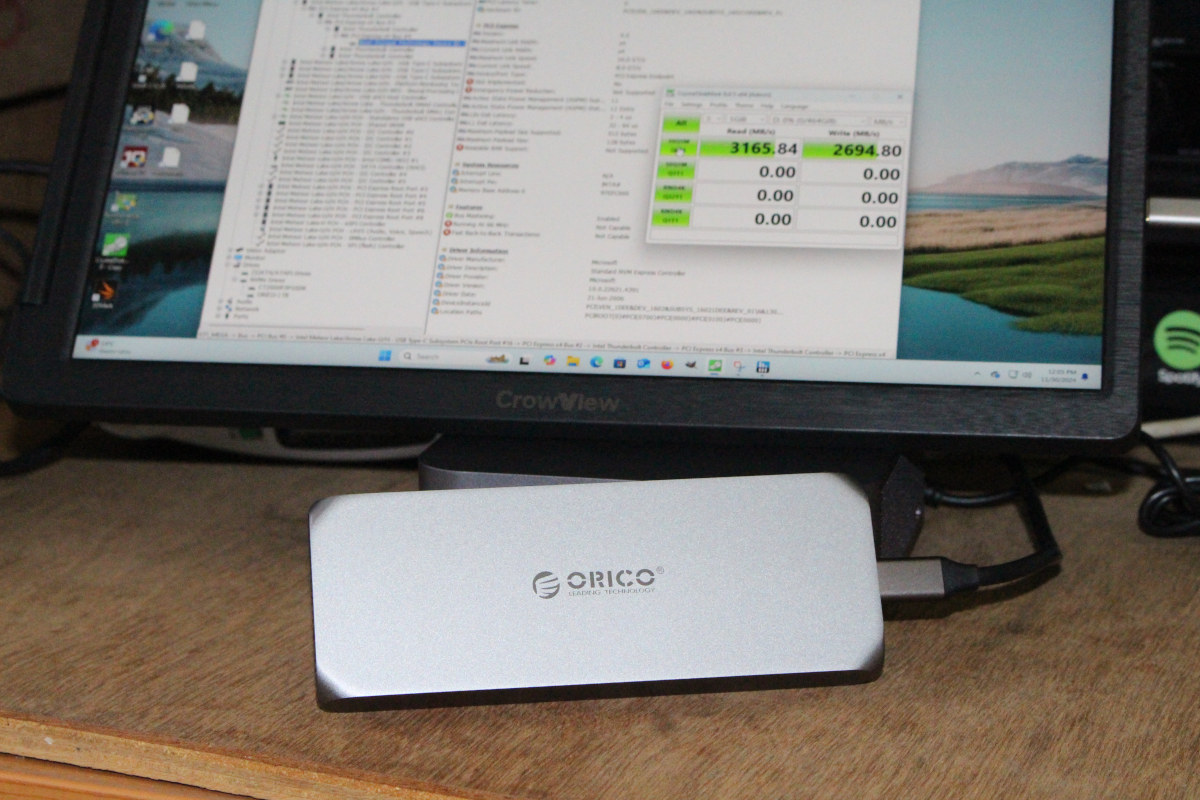
TerraMaster has sent me the D1 SSD Plus portable SSD enclosure for review, and helped me get a 2TB WD_BLACK SN850X NVMe SSD for testing, since the PCIe Gen4 x4 storage device reached up 7,300 MB/s to sequential read speeds, and 6,600 MB/s sequential write speeds, well beyond the 40Gbps capabilities of the enclosure. I had reviewed two ORICO NVMe enclosures previously, namely the ORICO COM2-T3 and ORICO M234C3-U4, which were both based on an Intel JH7440 Thunderbolt 3 chip. I tested the COM2-T3 up to 3166.71 MB/s with a fast SSD, but TerraMaster claims up to 3,853MB/s sequential read speed and 3,707 MB/s sequential write speed with a 4TB Samsung 990 PRO SSD, while connected to an Apple M4 Pro Mac mini (MacOS version 15.3.2) using AJA System Test software. So I thought it might be a good idea to give it a try. TerraMaster D1 SSD Plus unboxing […]

VisionFive 2 Lite low-cost RISC-V SBC launched for $19.90 and up (Crowdfunding)

VisionFive 2 Lite

StarFive VisionFive 2 Lite is a low-cost, credit card-sized RISC-V SBC powered by a 1.25 GHz JH7110S quad-core 64-bit processor and equipped with 2GB to 8GB RAM, and a microSD card slot for storage. It’s the little brother of the VisionFive 2 Pico-ITX SBC introduced in 2022, but in a more compact Raspberry Pi-like form factor with an M.2 2242 socket for storage, Gigabit Ethernet, optional WiFi 6 and Bluetooth 5.4, four USB ports, HDMI 2.0, MIPI DSI and CSI connector, and a 40-pin GPIO header. VisionFive 2 Lite specifications: SoC – StarFive JH7110S (a low-cost version of the JH7110 clocked up to 1.25 GHz) CPU – Quad-core 64-bit RISC-V (SiFive U74 – RV64GC) processor @ up to 1.25 GHz GPU – Imagination BXE-4-32 GPU supporting OpenGL ES 3.2, OpenCL 1.2, Vulkan 1.2 VPU 4Kp60 H.265/H.264 video decoder 1080p30 H.265 video encoder JPEG encoder/decoder System Memory – 2GB, 4GB, or […]

P250Q-M80 M.2 NVMe SSD supports one-click data destruction by software or hardware (smoke involved)

Self-destruct SSD

Team Group P250Q-M80 is a PCIe Gen4 x4 M.2 SSD with up to 2TB capacity and a rather unique feature: one-click data destruction with software or hardware method. If you press a button for 5 to 10 seconds, the software method is triggered, and the SSD automatically wipes out all data. A longer 10-second or over press triggers the hardware method, which applies high voltage to the SSD to self-destruct a la Mission: Impossible with smoke and all. P250Q-M80 specifications: Host Interface – PCIe Gen4 x4, M-Key Flash Type – 3D TLC Capacity – 256GB, 512GB, 1TB, and 2TB Sequential R/W – Up to 7,000 / 5,500MB/s Features – TRIM and SMART support;  no thermal sensor, no external DRAM buffer Max. Power consumption – 1358mA @ 3.3V Dimensions – 80 x 22 x 3.5 mm Temperature Range – Operating: 0°C to +70°C; storage: -55°C to +95°C Humidity – 5% ~ […]

Exit mobile version