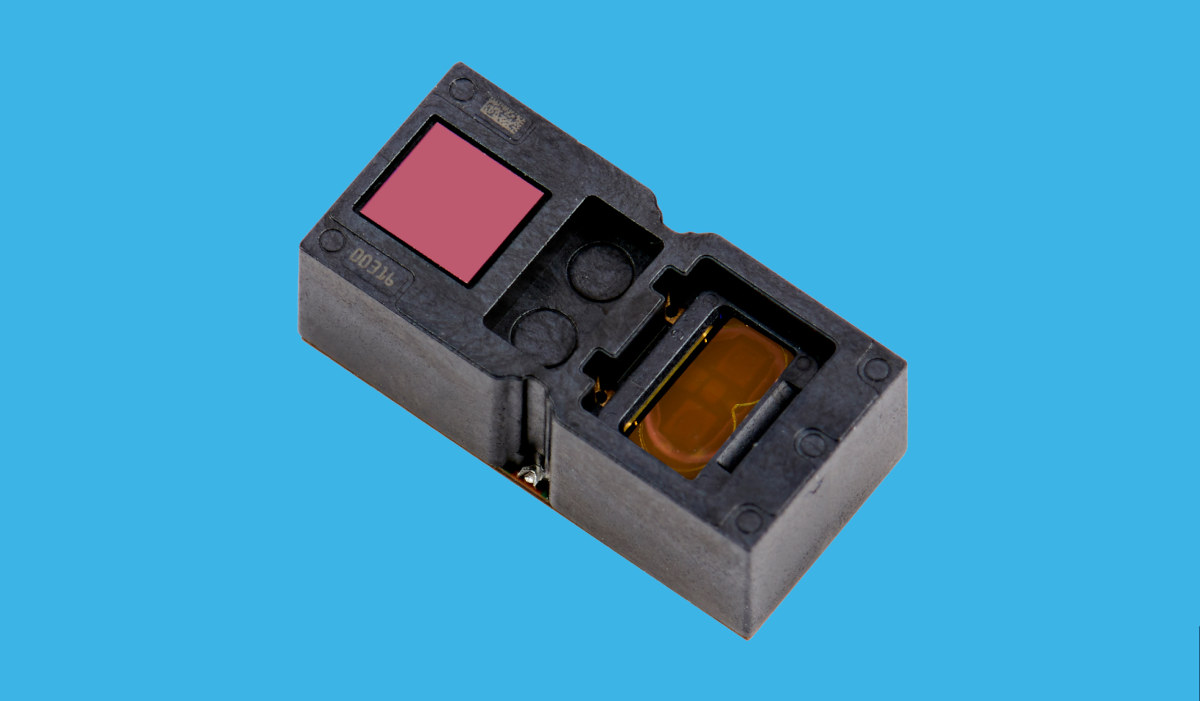
STMicroelectronics VD65G4 and VD55G4 are ultra-low-power 0.56-megapixel global shutter CMOS image sensors designed for battery-operated edge AI and always-on vision applications. The main difference between the two sensors is that the VD65G4 features a color RGB Bayer pattern, while the VD55G4 is a monochrome sensor designed to capture visible to near-infrared (NIR) light. Both sensors use a compact 1/9-inch optical format and a 2.16 µm pixel pitch, utilizing Back Side Illuminated (BSI), CDTI, and 3D stacking technologies to achieve a tiny 2.73 x 2.16 mm bare-die footprint. STMicro VD65G4 and VD55G4 specifications: Resolution – 0.56 MP (804 x 704) Chroma VD65G4 – RGB Bayer (RGGB). VD55G4 – Monochrome (Clear, Visible to NIR). Optical Characteristics – 1/9-inch (2.3mm) optical format with a 30° linear CRA and close to 1:1 aspect ratio. Pixel Technology – 2.16 µm x 2.16 µm pixel size utilizing global shutter, BSI, CDTI, and 3D stacking. Frame Rates […]
MoreSense MS-07 – An ESP32-S3 indoor air quality monitor with SEN66 multisensor and Home Assistant support
MoreSense MS-07 indoor air quality monitor is built around the Sensirion SEN66 multisensor, powered by an ESP32-S3 microcontroller, and features a 3.5-inch capacitive IPS touchscreen for local data visualization and control. The MS-07 is a direct upgrade to the earlier MS-06, replacing the Sensirion SCD40 used for basic CO₂, temperature, and humidity measurement with the more advanced Sensirion SEN66 multisensor, which adds support for PM1.0, PM2.5, PM4.0, PM10, nitrogen oxides (NOx), and volatile organic compounds (VOCs). Like the previous model, it focuses on local operation and privacy, and supports integration with Home Assistant and Domoticz via MQTT autodiscovery, as well as Homey through the HomeyDuino app. It is typically used in homes, offices, and indoor environments to track air quality, comfort levels, and pollution metrics in real time. MoreSense MS-07 specifications: Microcontroller – ESP32-S3 SoC, dual-core XTensa LX7 @ up to 240 MHz; 512KB SRAM; Integrated 2.4GHz Wi-Fi and BLE Storage […]
SparkFun OpenScale IoT – An ESP32 board with HX711 ADC for smart scales with WiFi and Bluetooth connectivity
The SparkFun OpenScale – IoT project is a ready-to-use ESP32-based IoT smart scale with open-source hardware and firmware support that makes it easy to read precise weight data from load cells without writing custom code from scratch for basic operation. It handles amplification via the HX711 24-bit ADC, calibration, temperature compensation (using the onboard TMP102 and an optional external DS18B20 probe), and serial output/configuration through a simple text-based menu. It also features Wi-Fi for live data and OTA firmware updates, requiring no dedicated apps—just standard terminal tools and a browser for viewing data. Additionally, there is a Qwiic I²C connector for adding extra sensors or displays. The board operates from 5 V with a typical current consumption of 80 to 100 mA, supports selectable output data rates of 10 or 80 SPS, and includes an adjustable gain for accurate measurements in long-term monitoring setups. SparkFun OpenScale – IoT Specifications: Wireless […]
ESP32-S3 AIoT Basic – A learning and prototyping kit with camera, audio, LCD, and sensors
The ESP32-S3 AIoT Basic is a low-cost, learning, and prototyping kit for the ESP32-S3. The board integrates common AIoT peripherals directly onto a single PCB, making the design part easy for beginners, classrooms, and rapid prototyping. Built around an ESP32-S3 board, the development platform integrates nine commonly used modules directly on the PCB, including a button, buzzer, LED indicator, light sensor, LCD, digital microphone, SD card slot, audio amplifier, and a camera. Most AI and IoT demos can be run without breadboards or jumper wires, while expansion is supported through standard pin headers and Grove connectors. The board supports 5V power via USB-C, and 6–12 V power input via Vin for driving additional devices. With various tutorials and sample projects, it is suitable for AIoT learning, STEM education, voice and vision demos, sensor-based projects, and quick proof-of-concept development. ESP32-S3 AIoT Basic Specifications: Main board – ESP32-S3 Core Board SoC – […]
Genesis IoT Discovery Lab is a modular ESP32-S3-based wire-free prototyping platform (Crowdfunding)
Developed by Axiometa in Lithuania, the Genesis IoT Discovery Lab is a modular Wi-Fi-enabled prototyping platform built around the ESP32-S3 and a standardized module with AX22 connectors, designed to replace messy breadboards with a structured, plug-and-play system. Designed to simplify hardware development and education, this prototyping module features eight universal AX22 ports, a USB OTG Type-C port, a battery module with charging, and support for over 50 sensors and peripherals. Modules include sensors, buttons, motors, LEDs, relays, and displays, all secured with robust connectors. With open-source hardware and various expansion add-ons, it’s suitable for education, IoT prototyping, and fast hardware iterations. Genesis IoT Discovery Lab specifications: Wireless Module – ESP32-S3-WROOM-1 SoC – Espressif Systems ESP32-S3 CPU – Dual-core Tensilica LX7 up to 240 MHz with vector extension for AI/ML workloads RAM – 512KB SRAM Storage – 8MB flash Wireless – WiFi 4 and Bluetooth LE 5 Antenna – PCB antenna USB […]
Infineon PSoC 4100T Plus multi-sense Arm Cortex-M0+ MCU supports ML-based liquid level sensing, wake-on-touch with 8µA deep sleep mode
Infineon PSoC 4100T Plus is a new low-power Arm Cortex-M0+ MCU designed for battery-powered or low-power embedded systems that require advanced capacitive touch and proximity sensing. The microcontroller comes with 128 KB of flash, 32 KB of SRAM, and an 8 KB ROM. One of the most interesting features of this MCU is Infineon’s fifth-generation CapSense MSCLP technology, which enables high-resolution, low-power capacitive sensing even in deep sleep mode (as low as 8 µA). Its capacitive sensing uses both self and mutual capacitance methods, supported by analog front-end filtering, sigma-delta modulation, and digital filtering techniques, delivering a signal-to-noise ratio greater than 5:1 for accurate detection. The MCU supports gesture detection, human-machine interfaces (HMI), and smart sensing applications, making it ideal for wearables, consumer devices, and IoT systems. Additional features include a 12-bit 1-MSps SAR ADC, six TCPWM blocks, smart I/O with programmable logic functions, multiple UART/I2C/SPI interfaces, and up to […]
Infineon PSoC 4000T multi-sense low-power MCU features capacitive, inductive, hover, and non-contact liquid sensing
Infineon Technologies has introduced the PSoC 4000T Multi-Sense low-power MCU, along with the upcoming PSoC 4100T Plus which will feature higher memory and more I/Os. These MCUs integrate fifth-generation CAPSENSE technology along with Multi-Sense capabilities, including proprietary inductive sensing, and non-contact liquid sensing solutions. This combination makes it easy to develop advanced HMI applications, such as touch-over-metal, hover touch, and accurate liquid-level detection. The MCU also supports SmartSense auto-tuning which eliminates manual calibration. It supports Always-On sensing with 10x lower power consumption and 10x higher SNR than previous generations. Additionally, the MCU enables hover touch detection through 2 cm air gaps and supports capacitive, inductive, and liquid sensing in a single device. The device also supports waterproofing for harsh environments and reduces system complexity and cost by integrating multiple sensing technologies into a single chip. Infineon PSoC 4000T specifications: MCU Core – 48 MHz Arm Cortex-M0+ CPU Memory – Up […]
CodeCell is a ESP32-C3 mini development board for robots, wearables, smart home projects
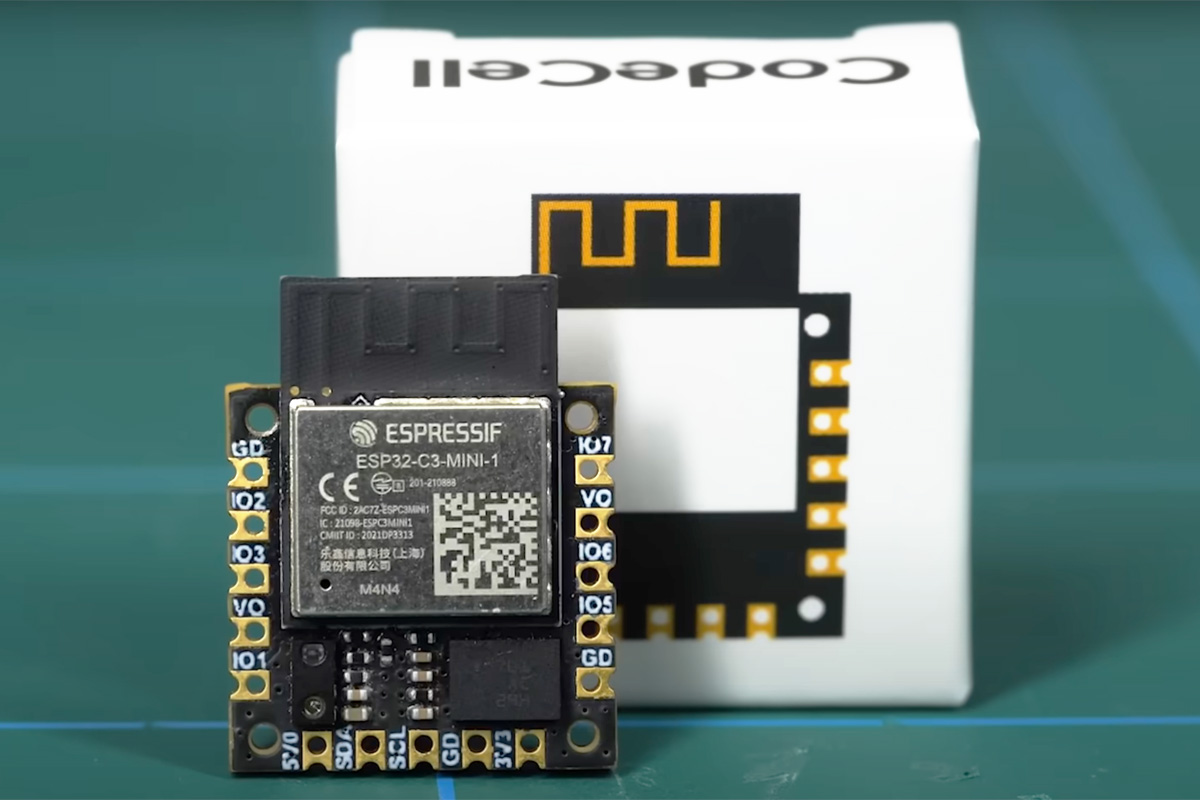
Engineer and YouTuber Carl Bugeja recently developed CodeCell, a tiny ESP32-C3 development board designed as the brain for robots, wearables, and smart home devices. This module features a nine-axis inertial measurement unit (IMU) for motion fusion and an optional VCNL4040 light sensor. It includes a USB Type-C port for data and power as well as a lithium-polymer battery with a charging circuit. Measuring just 18.5 x 18.5mm this compact board is even smaller than other tiny ESP32 development boards such as Waveshare’s ESP32-S3-Zero and Seeed Studio’s XIAO ESP32S3. However, the Epi C3 is smaller at 23 x 12.75 mm, and so are the Unexpected Maker NANOS3 (25 x 10 mm) and Unexpected Maker OMGS3 (28 x 11 mm). CodeCel ESP32-C3 mini development board specification Microcontroller – ESP32-C3 RISC-V MCU 160MHz 32-bit RISC-V processor core 400kB SRAM, 4MB flash storage Wi-Fi 4 and Bluetooth Low Energy (BLE) connectivity Sensors Vishay VCNL4040 light […]