Elecrow has sent us a sample of the “CrowPanel Advanced 7inch” ESP32-P4 HMI display for review. It is designed for high-performance AI and IoT (AIoT) applications with a 2MP camera module, an ESP32-C6-MINI-1 module for Wi-Fi 6, Bluetooth 5.3, and 802.15.4 (Zigbee, Thread, Matter) connectivity. Our kit also shipped with three wireless modules, namely an ESP32-H2 wireless module for an additional Thread, Zigbee, and Matter radio, an SX1262 module for LoRa low-power long-range connectivity, and an nRF2401 2.4 GHz wireless module. In the first part of the review, we will take you through an unboxing of the CrowPanel Advanced 7-inch, checking out the ESP32-P4 HMI AI Display’s hardware before testing it with the preinstalled firmware using LVGL and AI features. You can check the detailed specifications in our previous article: CrowPanel Advance 7-inch ESP32-P4 HMI display supports Zigbee, LoRa, and 2.4GHz radio modules. Note that the company calls it “Advance” […]
Raspberry Pi RP2350 devkit features 1.85-inch round touch display, microphone, optional speaker and battery box
Waveshare RP2350-Touch-LCD-1.85C is a Raspberry Pi RP2350 devkit with a 1.85-inch round touchscreen display with 360×360 resolution, a built-in microphone, a 28-pin GPIO header, and a USB-C port. The RP2350-Touch-LCD-1.85C-BOX model builds on the platform to add a box with a speaker and a 3.7V battery. Both models also come with 16MB SPI flash, a microSD card slot, a 6-axis IMU, a few buttons and LEDs, and UART and I2C expansion connectors. They can be used for HMI solutions using touch, button, and voice recognition inputs, as well as display and audio outputs. RP2350-Touch-LCD-1.85C specifications: Microcontroller – Raspberry Pi RP2350A MCU CPU 2x Arm Cortex-M33 cores @ 150 MHz 2x Hazard3 RISC-V cores @ 150 MHz Up to two cores can be used at any time (configured at boot) Memory – 520KB SRAM Storage – 8KB OTP Package – QFN-60; 7×7 mm Storage – 16MB SPI NOR flash, microSD card slot Display […]
NASP NeuroVoice VAD chip enables always-on voice activity detection at microwatt-level power consumption
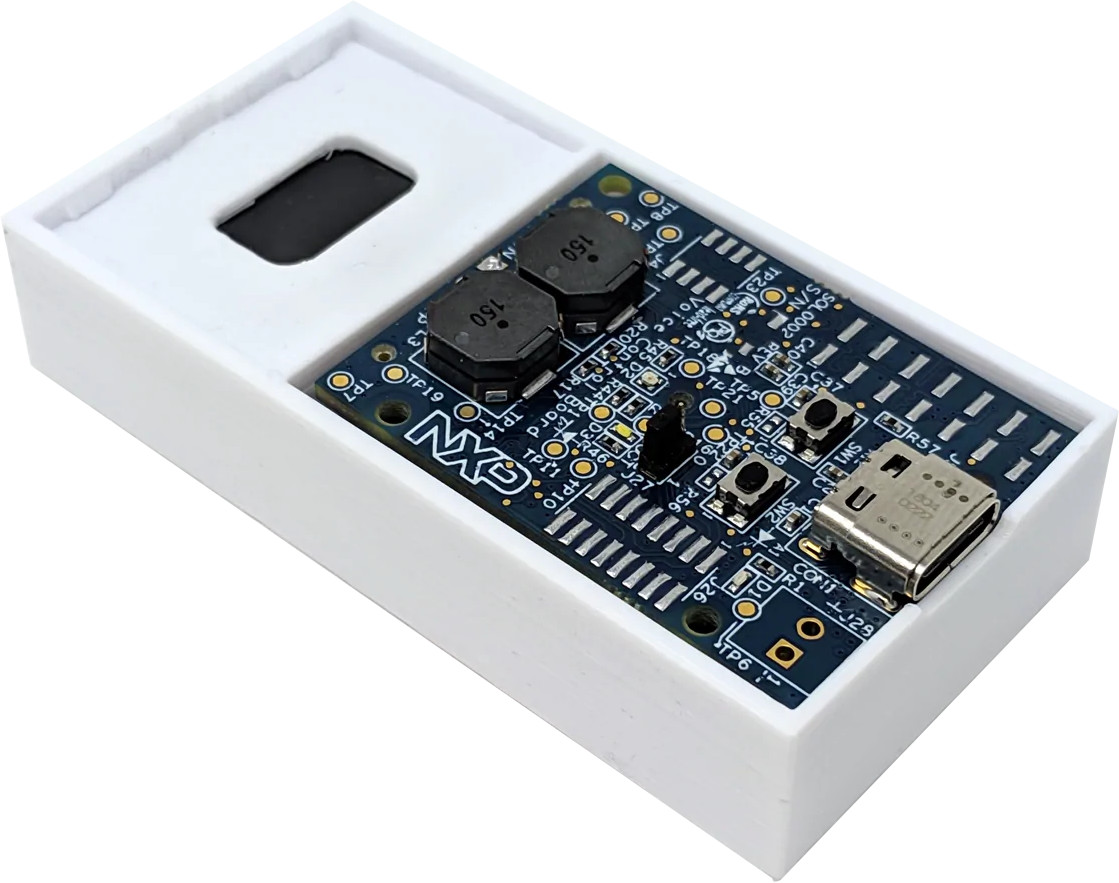
POLYN Technology’s Neuromorphic Analog Signal Processor (NASP) NeuroVoice VAD is an always-on, ultra-low-power chip that detects voice in any noisy background, at microwatt-level power consumption and microsecond-scale latency. Everything happens on the chip, so no Internet is needed. Potential applications include smart remote controls, earbuds, wearables, voice access, IoT, Industry 4.0, robotics, Smart Home/Factory, mobility, and more. NASP NeuroVoice VAD chip (NV-VAD 100) specifications: Features Voice detection at ultra-low power consumption Voice passthrough – Passes voice and mutes background sounds Background signal bypass – Wake Word Detection (WWD) command to activate transparent voice bypass Speech/command intelligibility in noisy spaces – Increases voice command intelligibility for WWD/KWS (Keyword Spotting) functionality in noisy environments for Smart Home, Smart Factory, Wearables, etc. Audio Interfaces – PDM/I2S Voice delay detection – 25 ms Host interfaces – SPI/I2C used for initial configuration and status readout, VAD pin Debugging – Boundary Scan and Debug unit access […]
Fusion HAT+ Raspberry Pi expansion board targets motor and servo control with AI and LLMs
SunFounder Fusion HAT+ for Raspberry Pi 5/4/3B+ and Zero single board computers is a motor control and GPIO expansion board designed to work with LLMs such as ChatGPT or Gemini using the board’s built-in speaker and microphone for voice interaction. It features four DC motor drivers, twelve PWM servo channels, four ADC inputs, I2C, SPI, and UART interface for sensors, and ships with two 18650 rechargeable batteries with smart power management & safe shutdown. It can be used in smart cars, humanoid robots, robotic arms, multi-legged spiders, and smart home systems. Fusion HAT+ specifications: MCU – Gigadevices GD32E203C8T6 Arm Cortex-M23 microcontroller @ 72MHz with 64KB flash, 8KB SRAM. Motor control – 4x motor ports Audio 2030 audio chamber speaker connected to an I2S audio port MEMS microphone Expansion 4-channel digital pins 4-pin I2C interface compatible with Qwiic/STEMMA Qt 7-pin SPI interface 4-pin UART interface 12-channel PWM pins for servos 4-channel […]
The ESP Private Agents platform aims to ease the development of ESP32-based AI voice assistants with on-device processing
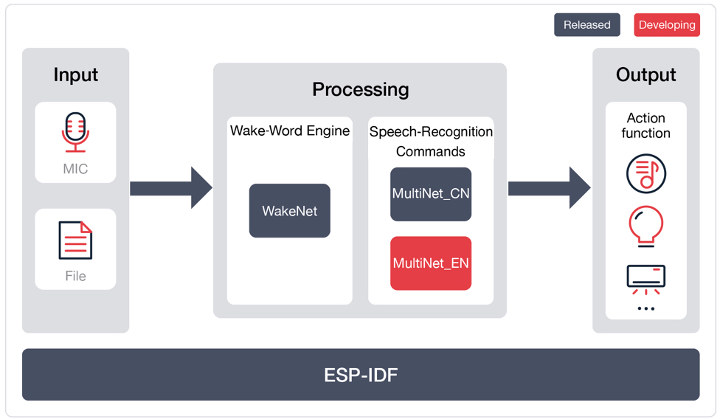
Espressif has just introduced the ESP Private Agents platform to help developers build local, private, and customizable AI assistants for ESP32 devices running on-device, although they can also support hybrid AI workloads with a mix of on-device and cloud processing. The ESP Private Agents platform offers a unified framework that allows developers to build applications combining speed, vision, automation, and agent-based interactions, for example, a multi-lingual, on-device voice agent (aka smart speaker) or task-oriented agents that automate workflows. The solution is built on AWS cloud services using AWS Fargate as a primary application platform and Amazon Bedrock Foundation Models as backend LLM systems. It not only works with ESP32-power devices with speaker and microphone, but also with mobile apps and web clients. Espressif released a Web-based demo, which you can use as a text-based chatbot or as a voice assistant leveraging the speaker and microphone on your computer. The company […]
Edgi-Talk machine learning development kit features Infineon PSOC Edge E84 Edge AI SoC (Crowdfunding)
Edgi-Talk is a machine learning platform/development kit powered by an Infineon PSOC Edge E84 Arm Cortex-M55/M33 SoC featuring Arm Helium, an Arm Ethos-U55 micro NPU, and an ultra-low-power NNLite neural network accelerator, all of which enable AI/ML processing at varying power/performance levels. The devkit also comes with 128 MB PSRAM, 128MB QSPI flash, a 4.3-inch capacitive touchscreen display, two digital microphones, a speaker, WiFi 6 and Bluetooth LE 6.0 wireless connectivity, motion and environmental sensors, as well as a 40-pin Raspberry Pi header and two PMOD connectors for expansion. Edgi-Talk specifications: SoC – Infineon PSOC Edge E84 CPU Arm Cortex-M55 @ 400 MHz with FPU, MPU, Arm Helium support, 256KB i-TCM, 256KB D-TCM, and 5MB SRAM Arm Cortex-M33 @ 200 MHz with 1MB SRAM, 64KB ROM GPU – Low-power 2.5D GPU NPU – Dual architecture Arm Ethos-U55 NPU + NNLITE NPU System Memory – 128 MB PSRAM Storage 128 MB […]
MIPI SoundWire I3S (SWI3S) targets high-bandwidth, low-latency audio applications
The MIPI Alliance has recently released the SoundWire I3S (MIPI SWI3S v1.0) specification for high-bandwidth, low-latency audio applications which unify control and data over a single, power-efficient interface. SWI3S builds upon the two-pin, multi-drop architecture of MIPI SoundWire released in 2014, and offers higher bandwidth, low power consumption, much better noise immunity, and support for scalable multi-device topologies to meet the increasing requirements of embedded audio systems. MIPI SWI3S v1.0 supports data rates up to 76 Mbps against 24 Mbps for the earlier SLIMbus and SoundWire audio interfaces, and improves noise immunity by operating in “forwarded clock” or “differential low voltage signaling”. It also implements a range of new features such as Hubs, multiple PHY support, control CRC, power-saving techniques, and more. MIPI SoundWire I3S key features: Transports audio data, control commands, interrupt signals, and synchronization information over a unified two-pin link Forwarded bit clock single-ended (FBCSE) and differential low-voltage […]
Ubo Pod – A Raspberry Pi 4/5-based personal AI assistant (Crowdfunding)
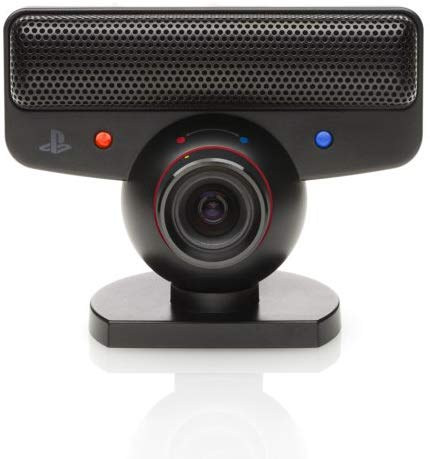
The Ubo Pod Developer Edition (DE) is an open-source AI vision and conversational voice assistant platform built around the Raspberry Pi 4 or 5, and designed for developers who want more control over their AI experiences. The device aims to replace black boxes like Amazon Echo or Google Next AI assistants, with an open hardware smart speaker running open-source software, and offering features such as speech-to-text, LLMs/VLMs, text-to-speech, tool calling, and various multiple trigger mechanisms, among others. The Ubo Pod supports both cloud-based and fully local private AI, and features an embedded GUI on the integrated display and a WebUI for no-code setup. Ubo Pod specifications: SBC Ubo Pro 4 – Raspberry Pi 4 Ubo Pro 5 – Raspberry Pi 5 Storage 32GB MicroSD card included and preloaded with OS. Ubo Pro 5 – M.2 PCIe socket for NVMe SSD (or AI accelerator) Display – 1.54-inch color TFT IPS display […]