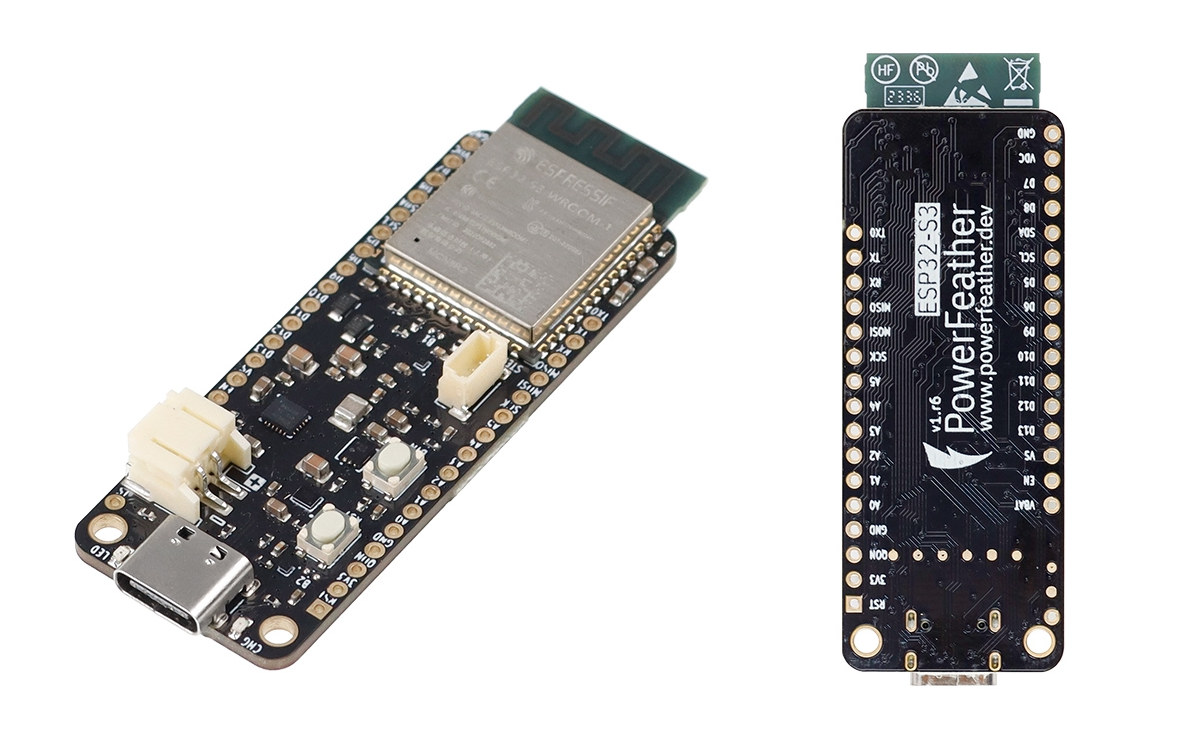
The ESP32-S3 PowerFeather V2 board is an ESP32-S3 WiFi and BLE IoT board with an Adafruit Feather form factor that supports LiFePO4/LFP batteries, as well as Li-Ion or LiPo batteries, and up to 18V DC input for solar panel connection. As one could have guessed, it’s an update to the ESP32-S3 PowerFeather board introduced in 2024 with support for solar panel input, Li-Ion, and LiPo batteries. The V2 design is virtually identical, except it features an Analog Devices MAX17260 fuel gauge and a TPS631013 buck-boost regulator that keeps 3.3 V stable to add support for LiFePO4 batteries. Lithium Iron Phosphate batteries are said to be safer and longer-lasting than Li-ion or LiPo batteries, albeit at the cost of lower energy density. ESP32-S3 PowerFeather V2 specifications: ESP32-S3-WROOM-1-N8R2 SoC – ESP32-S3 CPU – Dual-core Tensilica LX7 up to 240 MHz Memory – 512KB SRAM, 16 KB RTC SRAM Wireless – 2.4 GHz […]
LightInk – An ESP32-based, solar-powered E-ink smartwatch with up to 10 months of battery life
Daniel Ansorregui has developed LightInk, an open-source solar-powered E-ink watch inspired by 90s solar digital watches. It features a 1.54-inch e-paper display and supports Wi-Fi, Bluetooth, LoRa, and GPS, running on a 100mAh battery. The project integrates a custom low-quiescent-power design using a TPS63900 buck-boost converter, capacitive-touch input, and deep-sleep-driven firmware, along with ultra-fast partial e-ink updates (<1 ms active time) and precise RTC timekeeping with drift calibration. It also supports solar-first operation (no dedicated charging IC) and dynamic power gating of peripherals, enabling around 9–10 months of operation on a small battery supplemented by solar power. LightInk specifications: System-in-package – ESP32-PICO-D4 SiP CPU – Dual-core processor @ 240MHz Memory – 520KB SRAM Storage – 4MB flash Wireless – 2.4 GHz Wi-Fi 4 up to 150 Mbps and Bluetooth 4.2 BR/LE connectivity Display – 1.54-inch 200×200 B/W e-Paper panel (GDEH0154D67 or compatible) Audio – 10-15mm piezo electric disc speaker Connectivity […]
SN1 Solar Node – An ESP32-C3-based board with IP67 enclosure, solar charging, ESPHome firmware
Designed by Granz Scientific LLC, the SN1 Solar Node is an ESP32-C3-based IoT node/development board designed specifically for off-grid IoT projects. Development boards like Seeed Studio Wio Tracker, or industrial controllers like DFRobot LoRaWAN Control Terminal, allow you to handle your own battery management and weatherproofing, or on the other end, you have products like SenseCAP Solar Node P1 that come with everything integrated but do not allow adding custom hardware. This is where the SN1 Solar Node is different; it features an IP67-rated enclosure with an integrated solar panel on the lid, 18650 battery support, and prototyping strip-board areas for custom circuitry. It also includes a smart power switch that allows the battery to continue charging from the solar panel even when the board is powered off. Additionally, it provides battery voltage monitoring, breaks out most GPIOs for easy access, and includes optional jumpers for an onboard LED and […]
Mini review of the ThinkNode M6 “outdoor solar power for Meshtastic”
Elecrow has sent us a solar-powered ThinkNode M6 Meshtastic device for review. Last year, I reviewed the ThinkNode M1 and M2 Meshtastic nodes, and I was a bit disappointed by the point-to-point range in a suburban environment, where I got about 550 meters of range after switching to LONG SLOW mode. Nine months have passed since that review, and there still doesn’t seem to be any Meshtastic community in the second-largest city in Thailand, probably because typical Meshtastic terminals are more expensive than entry-level Android smartphones, have limited functionality, and the mobile app is still a mess despite a revamp. Nevertheless, when Elecrow asked me whether I wanted to test the “ThinkNode M6 outdoor solar power for Meshtastic”, I thought it might be fun. The main purpose of this mini review is to check the range I get using the M6 as a router between the M1 and M2 nodes. […]
STM32U3B5/C5 ultra-low-power MCU features 640 KB RAM, 2 MB Flash, and HSP accelerator to run AI without batteries
STMicroelectronics has added two members to the STM32U3 ultra-low-power Arm Cortex-M33 microcontroller family: the STM32U3B5 and STM32U3C5 MCUs get more resources with up to 640 KB SRAM and 2 MB flash, as well as an HSP (hardware signal processor) accelerator to run AI/ML workloads without batteries, just using energy harvesting. The new chips are still clocked at up to 96 MHz, benefit from a near-threshold design (down to 0.65 V), allowing a power consumption of just 117 Coremark/mW in active mode, and can operate up to 105°C ambient temperature. They come with one additional group of interfaces, bringing the total to four SPI and I2C, two I3C and CAN-FD, and five UARTs, as well as five more 16-bit timers, for a total of 10. The STM32U3C5 also includes a cryptocore to accelerate encryption and decryption operations, and supports the CCB (Coupling and Chaining Bridge) hardware security feature, both of which […]
LoRa, BLE, and GNSS tracker supports open-source software, solar charging, outdoor and indoor tracking
Designed by Ruictec in China, the TD04 is a LoRa-based low-power tracker that also features BLE and dual-band GNSS. It supports both indoor and outdoor positioning, and is suitable for fleet management, asset tracking, and geofencing over public or private LoRaWAN networks with minimal maintenance. The device combines GNSS (L1/L5) for outdoor positioning with BLE-based indoor tracking. It automatically switches between the two to optimize accuracy and power usage, delivering around 1–2 m accuracy outdoors and 2–4 m indoors. It is LoRaWAN 1.0.3-compliant, supports OTAA and ABP, and operates across multiple regional bands (EU868, US915, IN865, AS923, and others). Other features include a built-in motion sensor (G-sensor), configurable reporting and heartbeat intervals, iBeacon support, optional Bluetooth gateway mode, BLE-based configuration, OTA updates, and batch firmware upgrades. The device is powered by a 6000 mAh rechargeable battery and support 1.3 W solar panel input, enabling up to six months of standby […]
FireBeetle 2 ESP32-C5 IoT development board offers GDI display interface, LiPo battery support
Just the other day, I lamented the lack of options when it came to ESP32-C5 boards featuring dual-band WiFi 6 support. The FireBeetle 2 ESP32-C5 IoT development board made by DFRobot shows that I needed to be more patient… The ESP32-C5 board features 4MB flash, a USB-C port, a LiPo battery connector, and two GPIO headers for expansion, as well as a GDI display connector designed to add an SPI/I2C touchscreen display. The new RISC-V board has about the same features and form factor as the FireBeetle 2 ESP32-S3. It adds 5 GHz WiFi and an 802.15.4 radio for Zigbee, Thread, and Matter, but loses a camera connector, and comes with less memory and storage. FireBeetle 2 ESP32-C5 specifications: Wireless module – ESP32-C5-WROOM-1-N4 SoC – Espressif Systems ESP32-C5 CPU Single-core 32-bit RISC-V processor @ up to 240 MHz Low-power RISC-V core @ 40 MHz acting as the main processor for […]
The PV PI HAT adds 10A true MPPT solar charging to the Raspberry Pi (Crowdfunding)
Developed by Luke Ditria and his team at AutoEcology, the PV PI is a plug-and-play MPPT solar charging HAT designed for Raspberry Pi and other SBCs like the Orange Pi, Banana Pi, and NVIDIA Jetson. Designed for outdoor and remote projects and built around TI BQ25756 charge controller and STM32F103 MCU, it supports LiFePO4 management, true MPPT charging, power monitoring, and automation over the RS-232 UART interface. It also produces 5V output via a high-current buck/boost converter, supports watchdog-based power cycling, RTC wake-up scheduling, and automatic restart at safe voltage levels. With XT30 connectors, stackable headers, and RTC backup, the PV PI HAT is ideal for solar-powered IoT like AI-based wildlife monitors, environmental monitoring, and remote data logging applications. PV PI HAT specifications Compatibility – Raspberry Pi, Orange Pi, Banana Pi, NVIDIA Jetson, etc… Main MCU – STmicro STM32F103 Arm Cortex-M3 microcontroller @ 72 MHz Charge controller – BQ25756 I2C […]