
Qualcomm Dragonwing Q‑7790 and Q‑8750 AIoT SoCs target AI-enhanced drones, cameras, TVs and media hubs

Dragonwing Q-7790

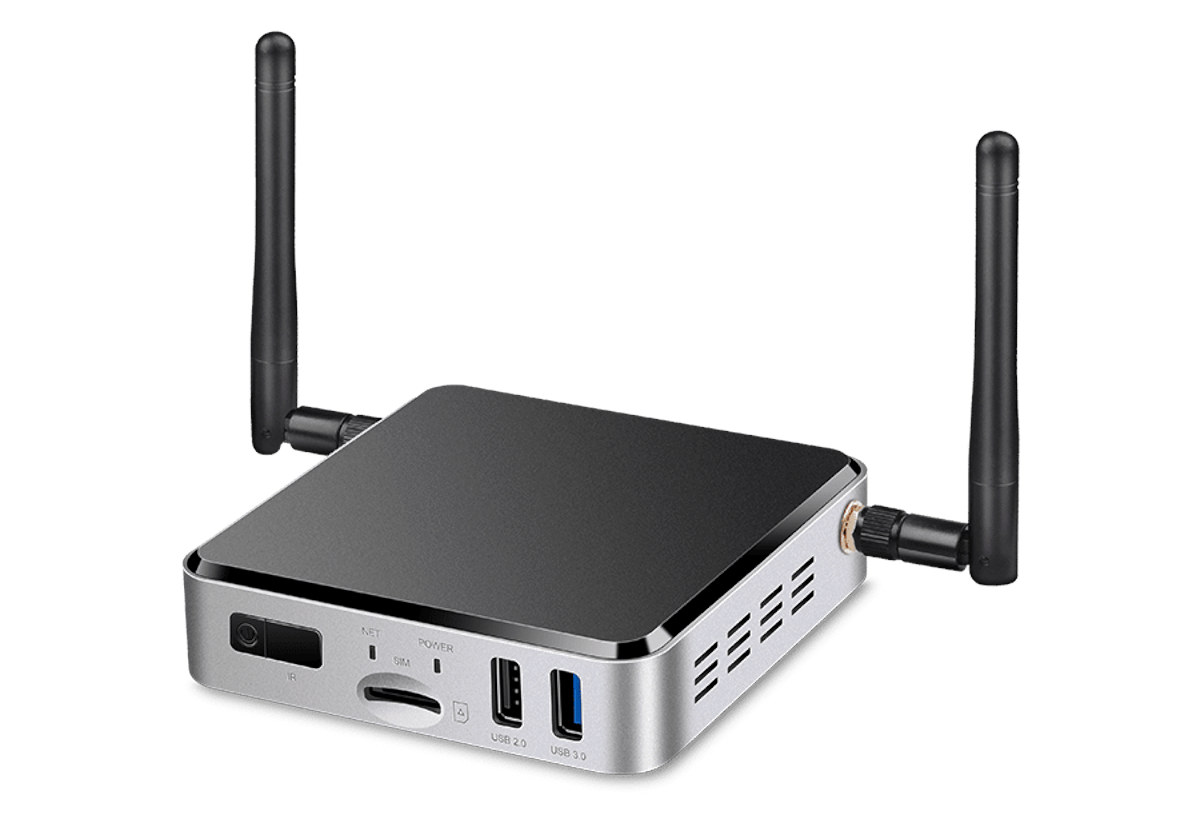
Qualcomm has made a range of announcements at CES 2026, and notably introduced the Dragonwing Q‑7790 and Q‑8750 processors supporting on‑device AI for drones, smart cameras & industrial vision, AI TVs/media hubs, and video collaboration systems. The mid-range Dragonwing Q-7790 targets both consumer and industrial IoT devices, and offers up to 24 TOPS of on-device AI, 4K video outputs and camera inputs, and AV1 hardware video decode. The higher-end Dragonwing Q-8750 is designed for more advanced IoT applications, delivers up to 77 TOPS (dense) for real-time inference and up to 11B LLMs, handles 8K displays and 8K cameras, and supports up to 12 physical cameras for drones, media hubs, and multi-angle vision systems. Dragonwing Q-7790 Dragonwing Q-7790 (CQ7790M/CQ7790S) specifications: CPU – Octa-core Kryo processor up to 2.8 GHz 1x Gold+ core @ 2.8 GHz 4x Gold cores @ 2.4 GHz 3x Silver cores @ 1.8 GHz GPU – Qualcomm Adreno […]

Linux 6.18 LTS release – Main changes, Arm, RISC-V, and MIPS architectures

Linux 6.18

Linus Torvalds has just announced the release of Linux 6.18 on the Linux Kernel Mailing List (LKML), which will likely become the next LTS kernel [update: it’s now official]: So I’ll have to admit that I’d have been happier with slightly less bugfixing noise in this last week of the release, but while there’s a few more fixes than I would hope for, there was nothing that made me feel like this needs more time to cook. So 6.18 is tagged and pushed out. Most of the last-minute fixes are minor fixes to drivers, with some random noise elsewhere (bluetooth, ceph, afs..). Nothing strikes me as standing out, but hey, there’s a shortlog appended if you want to see the details. And this obviously means that the merge window will open tomorrow, and I already have three dozen pull requests pending. Thanks. And as I already mentioned a couple of […]

Linux-based Vega OS replaces Android-based Fire OS in Amazon Fire TV Stick 4K Select

Amazon Fire TV Stick 4K Select

Amazon has recently introduced the Fire TV Stick 4K Select media streamer with a MediaTek MT8698 quad-core Cortex-A55 processor, 1GB RAM, 8GB eMMC flash, HDMI 2.1 video output, and WiFi 5 and Bluetooth 5.0 connectivity. However, the most interesting part of the announcement is the software, as Amazon has dropped the Android-based Fire OS used in its previous devices and instead relies on the new Linux-based Vega OS for the Fire TV Stick 4K Select. Amazon Fire TV Stick 4K Select (AFTCA002) specifications: SoC – MediaTek MT8698 MCM CPU – Quad-core Arm Cortex-A55 clocked up to 1.7 GHz GPU – Mali G310v2 up to 500 MHz with OpenGL ES 3.1 support VPU (hardware video decoder) AV1 up to 3840x2160p (4K) @ 60 fps, 100 Mbps, 8-bit and 10-bit input with HDR10, HDR10+, and HLG H.265 (HEVC) up to 3840x2160p (4K) @ 60 fps, 35 Mbps, 8-bit and 10-bit input with […]

Linux 6.17 release – Main changes, Arm, RISC-V, and MIPS architectures

Linux 6.17 changelog

Linux 6.17 has just been released on LKML: No huge surprises this past week, so here we are, with kernel 6.17 pushed out and ready to go. Below is the shortlog for just the last week – not the full 6.17 release – as usual. It’s not exciting, which is all good. I think the biggest patch in there is some locking fixes for some bluetooth races that could cause use-after-free situations. Whee – that’s about as exciting as it gets. Other than that, there’ the usual driver fixlets (GPU and networking dominate as usual, but “dominate” is still pretty small), there’s some minor random other driver updates, some filesystem noise, and core kernel and mm. And some selftest updates. This obviously means that the merge window for 6.18 will open tomorrow, and I already have four dozen pull requests pending. Thanks to the proactive people – you know who […]

Realtek RTD1319C SoC with Mali-G57 GPU powers Formuler Z12 Ultra 4K TV box with optional USB DVB or ATSC tuner

Formuler Z12 Ultra 4K TV box

Formuler Z12 Ultra is an Android 12 4K TV box powered by a Realtek RTD1319C SoC coupled with 4GB RAM and 128GB eMMC flash, support for Dolby Vision and Atmos, and popular USB ATSC or DVB-T/T2 digital TV tuners. While it was first seen in 2022 on the Formuler Z11 Pro Max, the RTD1319C is new to me, and it appears to be a variant of the RTD1319 quad-core Cortex-A55 SoC introduced in 2020, which replaces an entry-level Mali-G31 MP2 with an older, mid-range Mali-G57 MC1 GPU that should allow for smoother or higher-resolution user interfaces. However, it lacks the 4Kp60 H.266/VVC video codec support found in the Realtek RTD1319D. Formuler Z12 Ultra specifications: SoC – Realtek RTD1319C CPU – Quad-core Arm Cortex-A55 GPU – Arm Mali-G57 MC1 VPU – Up to 4Kp60 AV1, H.265 (HEVC), AVS, H.264 (AVC, MVC), Real, MPEG-1/2/4, VC-1​ System Memory – 4GB DDR4 @ 2400MHz […]

Ugoos AM9 Android 14 TV box features Amlogic S905X5 Armv9 SoC, supports H.266 and AV1 codecs

Ugoos AM9

Ugoos AM9 is an Android 14 TV box powered by an Amlogic S905X5 quad-core (Armv9) Cortex-A510 SoC, which supports features such as H.266 and AV1 hardware video decoding and AI Super Resolution (AI-SR) through the built-in 4 TOPS NPU. We first noted the Amlogic S905X5 SoC in an upcoming SEI Robotics TV box about two years ago. Details were sparse at the time, and in the meantime, Amlogic introduced the similarly named S905X5M, which is still a “regular” Armv8 SoC with four Cortex-A55 cores, and found in products such as ODROID-C5 SBC and Ugoos X5M Pro. However, I had not heard anything about the more powerful S905X5 SoC until I came across the Ugoos AM9 TV box this morning. Ugoos AM9 specifications: SoC – Amlogic S905X5 CPU – Quad-core Cortex-A510 Armv9 processor delivering 40K+ DMIPS GPU – Arm Mali-G310 V5 GPU clocked at 1 GHz for 4K HDR user interfaces […]

Xiaomi TV Stick 4K (2nd Gen) – A quad-core Cortex-A55 TV Stick with Google TV

Xiaomi TV Stick 4K 2nd Gen

We’ve just written about the Ugoos X5M Pro as one of the first Amlogic S905X5M TV boxes, but the market is expanding, and Xiaomi TV Stick 4K (2nd Gen) Google TV dongle is now available as a smaller version of the company’s Xiaomi TV Box S (3rd Gen) based on the same or similar processor. The TV stick features 2GB RAM, 8GB eMMC flash, a 4K-capable HDMI male port, and WiFi 6 and Bluetooth 5.2 connectivity, and not much else, as one would expect from an HDMI TV stick. It ships with a Bluetooth remote that supports Google Assistant voice commands. The company did not list the exact part number of the processor, and while it matches the Amlogic S905X5M specifications, it should be another model without Ethernet support, like Amlogic did in the past with the S905Y4, so maybe an S905Y5M? Xiaomi TV Stick 4K (2nd Gen) specifications: SoC – […]

Ugoos X5M Pro Android 14 TV Box is powered by a 2.5 GHz Amlogic S905X5M SoC

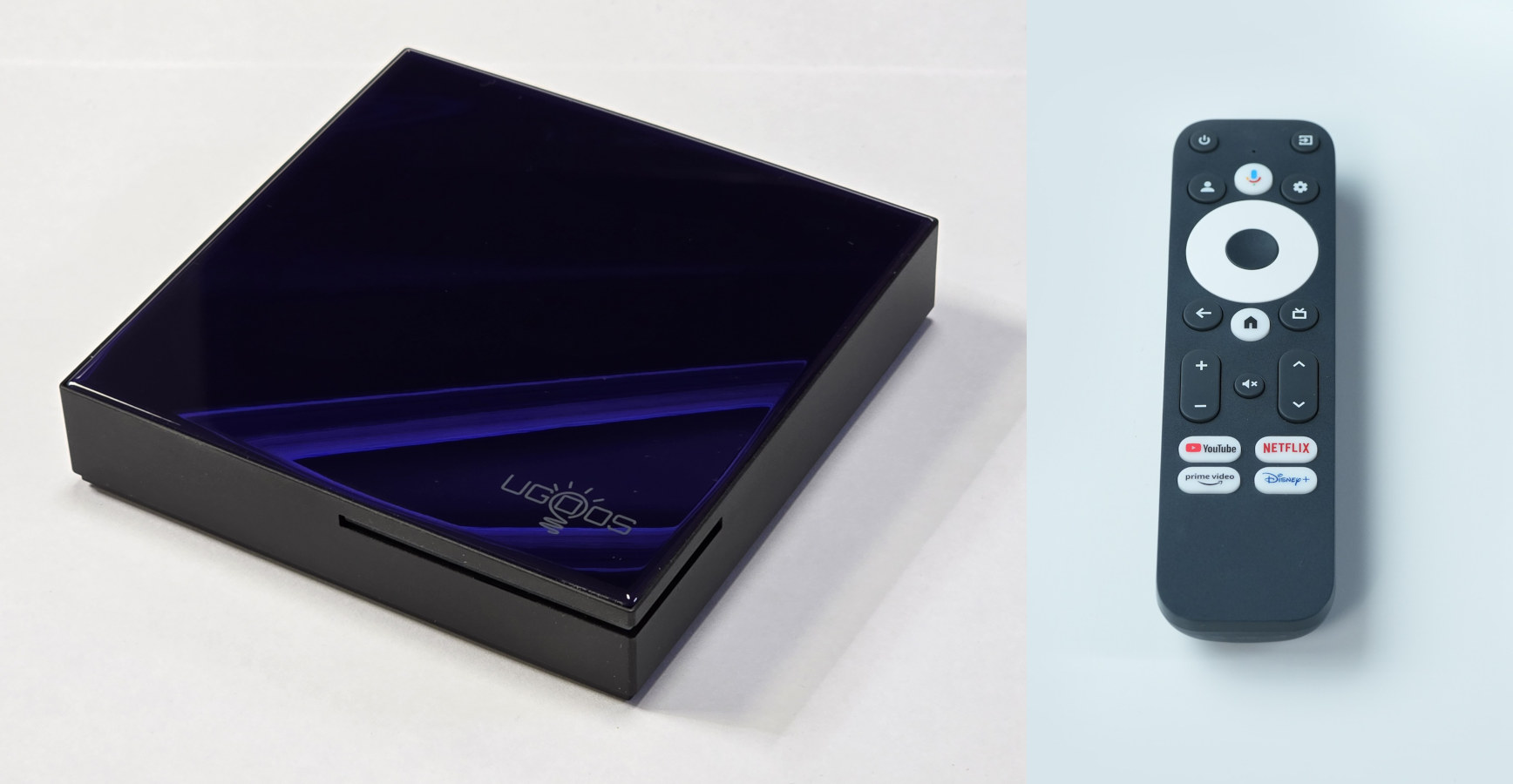
Ugoos X5M Pro TV Box BLuetooth Remote Control

Ugoos X5M Pro is an Android 14 TV box powered by the new Amlogic S905X5M quad-core Cortex-A55 SoC, so far found in some operator TV boxes, Xiaomi TV Box S (3rd Gen), and Hardkernel ODROID-C5 SBC. The new TV box comes with 4GB RAM, 32GB eMMC flash, HDMI 2.1 video output up to 4Kp60, Gigabit Ethernet and WiFi 6 networking, optical S/PDIF audio output, a USB 3.0 port, and a USB 2.0 OTG port. A Bluetooth remote control with voice control and IR learning function is also provided. Ugoos X5M Pro specifications: SoC – Amlogic S905X5M CPU – Quad-core Cortex-A55 processor @ 2.5 GHz GPU – Arm G310-V2 GPU @ 850 MHz supporting OpenGL ES 3.2, Vulkan 1.0, and OpenCL 2.0 VPU Video Decoding 4Kp60 10-bit: AV1, H.265, VP9, AVS2 4Kp30: H.264 1080p60: MPEG-4, VC1, AVS, MPEG-2, MPEG-1, MJPEG Video Encoding – 1080p30 H.264 NPU – Inline AI-SR (AISR2) for […]

Exit mobile version