WCH CH32H417 is a high-performance dual-core RISC-V microcontroller clocked at up to 400 MHz with up to 960 KB flash, 896KB SRAM, and a range of interfaces, including a 5 Gbps USB 3.0 Host/Device SuperSpeed interface. Other notable features include a 500MB/s UHSIF (Universal High Speed Interface), 10/100Mbps Ethernet MAC and PHY, a SerDes high-speed isolated transceiver, a USB 2.0 High-Speed Host/Device, a USB 2.0 OTG Full Speed, USB PD support, and Display and Camera interfaces. The CH32H417 also offers the usual low-speed I/Os (95x GPIO, SPI…) and analog inputs and outputs (ADC/DAC). WCH CH32H417 CH32H417 specifications: Cores (Coremark: 5.73/MHz) QingKe RISC-V5F up to 400 MHz QinKe RISC-V3F up to 144 MHz GPU – Graphics Processing Hardware Accelerator GPHA Memory – 896KB SRAM Storage 960KB Flash 200MHz dual-edge SD/EMMC controller (SDMMC) SDIO master/slave interface with support for SD/SDIO/MMC Flexible Storage Controller FMC Display – DCT-TFT Display Controller LTDC Camera I/F […]
WCH BLE Analyzer Pro – A Bluetooth LE sniffer, analyzer, and debugging tool
WCH BLE Analyzer Pro is a USB-based Bluetooth Low Energy (BLE) sniffer and debugging tool designed to capture, decode, and analyze BLE communication packets in real-time. The analyzer supports adjustable polling intervals, broadcast and connection packet tracking, address filtering, and detailed packet inspection with statistics and graphical representation. It can monitor BLE broadcast and connection data in real-time and includes functions such as PHY mode selection and whitening control. These features enable low-level monitoring of BLE communication, help identify transmission issues, and verify protocol behavior. Applications include use in R&D, testing, and debugging of Bluetooth-enabled products such as IoT devices, wearables, and sensors. WCH BLE Analyzer Pro specifications: Main chips – 3x CH582F Bluetooth LE RISC-V microcontrollers, and a CH334 USB hub (see board photo at the end of the post) Supported protocol – Bluetooth Low Energy (BLE) 4.0/4.2/5.0 Capture range – BLE advertisement and connection packets Frequency band – […]
Sub $7 CH32V317 board offers 10/100Mbps Ethernet, dual USB 2.0 Type-C, DVP interface
The nanoCH32V317 from MuseLab is a low-cost RISC-V development board designed for prototyping embedded systems and education. Built around the 144MHz WCH CH32V317WCU6 MCU. This development board is suitable for various embedded, IoT, prototyping, and automation projects. Other features of the development board include a USB 2.0 high-speed and full-speed controller, a 10/100Mbps Ethernet MAC with PHY, SDIO, and a DVP interface for digital video input, as well as advanced motor PWM timers for control applications. The board also includes an 8MHz main crystal and a 32.768KHz RTC crystal. For programming, it includes a dual USB Type-C interface, a USB ISP, as well as an SWD port. nanoCH32V317 board specifications: MCU – WCH CH32V317WCU6 32-bit RISC-V core up to 144 MHz clock frequency USB 2.0 High-Speed (HS) and Full-Speed (FS) controllers Integrated Ethernet MAC + 10/100M PHY DVP interface, SDIO, and advanced motor PWM timer support Memory – Up to […]
10-cent WCH CH570/CH572 RISC-V MCU features 2.4GHz wireless, Bluetooth LE 5.0, USB 2.0
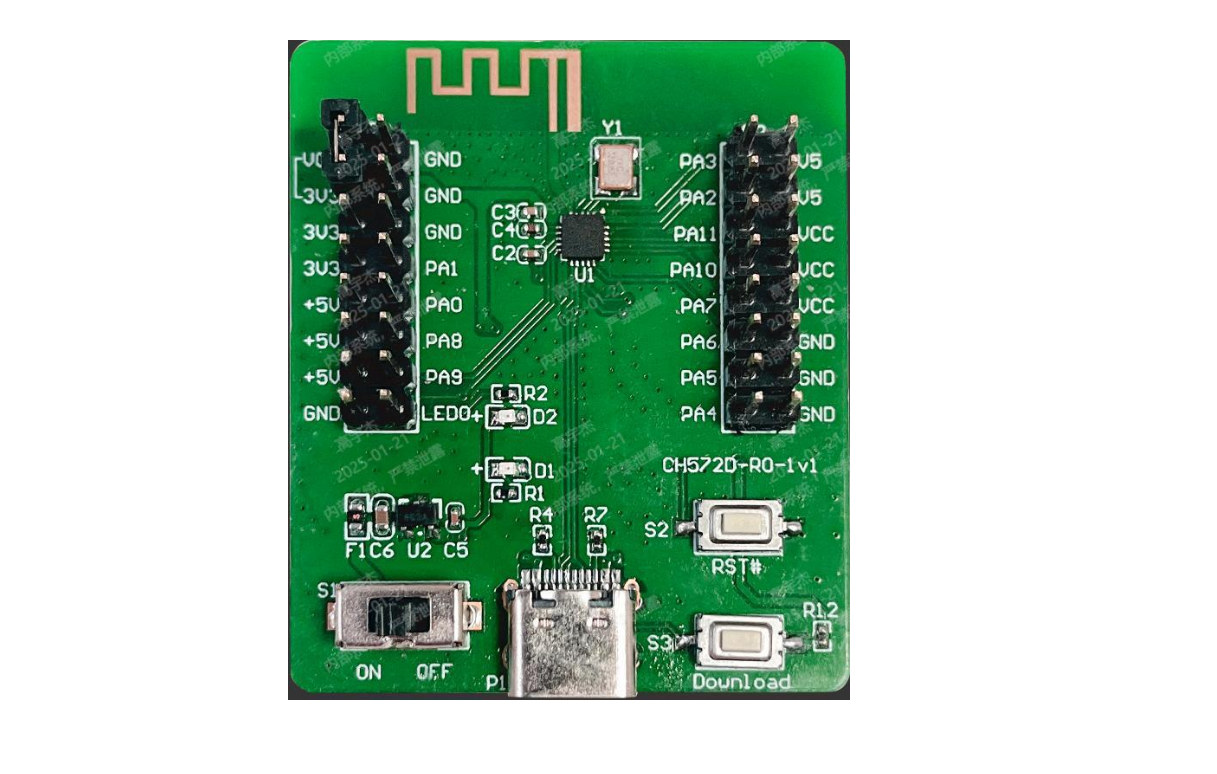
Patrick Yang, CTO at WCH, has recently unveiled the CH570 RISC-V SoC with 2.4GHz wireless and USB 2.0 (host & device) as an upgrade to the popular CH32V003 general-purpose RISC-V MCU with more features at the same low price (10 cents). CH570 also comes with 12KB SRAM and 256KB flash (vs 2KB SRAM and 16KB flash for the CH32V003), offers up to twelve GPIO, six PWM, I2C, UART, SPI, and a 20-channel key detection module. There’s also the CH572 with the same features, except it also supports Bluetooth LE 5.0. As a side note, I wrote about the CH572 RISC-V MCU with BLE in 2019, but I guess it was scrapped likely because it had OTP instead of flash…, and the new CH572 (2025) is different. WCH CH570/CH572 specifications: CPU core QingKe 32-bit RISC-V3C core @ up to 100 MHz (RV32IMBC instruction set and custom instructions) Low-power 3-stage pipeline High-speed […]
$5 CH32-Ant CH32V003 RISC-V development board comes with Stemma QT connector
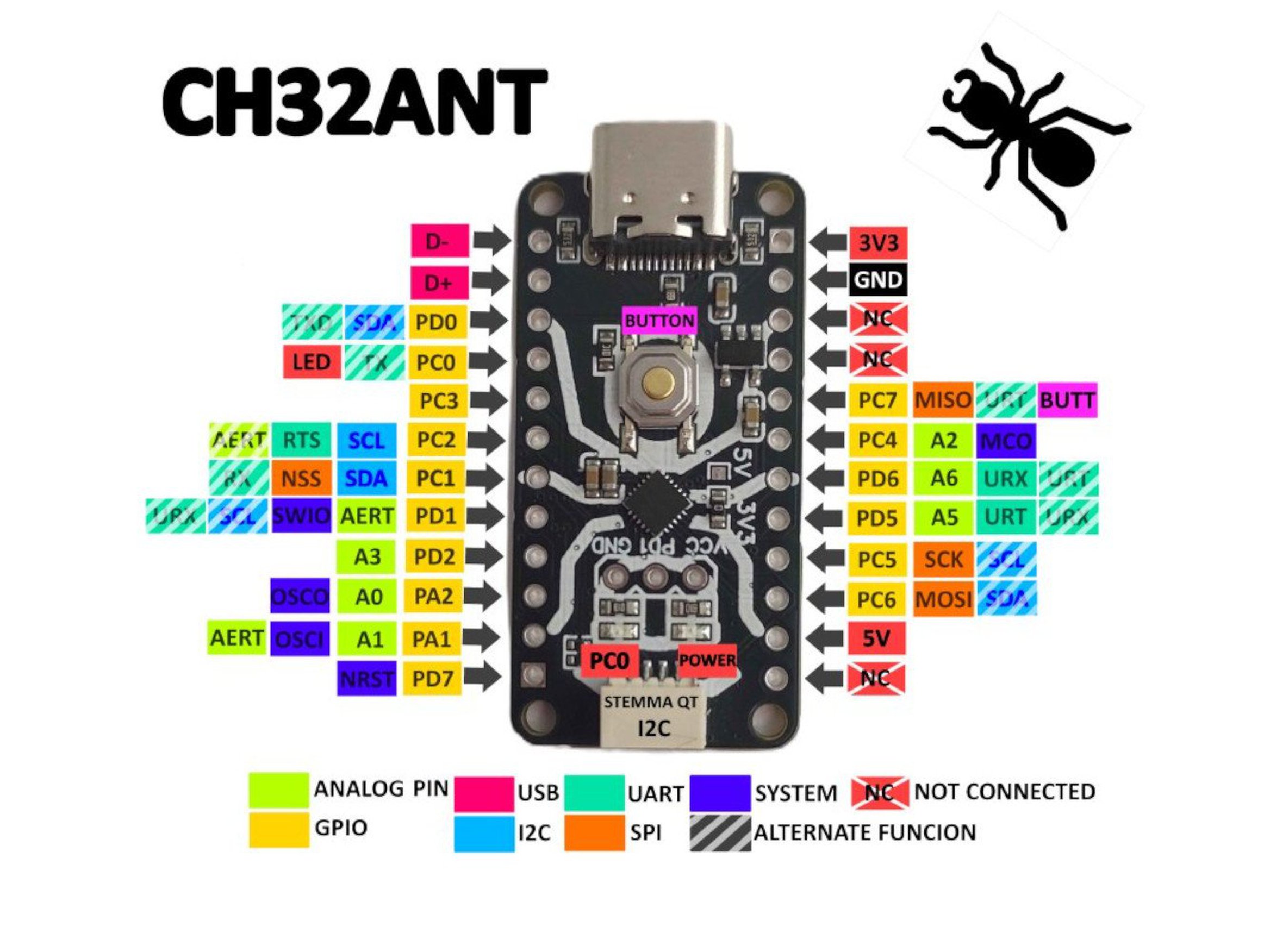
The CH32-Ant is a low-cost, breadboard-compatible development board powered by the WCH Electronics CH32V003-F4U6 RISC-V microcontroller, ideal for prototyping. It is pin-compatible with Prokyber’s ESP32-C6-Bug, offering an easy transition for users who don’t need wireless capabilities or the higher performance of the ESP32-C6FH4. The board features a Stemma QT connector for straightforward I2C sensor integration and a USB Type-C port that supports data transfer and power through software-based USB on the CH32V003. The CH32-Ant offers configurable logic voltage at 3.3V or 5V, adjusted via an onboard 0-ohm resistor, providing flexibility for sensor projects. Powered by the CH32V003F4U6 microcontroller, it operates up to 48MHz with 2kB of RAM and 16kB of flash, making it cost-effective for applications requiring basic processing without wireless. The CH32-Ant features a compact layout designed for breadboard compatibility, a Stemma QT connector for an I2C module on one end of the board, and a USB Type-C connector […]
Phyx LANA-TNY – A WCH CH32V203 RISC-V development board for embedded applications
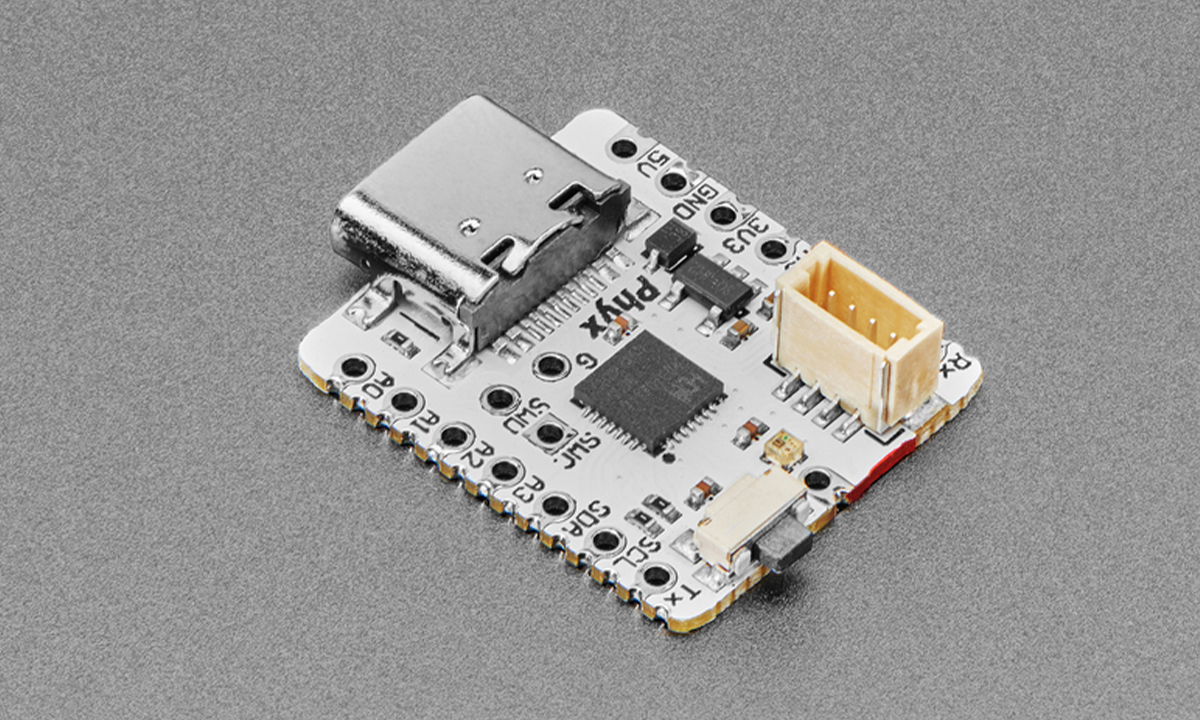
The LANA-TNY is a compact development board created by Phyx and built around the CH32V203 RISC-V microcontroller. It offers a low-cost solution for embedded development and features a built-in USB bootloader, eliminating the need for an external programmer to flash the firmware. With a USB-C connector and a minimalist design, the board provides essential components to start development quickly. At its core, the Phyx LANA-TNY is powered by the CH32V203G6U6, a 32-bit RISC-V microcontroller from WCH Electronics, capable of running up to 144MHz with 1-cycle multiply/divide operations. It includes 10KB of SRAM, 32KB of single-cycle Flash, and 224KB of additional external flash for program or data storage, though the external memory operates at a slower speed. The CH32V203 microcontroller supports a range of peripherals, including ADC, timers, USB devices, UART, I2C, and SPI, making it suitable for a wide variety of embedded applications. Designed in the style of Adafruit’s QT […]
WCH CH32V002 32-bit RISC-V MCU comes with 4KB SRAM, supports 2V to 5V DC supply voltage
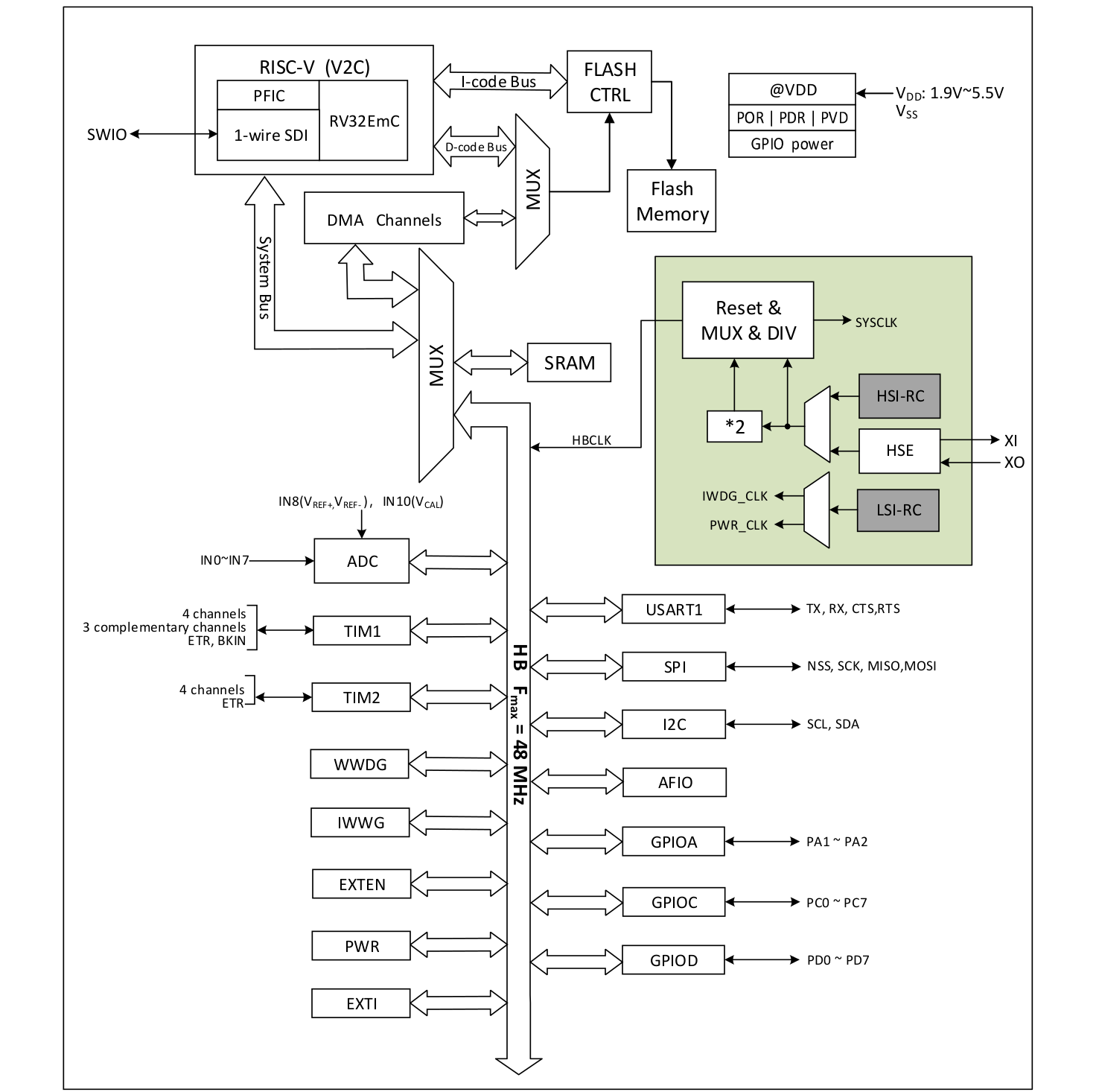
WCH CH32V002 is an industrial-grade general-purpose 32-bit RISC-V microcontroller that is pin-to-pin compatible with the popular CH32V003 MCU with 4KB SRAM instead of 2KB, a wider input voltage range from 2V to 5V, and other improvements. Earlier this month we wrote about the WCH CH32V006 RISC-V microcontroller that offers an upgrade to the CH32V003 with more I/Os, memory, and storage, requiring a new PCB layout. But now, the Chinese company has unveiled a pin-compatible alternative with the CH32V002 that adds more SRAM, uses the new V2C core with RV32EmC instruction set (also used in the CH32V006), offers a larger bootloader and configuration memories, upgrades the ADC to 12-bit, and adds support for 8-channel touch-key channel detection. WCH CH32V002 specifications (highlights in bold show differences against the CH32V003): CPU – 32-bit “RISC-V2C” core up to 48 MHz using RV32EmC instruction set Memory – 4KB SRAM Storage – 16KB flash, 3328 Bytes […]
WCH CH32V006 RISC-V microcontroller adds more I/Os, memory, and storage compared to CH32V003
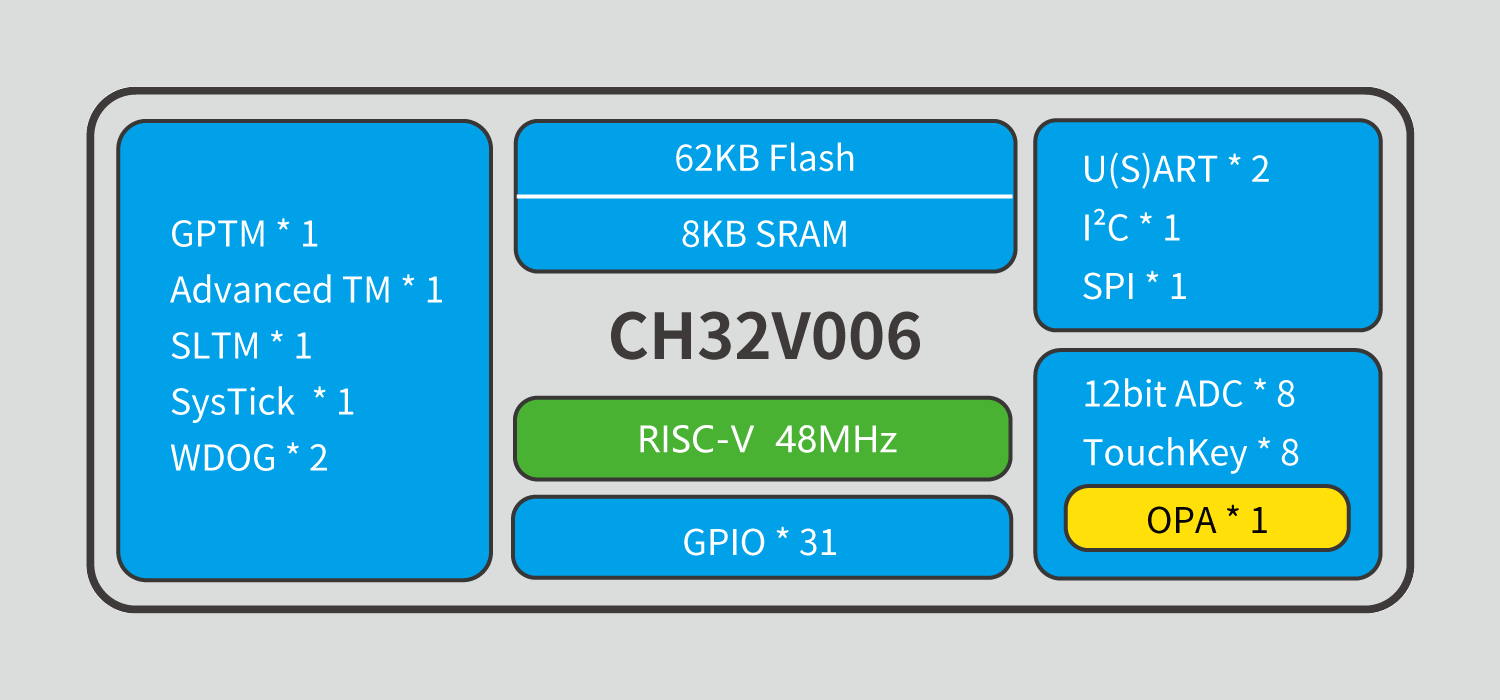
WCH CH32V006 RISC-V microcontroller is an upgrade to the 10-cent CH32V003 microcontroller with more I/Os, up to four times the memory, storage, a wider supply voltage range, the addition of a TouchKey interface, as well as a new 32-bit V2C RISC-V core instead of the V2A core found in the CH32V003. More specifically that means we went from the CH32V003 with 2KB SRAM and 8KB flash, up to 8KB SRAM and 62KB for the CH32V006, and 6KB SRAM and 32KB flash for the CH32V005, a smaller sibling of the new RISC-V microcontroller. WCH CH32V005 & CH32V006 specifications (with highlights in bold to show differences against CH32V003): CPU – 32-bit “RISC-V2C” core up to 48 MHz Memory – 6KB SRAM (CH32V005) or 8KB SRAM (CH32V006) Storage – 32KB flash (CH32V005) or 62KB flash (CH32V006) Peripherals Up to 31x GPIO with interrupt support (CH32V003 had up to 18x GPIO) 2x USART interfaces […]