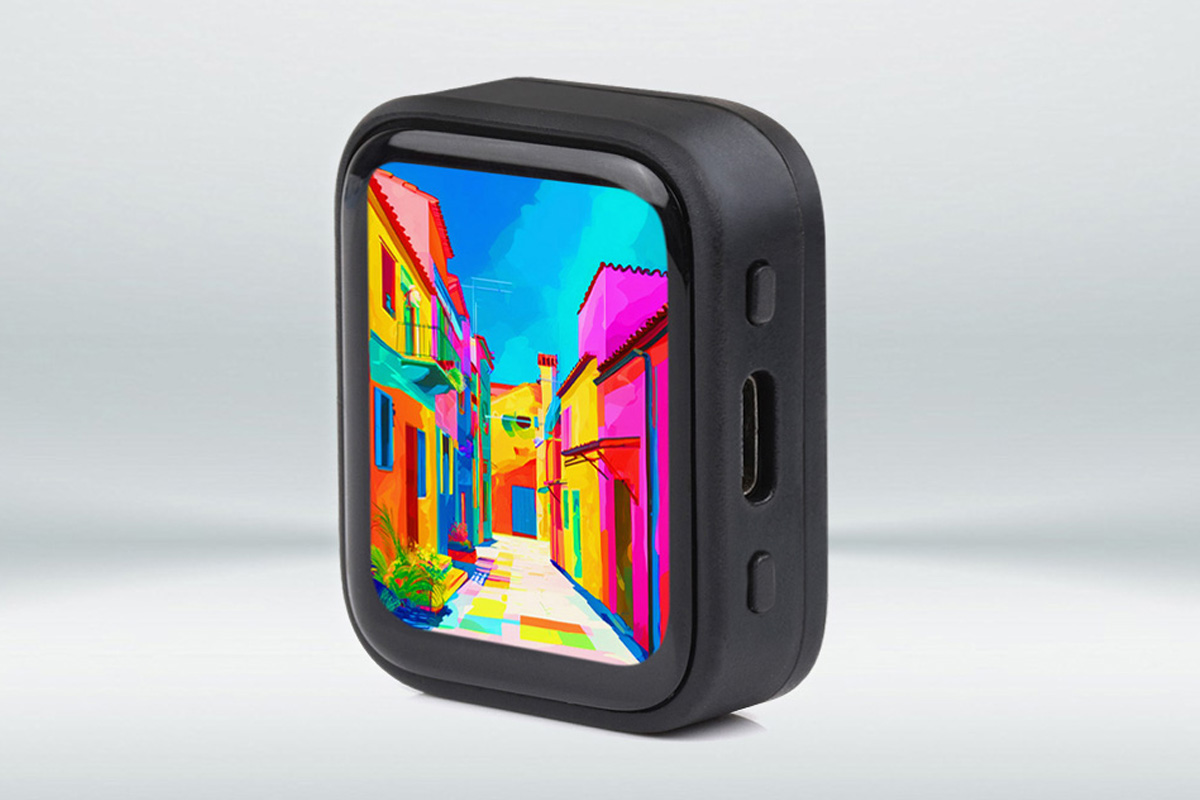

Waveshare has recently released the ESP32-S3 2.06-inch AMOLED Touch, an ESP32-S3-based watch devkit with Wi-Fi 4, Bluetooth 5, and offline voice recognition in a watch-style enclosure. We have written about various ESP32-S3-powered smartwatches in the past. Some examples include the TinyWatch S3 open-source device with various sensors, but no battery or a strap, and the more complete LILYGO’s T-Watch S3 with LoRa, audio, and a built-in battery. Compared to both of those, the Waveshare ESP32-S3 watch stands out with a 2.06-inch AMOLED capacitive touchscreen, a 6-axis IMU, two digital microphones, an ES8311 audio codec, an RTC (PCF85063), and AXP2101 PMIC with lithium battery support. The watch also features a microSD card slot, a USB Type-C port, programmable buttons, and reserved I2C/UART/USB headers for communications. ESP32-S3-Touch-AMOLED-2.06 specifications: SoC – Espressif ESP32-S3R8 CPU – Dual-core Tensilica LX7 microcontroller up to 240 MHz with vector instructions for AI acceleration Memory – 8MB PSRAM Wireless – […]
CamThink NeoEyes NE101 – A low-power, modular ESP32-S3 Vision AI Camera with optional 4G LTE and WiFi HaLow connectivity
CamThink NeoEyes NE101 is a battery-powered, low-power Vision AI Camera powered by an ESP32-S3 wireless module, featuring event-triggered image capture, and suitable for real-time vision control. By default, the camera supports WiFi 4 and Bluetooth 5.0 connectivity, and ships with a 5MP OV5640 camera module with an LED flash. However, the ESP32-S3 camera has a modular design, and it is offered with 4G LTE Cat 1 or WiFi HaLow connectivity, supports replaceable lenses, optional housing, and custom mounting options. CamThink NeoEyes NE101 specifications: Wireless Module – ESP32-S3-WROOM-1 MCU – ESP32-S3 dual-core Tensilica LX7 up to 240 MHz with 512KB SRAM, up to 8MB PSRAM Storage – 16MB flash Wireless – WiFi 4 and Bluetooth LE 5 PCB antenna Optional wireless features NE101-L01GL – LTE Cat 1 with global support NE101-HL00 – WiFi HaLow 868 MHz NE101-HL01 – WiFi HaLow 915 MHz Storage – MicroSD card slot Camera FPC camera connector […]
GamerCard is a gift card-sized, Raspberry Pi Zero 2 W-powered handheld console with a 4-inch color display
Grant Sinclair’s GamerCard is a handheld console based on the Raspberry Pi Zero 2 W and a 4-inch color IPS display offered in an ultrathin design that’s about the size of a typical retail gift card. It joins other Raspberry Pi-based handheld terminals like the BeepBerry, ShaRPiKeebo, or DevTerm, but it’s more of a consumer device and offers by far the slimmest design at just 6mm thick. Being described as a “Grab & Go Raspberry Pi Gaming” platform, it’s mainly designed as a portable gaming console, but since it’s based on Raspberry Pi hardware, you could also use it as a battery-powered Linux terminal connected to a USB keyboard and mouse, and it also offers expansion capabilities through a Qwiic connector. GamerCard specifications: SBC – Raspberry Pi Zero 2 W (soldered on mainboard) – Based on Raspberry Pi RP3A0 quad-core Arm Cortex-A53 SiP with 512 MB SDRAM, Bluetooth 4.2 and […]
Nexus RP2350 LiPo board improves on Raspberry Pi Pico 2 with LiPo battery support, 16MB flash, USB-C port
Zaitronics Nexus RP2350 LiPo is a Raspberry Pi RP2350 board similar to the Raspberry Pi Pico 2, but with various improvements, namely support for LiPo batteries, a 16MB SPI flash, a USB-C port, and a Qwiic/STEMMA QT expansion connector. The Australian company says that apart from those improvements, the board has the same size and pinout as the original Raspberry Pi Pico 2, and if there’s enough interest, a Nexus RP2350 LiPo W board adding WiFi and Bluetooth may also be designed in the future. Nexus RP2350 LiPo specifications: SoC – Raspberry Pi RP2350A CPU Dual-core Arm Cortex-M33 @ 150 MHz with Arm Trustzone, Secure boot OR Dual-core RISC-V Hazard3 @ 150 MHz Either two cores can be used. Memory – 520 KB on-chip SRAM Security 8KB of anti-fuse OTP for key storage Secure boot (Arm only) SHA-256 acceleration Hardware TRNG Fast glitch detectors. Package – QFN-60 Storage – 16 […]
ESP32-S3 development board integrates SI4732 AM/FM radio receiver
LILYGO T-Embed SI4732 is an ESP32-S3 development board with an AM/FM radio, a TFT display, a rotary encoder, a built-in microphone, and a microSD card slot powered through a USB-C port or LiPo battery. As its name implies, it’s based on the earlier LILYGO T-Embed battery-powered WiFi and BLE controller with a display and rotary encoder, but also adds a Skyworks SI4732 AM//FM/SW/LW radio receiver to the mix. LILYGO T-Embed SI4732 specifications: Wireless module – ESP32-S3-WROOM-1 module SoC – ESP32-S3 CPU – Dual-core Xtensa LX7 processor @ 240 MHz with vector extension for AI/ML Memory – 512 KB SRAM, 8 MB PSRAM Storage – 16MB flash Wireless – 2.4 GHz WiFi 4 and Bluetooth 5.0 LE PCB antenna Storage – MicroSD card slot Display – 1.9-inch IPS color TFT LCD with 320 x 170 resolution (ST7789V SPI driver) Audio – 2x microphones, 8 Ohm @ 1W speaker Radio – Skyworth […]
Renesas RA2L2 – The first low-power MCU with USB-C Revision 2.4 support
Renesas RA2L2 is the world’s first low-power MCU to support the USB-C Revision 2.4 standard with 15W CC detection, USB FS support. It also offers support for CAN Bus, I3C, and low-power UART. The announcement follows other devices from the Renesas RA series, such as the RA2A2 Arm Cortex-M23 MCU introduced in 2024, and the RA4L1 ultra-low-power MCU unveiled earlier this year with just 168 µA/MHz operation, dual-bank flash, and capacitive touch. The RA2L2 Cortex-M23 microcontroller also embeds up to 128KB of code flash, 16KB SRAM, and 4KB data flash for EEPROM-like storage. It supports a wide 1.6V to 5.5V supply voltage and an industrial-grade -40°C to +125°C temperature range. The MCU also integrates a ±1% high-accuracy on-chip oscillator, multiple timers including 16-bit and 32-bit PWM and low-power asynchronous timers, a 12-bit ADC, a real-time clock, and an internal temperature sensor. It’s available in 32- to 64-pin packages and offers […]
Battery-powered SQUiXL devkit pairs 4-inch touchscreen display with ESP32-S3 WiFi and Bluetooth SoC
Unexpected Maker’s SQUiXL is a battery-powered ESP32-S3 WiFi and Bluetooth IoT controller and development platform with a 4-inch touchscreen display with 480×480 resolution. Designed for makers, hardware engineers, embedded developers, and home automation enthusiasts, the SQUiXL integrates with 8MB PSRAM and a 16MB SPI flash for plenty of resources for the firmware. Other features include a microSD card, an amplifier with speaker connector, a haptic driver and motor, an RTC, and a STEMMA/Qt connector for expansion. SQUiXL specifications: WiSoC – Espressif Systems ESP32-S3 CPU – Dual-core Tensilica LX7 @ up to 240 MHz with vector instructions for AI acceleration Memory – 512KB RAM Wireless – 2.4 GHz WiFi 4 and Bluetooth 5.0 LE + Mesh Memory – 8MB octal PSRAM Storage 16MB QSPI flash MicroSD card slot (multiplexed with audio amplified) Display – 4-inch 480×480 RGB display with capacitive touch (GT911) Audio MAX98357A I2S Audio Amplifier (multiplexed with microSD card […]
ThinkNode M2 ESP32-S3-based Meshtastic handset features 1.3-inch OLED display, 1,000 mAh battery
Elecrow ThinkNode M2 is yet another Meshtastic handset for off-grid messaging and GPS coordinate sharing based on an ESP32-S3 module providing Bluetooth connectivity to a smartphone, and a Semtech SX1262 LoRa transceiver for low-power long-range wireless connectivity. It’s an evolution of the ThinkNode-M1, itself similar to the LILYGO T-Echo, based on a Nordic Semi nRF52840 Bluetooth module and SX1262 LoRa transceiver with an external antenna housed in a 3D printed enclosure. The new ThinkNode M2 is very similar but features a more powerful ESP32-S3 module instead, relies on a 1.3-inch OLED display instead of a 1.54-inch e-paper display, and is housed in an ABS plastic case. ThinkNode M2 specifications: Core module – ESP32-S3 module (looks to be ESP32-S3-WROOM-1 on the photo below) SoC – ESP32-S3 CPU – dual-core 32-bit microcontroller @ 240MHz Memory – 512KB SRAM, 8MB PSRAM Storage – 384KB ROM 4MB flash Wireless – 2.4GHz Wi-Fi and Bluetooth […]