ESP-Scope is an open-source firmware transforming any ESP32 board into an oscilloscope using one of the ADC pins up to 83,333 Hz sample rate (on the ESP32-C6) and visualizing the results over Wi-Fi in a web browser, be it Google Chrome, Mozilla Firefox, or others. It’s not the first ESP32 oscilloscope project we’ve seen, as last year, we covered Bojan Jurca’s “Esp32_oscilloscope” Arduino sketch doing something very similar. The ESP-Scope is a little different, since it’s based on the ESP-IDF framework, and was used to test AI code generators, specifically “Google Antigravity using Gemini 3, with refinements, hints and tips and overall design specified by a human”. It just took a few hours to build. ESP-Score firmware features: Real-time signal visualization on a web browser. Adjustable sample rate (1-83333 Hz) and attenuation. Crosshair functionality for precise measurements Adjustable trigger level Test signal generation Reset functionality to clear settings and reload […]
GigaDevice GD32VW553-UNIFI – A $2+ WiFi 6 and Bluetooth 5.2 LE wireless IoT module
GD32VW553-UNIFI is an inexpensive wireless IoT module based on GigaDevice GD32VW553 RISC-V microcontroller featuring 2.4 GHz WiFi 6 and Bluetooth 5.2 LE connectivity, and offered with a PCB antenna or IPEX antenna connector. The GD32VW553 MCU integrates 320KB SRAM and 4096KB on-chip flash, and supports link rates of up to 114.7 Mbps over WiFi and 2 Mbps over Bluetooth LE. The UNIFI module exposes 18 GPIOs from the microcontroller and is available in two different temperature ranges: -40 to +85°C or -40 to +105°C. GD32VW553-UNIFI specifications: SoC – GigaDevice GD32VW553 CPU – 32-bit RISC-V processor up to 160 MHz with RV32I/M/A/F/D/C/P/B instruction extensions Memory – 320KB (288 KB + 32KB shared) SRAM Storage – 4096 KB flash Wireless WiFi 802.11b/g/n/ax compatible 802.11i (WPA, WPA2, WPA3). Open, shared key, and pair-wise key authentication services Single antenna 1×1 stream in 20MHz channels upport of 802.11ax MCS up to MCS9 with a Max […]
ESP32-P4 learning and prototyping kit features 7-inch touchscreen, comes with 16 modules and AI lessons
Elecrow’s “All-in-One Starter Kit for ESP32-P4” is an open-source learning and prototyping platform based on the ESP32-P4 processor, offering AI, multimedia, and embedded features in a single, self-contained kit designed for students, educational institutions, and developers for rapid prototyping. The open hardware kit integrates a 7-inch touchscreen display, a 2MP camera, and sixteen built-in electronic modules, supported by over 20 structured lessons that progressively cover I/Os, audio, LVGL GUI development, and basic AI use cases. Development is done in C using Espressif’s ESP-IDF framework, ready-to-build examples, and modular BSP drivers, making the kit suitable for learning embedded systems, IoT device control, human-machine interfaces, smart home concepts, and entry-level Edge AI applications. All-in-one Starter Kit for ESP32-P4 kit specifications: Wireless MCU – ESP32-P4NRW32 MCU Dual-core RISC-V microcontroller @ 400 MHz with AI instructions extension and single-precision FPU Single-RISC-V LP (Low-power) MCU core @ up to 40 MHz GPU – 2D Pixel […]
Raspberry Pi RP2350 devkit features 1.85-inch round touch display, microphone, optional speaker and battery box
Waveshare RP2350-Touch-LCD-1.85C is a Raspberry Pi RP2350 devkit with a 1.85-inch round touchscreen display with 360×360 resolution, a built-in microphone, a 28-pin GPIO header, and a USB-C port. The RP2350-Touch-LCD-1.85C-BOX model builds on the platform to add a box with a speaker and a 3.7V battery. Both models also come with 16MB SPI flash, a microSD card slot, a 6-axis IMU, a few buttons and LEDs, and UART and I2C expansion connectors. They can be used for HMI solutions using touch, button, and voice recognition inputs, as well as display and audio outputs. RP2350-Touch-LCD-1.85C specifications: Microcontroller – Raspberry Pi RP2350A MCU CPU 2x Arm Cortex-M33 cores @ 150 MHz 2x Hazard3 RISC-V cores @ 150 MHz Up to two cores can be used at any time (configured at boot) Memory – 520KB SRAM Storage – 8KB OTP Package – QFN-60; 7×7 mm Storage – 16MB SPI NOR flash, microSD card slot Display […]
Mongoose Wizard builds professional embedded device dashboards for microcontrollers like ESP32, STM32, NXP, RPi and others (Sponsored)
Cesanta Software introduced Mongoose Wizard – a no-code visual tool that enables embedded developers to effortlessly build a professionally looking device dashboard (WebUI) and REST API without writing any frontend code, transforming the microcontroller (MCU) board into a browser-accessible web dashboard for control, monitoring, and updates. Whether for prototyping or building production devices, integrating a web dashboard into firmware gives end users intuitive and powerful control. Designed for use in Industrial, Automotive, Smart home, or any Internet of Things product (machinery, devices, appliances, etc.) that benefits from a browser-based interface. Mongoose Wizard utilises the Mongoose Library, an open source network library for C/C++. Mongoose Library provides event-driven non-blocking APIs for TCP, UDP, HTTP, WebSocket, MQTT, and other protocols. It is designed for connecting devices and bringing them online. On the market since 2004, used by a vast number of open-source and commercial products – it even runs on the International […]
pdsink – An open-source USB PD 3.2 sink stack for embedded devices
pdsink is an open-source USB Power Delivery (PD) 3.2 sink implementation for embedded devices released under an MIT license. Vitaly Puzrin noticed that most available USB PD stacks come with at least one hard constraint: vendor lock-in, NDA, no public sources, coupling to a specific OS or framework, incomplete sink feature set (e.g., no EPR), or difficulty extending to new Type-C Port Controller (TCPC)/MCU combinations. So he created pdsink is an attempt to provide a small, platform-agnostic, readable sink-only stack that’s easy to adapt to different controllers. pdsink highlights: USB PD 3.2, SPR (Extended Power Range), and EPR (Extended Power Range for 28V and up) support on the sink side. Platform-agnostic C++ core that does not depend on a specific HAL or RTOS. Reference implementation using OnSemi FUSB302B + FreeRTOS (ESP32-C3). MIT license enabling the project to be used in commercial products without conditions. pdsink can be found on any […]
HackBEE is a Raspberry Pi RP2350 USB-C dongle for developers (Crowdfunding)
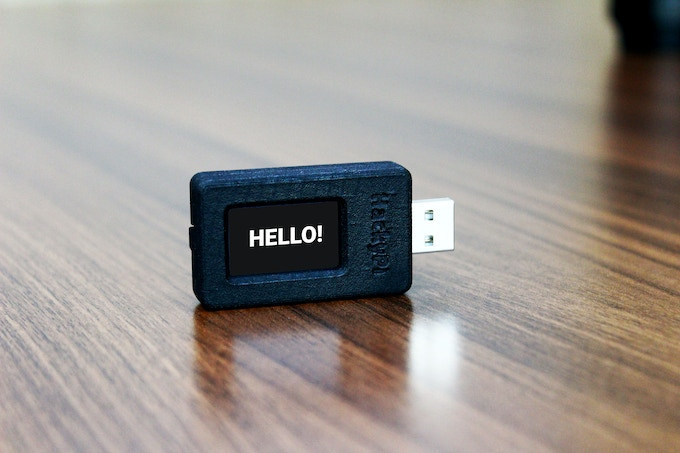
Hack the Board’s HackBEE is a tiny programmable USB-C dongle and development platform powered by the Raspberry Pi RP2350 Arm Cortex-M33/Hazard3 RISC-V microcontroller. It supports USB host and device modes, has side buttons, and includes a multi-color RGB LED for feedback. The device can be used as a programmable HID device (keyboard/mouse/media controller), a USB host or device for testing and prototyping, an automation tool for repetitive tasks, a compact input emulator, or a teaching tool for C/C+, MicroPython, and embedded systems education. HackBEE specifications: MCU – Raspberry Pi RP2350A CPU Dual-core Arm Cortex-M33 @ 150 MHz with Arm Trustzone, Secure boot OR Dual-core RISC-V Hazard3 @ 150 MHz Either two cores can be used. Memory – 520 KB on-chip SRAM Package – QFN-60 Storage – Not disclosed USB – 1x USB Type-C host/device port Security – Arm TrustZone for Cortex-M33 cores, optional boot signing (OTP), protected OTP storage, SHA-256 […]
$4 Shrike-lite FPGA board combines 1120 LUTs Renesas ForgeFPGA with Raspberry Pi RP2040 MCU
Shrike-lite is an ultra-cheap FPGA board based on a 1120 LUTs Renesas ForgeFPGA device (SLG47910V) and also equipped with a Raspberry Pi RP2040 microcontroller. The board also features a USB-C port for power and programming, two 18-pin headers and a 12-pin PMOD-compatible header for I/Os, as well as Boot and Reset buttons, but not much else since it’s designed as a minimal development board. Shrike-lite and Shrike boards specifications: FPGA – Renesas ForgeFPGA (SLG47910V,1120 LUTs) 1120 5-bit LUTs 1120 DFFs 5 kb distributed memory 32 kb BRAM Configurable through NVM and/or SPI interface Package – STQFN-24 MCU – Raspberry Pi RP2040 dual-core Cortex-M0+ microcontroller @ 125 MHz with 264KB SRAM FPGA/ MCU interface – 6-bit high-speed bridge Storage – QSPI flash for configuration and storage USB – USB Type-C for programming & power Expansion 2x 18-pin headers for RP2040 and ForgeFPGA’s I/Os 12-pin PMOD compatible header Misc Boot and Reset buttons […]