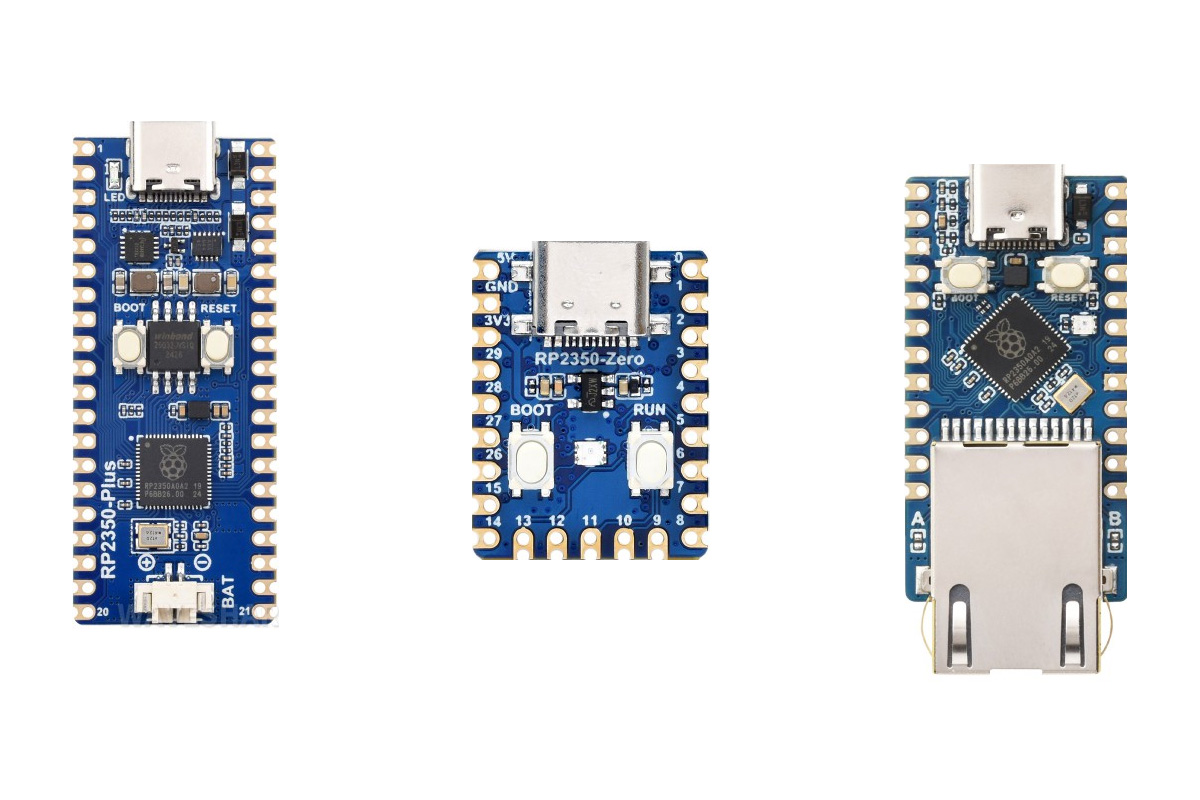
WIZnet WIZ630io is a small module featuring an RJ45 jack and a W6300 controller supporting up to 80+ Mbps Ethernet over QSPI @ 150 MHz. As a reminder, the W6300 features 64KB of SRAM for 8 sockets, each with a 4KB TX/RX buffer by default. It is notably found in the WIZnet W6300-EVB-Pico2 development board powered by a Raspberry Pi RP2350 MCU. The WIZ630io allows you to easily add Ethernet to any RP2350 board or other microcontroller with a SPI or QSPI interface. WIZnet WIZ630io specifications: W6300 QSPI Ethernet controller Host Interface – High-speed QSPI (MODE 0/3), system bus with 2 address signals & 8-bit data Internal 32KB SRAM for Tx/ Rx buffers (64KB in total) 8x independent sockets with 64KB Memory 10BaseT / 10BaseTe / 100BaseTX Ethernet PHY Integrated Auto negotiation (Full and half-duplex, 10 and 100-based) Auto-MDIX only on Auto-Negotiation Mode IP Fragmentation not supported Hardwired TCP/IP protocols […]
Olimex RP2350-PICO2 open hardware boards expose all 48 GPIOs for breadboard prototyping
Olimex RP2350-PICO2-BB48 and RP2350-PICO2-BB48R open hardware development boards are built around the Raspberry Pi RP2350B MCU, and expose all 48 GPIOs in a 0.6-inch dual-inline PCB layout. Compared to the earlier PICO2-XL and PICO2-XXL boards, this new board features a breadboard-friendly design with options for PSRAM and microSD on the BB48R version. Other features include USB-C power/data, BOOT and RESET buttons, a 2A 3.3V regulator, UEXT and Qwiic/Stemma connectors, status LED, and debug pads. With pre-soldered headers, it can be plugged directly into a breadboard, making it ideal for DIY projects, IoT, retro computing, and hardware prototyping. Olimex RP2350-PICO2-BB48 and RP2350-PICO2-BB48R specifications: MCU – Raspberry Pi RP2350B CPU Dual-core Arm Cortex-M33 @ 150 MHz with Arm Trustzone, Secure boot OR Dual-core RISC-V Hazard3 @ 150 MHz Either two cores can be used. Memory – 520 KB on-chip SRAM Package – QFN-80 Memory – 8 MB external QSPI PSRAM (only on […]
Using an overpowered vape as a secondary display
Last week, we noted that it was possible to run a web server on a disposable vape through its USB-C port, and now I’ve been shown DOOM on an even more overpowered vape acting as a secondary display, which is a bit larger in size than the WeAct Display FS 0.96-inch USB display we just covered. Perhaps I should add a ‘vaporware’ category on CNX Software… The new hack was done by Aaron Christophel (ACT1441) using an Aspire PIXO Vape with a Cortex-M4F MCU, a small color LCD, a USB-C port, Bluetooth LE connectivity, and a battery. Aspire PIXO vape hardware specifications: MCU – Puxa PY32F403XC Arm Cortex-M4F microcontroller @ 144 MHz with 64KB RAM, 256KB Flash Storage – External 16MB SPI Flash Display – 323 x 173 LCD Wireless – WS8000 BLE chip USB – 1x USB Type-C port Misc Heating Coil Vape microphone (designed to detect airflow from […]
Converting a disposable vape into a web server
People have been recycling batteries in disposable vapes for a while, but BogdanTheGeek has gone a lot of further, converting a specific model of disposable vape into a web server. How is that possible? Vapes have apparently become a bit more sophisticated in recent times, and some integrate an Arm Cortex microcontroller with a USB-C port that can be used to bring a network interface and run a web server. The specific disposable vape (exact model not provided, but Grok thinks it may be from Bang King. Update: Wrong!) used by BogdanTheGeek features one of the ultra-cheap Puya PY32 microcontrollers, namely a 24 MHz PY32F002B Cortex-M0+ MCU with 3 kB SRAM and 24 kB flash. The web server hack here involves using the SLIP (Serial Line Internet Protocol) through a /dev/tty device to bring up a network interface, along with uIP lightweight TCP/IP stack. The first implementation was really slow […]
WiFIRCard – A credit card-sized WiFi and IR-controlled dual relay board (Crowdfunding)
WiFIRCard is a credit card-sized ESP32-S3 board designed for home automation with two relays and a few GPIOs (headers and screw terminals) that can be controlled over WiFi 4 or an IR (infrared) remote control. The board also features a microSD card slot for data logging or other storage uses, a buzzer for audio feedback, a USB-C port for power and programming, and a few buttons and LEDs. WiFiRCard specifications: Wireless module – ESP32-S3-WROOM-1 with Xtensa® LX7 dual-core 32-bit SoC – Espressif Systems ESP32-S3 CPU – Dual-core Tensilica LX7 up to 240 MHz with vector extension for AI/ML workloads RAM – 512KB SRAM, up to 8MB PSRAM Storage – Up to 16MB flash Wireless – WiFi 4 and Bluetooth LE 5 Antenna – PCB antenna Storage – MicroSD card slot for data logging/storage USB – 1x USB Type-C port for power and programming Relays 2x HLS8L-DC5V-S-C relays 10A/250V AC, 15A/120V AC, […]
LWMalloc is a lightweight dynamic memory allocator for embedded systems
LWMalloc is an ultra-lightweight dynamic memory allocator designed for embedded systems that is said to outperform ptmalloc used in Glibc, achieving up to 53% faster execution time and 23% lower memory usage. Malloc can cause memory fragmentation on embedded systems, potentially leading to crashes after the firmware runs long enough. Garbage collection is one technique for lowering fragmentation, but it’s not always practical on resource-constrained devices, and some simply avoid using malloc in their firmware, preferring static memory allocation or memory pools to improve reliability. Custom dynamic memory allocators are another option, and that’s what LWMalloc provides. LWMalloc is described in a paper entitled “LWMalloc: A Lightweight Dynamic Memory Allocator for Resource-Constrained Environments” as follows: LWMalloc incorporates a lightweight data structure, a deferred coalescing (DC) policy, and dedicated small chunk pools to optimize memory allocation. The lightweight data structure minimizes metadata overhead, ensuring a compact and efficient implementation. The DC […]
Waveshare RP2350-Matrix board features 8×8 WS2812 RGB LED matrix, 6-axis IMU, Dout pin for more LEDs
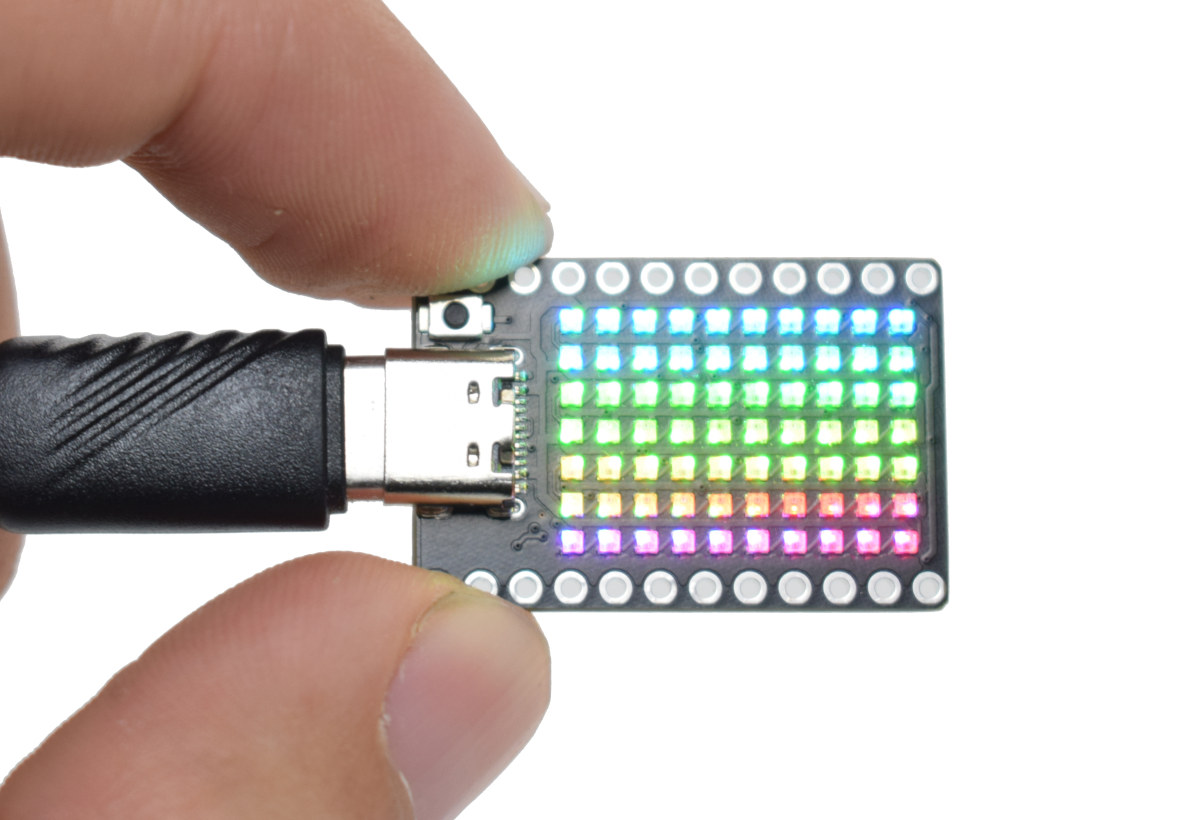
Waveshare’s RP2350-Matrix is a Raspberry Pi RP2350A-powered LED matrix board featuring 64 RGB LEDs (8×8 RGB matrix), a built-in 6-axis IMU, and a Dout pin in case the user needs even more LEDs. The RP2350-Matrix also includes 25 GPIOs along with 12 PIO state machines for custom peripheral support, an on-chip temperature sensor, accurate hardware timers, and support for low-power sleep and dormant modes. It comes with a USB Type-C port for power and programming via USB 1.1 device/host, and an onboard 800mA LDO regulator for stable power delivery. These features make this board suitable for motion sensing and visual feedback. Waveshare RP2350-Matrix Specifications: SoC – Raspberry Pi RP2350A CPU Dual-core Arm Cortex-M33 @ 150 MHz with Arm Trustzone, Secure boot OR Dual-core RISC-V Hazard3 @ 150 MHz Up to two cores can be used in any combination Memory – 520 KB on-chip SRAM Package – QFN-60 Storage – 16 MB […]
Getting Started with Quectel EC200U 4G LTE Cat 1 IoT board using the QNavigator and the QuecOpen SDK
CNXSoft: This is a guest post by Eicut showing how to get started with a Quectel EC200U 4G TLE Cat 1 IoT development board using QNavigator and the QuecOpen SDK. In IoT projects—and across embedded systems in general—we’ve seen a growing demand for higher data exchange rates, along with broader frequency band coverage. These advancements are critical for enhancing the reliability of a device’s communication link with the network. As a result, 4G modules with fallback capability to 2G and 4G networks have emerged as a leading solution in this space. But the key question remains: Which modules should we use to leverage this technology, and what features do they offer? Exploring the Quectel EC200U LTE Cat 1 Module for IoT In this section of the EC200U tutorial, we’ll take a closer look at one of the most popular and dependable options in the IoT space—Quectel’s EC200U module. If you’ve […]