While most people use Linux on Arm SBCs, it’s typically possible to run Windows 11 on Arm boards with UEFI support, but with caveats such as the GPU and VPU not working and other issues. One solution is to avoid the Arm architecture altogether and go with an x86 SBC like the Radxa X4, ODROID-H4+, or LattePanda IOTA, among others. But things may change for the better now that Qualcomm SBCs are becoming a thing, and Radxa has just announced official Windows support for the Radxa Dragon Q6A. Note that it is only a preview image for now. Nevertheless, here’s what is working without installing additional drivers on Windows 11: HDMI output (inherited from UEFI GOP) PCIe – Note: NVMe available; system does not include network card drivers eMMC flash UFS USB 2.0 USB 3.0, but devices must be connected before booting into the system But once you install drivers, […]
Linux 6.18 LTS release – Main changes, Arm, RISC-V, and MIPS architectures
Linus Torvalds has just announced the release of Linux 6.18 on the Linux Kernel Mailing List (LKML), which will likely become the next LTS kernel [update: it’s now official]: So I’ll have to admit that I’d have been happier with slightly less bugfixing noise in this last week of the release, but while there’s a few more fixes than I would hope for, there was nothing that made me feel like this needs more time to cook. So 6.18 is tagged and pushed out. Most of the last-minute fixes are minor fixes to drivers, with some random noise elsewhere (bluetooth, ceph, afs..). Nothing strikes me as standing out, but hey, there’s a shortlog appended if you want to see the details. And this obviously means that the merge window will open tomorrow, and I already have three dozen pull requests pending. Thanks. And as I already mentioned a couple of […]
The Librephone project aims to remove proprietary blobs from smartphones running an open-source OS
Some of you may already be running an open-source operating system on your smartphone, which could be Android-based, such as LineageOS, GrapheneOS, and e/OS, or Linux-based like postmarketOS and Ubuntu Touch. However, due to closed-source firmware files/proprietary blobs, you’re only running a partially open-source OS. The Free Software Foundation aims to change that with the Librephone project, whose goal is to reverse-engineer nonfree blobs and provide open-source alternatives. Some proprietary blobs are used to run WiFi, Bluetooth, 4G LTE/5G modems, touchscreen, fingerprint sensor, and other hardware. So it won’t be a trivial task, as serious reverse-engineering work is needed and done in a clean-room way to prevent copyright lawsuits, plus there may be regulatory issues with the code handling the radios\ frequency and power from the FTC and other governmental agencies around the world. To be clear, the Librephone project won’t be another operating system, and the only goal is […]
FourThirdsEye is an open-source hardware 10.7MP IMX294 camera module for the Raspberry Pi 5/CM4
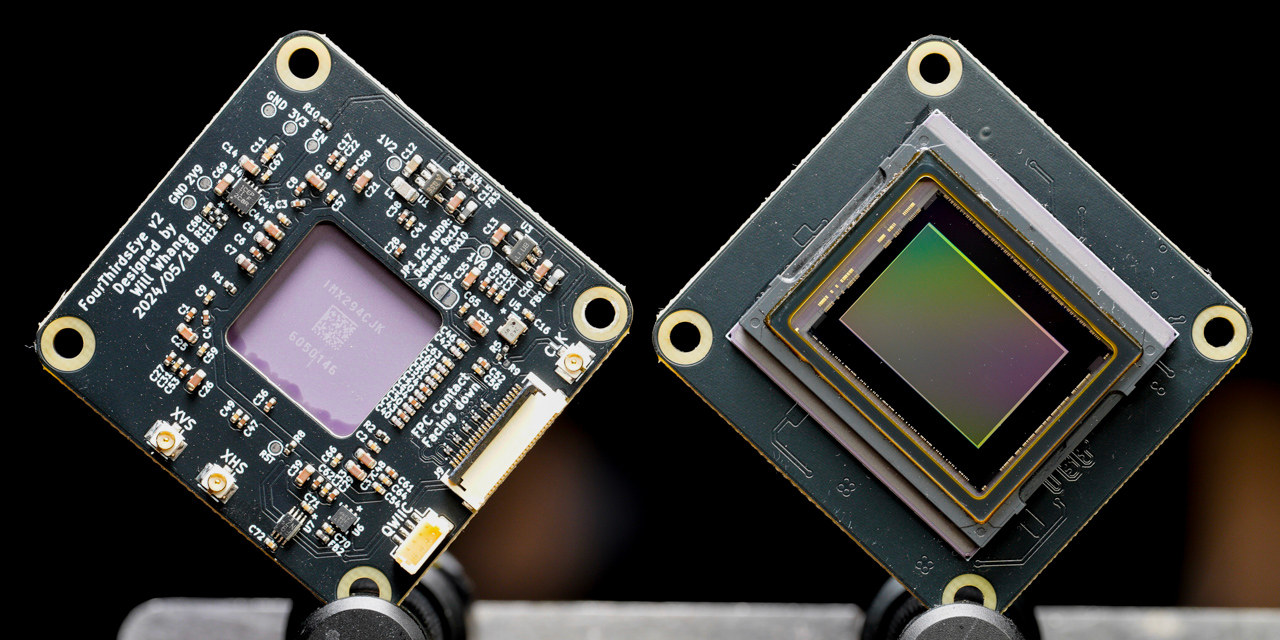
Will Whang’s FourThirdsEye project is an open-source hardware camera module designed for Raspberry Pi 5 SBC and Raspberry Pi Compute Module 4 SoM using a Sony IMX294 Type 4/3 CMOS image sensor. The camera module can capture 10.7 MP images and 4K (4096 x 2160) videos with improved low-light performance and dynamic range (4.63 μm pixel size) compared to existing Raspberry Pi camera modules. Will claims it’s perfect for photography enthusiasts, developers, and makers who want a more powerful camera for their Raspberry Pi projects. FourThirdsEye camera module specifications: Sony IMX294 sensor Output image size – Diagonal 21.63 mm (Type 4/3) aspect ratio 17:9 & 4:3 Number of effective pixels 4168 (H) × 2176 (V) approx. 8.93M pixels (aspect ratio 17:9) 3792 (H) × 2824 (V) approx. 10.71M pixels (aspect ratio 4:3) Unit cell size – 4.63 μm (H) × 4.63 μm (V) Optical blacks Horizontal – Front: 0 pixels, […]
Linux 6.9 release – Main changes, Arm, RISC-V, and MIPS architectures
Linus Torvalds has just announced the release of Linux 6.9 on LKML: So Thorsten is still reporting a few regression fixes that haven’t made it to me yet, but none of them look big or worrisome enough to delay the release for another week. We’ll have to backport them when they get resolved and hit upstream. So 6.9 is now out, and last week has looked quite stable (and the whole release has felt pretty normal). Below is the shortlog for the last week, with the changes mostly being dominated by some driver updates (gpu and networking being the big ones, but “big” is still pretty small, and there’s various other driver noise in there too). Outside of drivers, it’s some filesystem fixes (bcachefs still stands out, but ksmbd shows up too), some late selftest fixes, and some core networking fixes. And I now have a more powerful arm64 machine […]
Linux 6.6 LTS release – Highlights, Arm, RISC-V and MIPS architectures
The Linux 6.6 release has just been announced by Linus Torvalds on the Linux Kernel Mailing List (LKML): So this last week has been pretty calm, and I have absolutely no excuses to delay the v6.6 release any more, so here it is. There’s a random smattering of fixes all over, and apart from some bigger fixes to the r8152 driver, it’s all fairly small. Below is the shortlog for last week for anybody who really wants to get a flavor of the details. It’s short enough to scroll through. This obviously means that the merge window for 6.7 opens tomorrow, and I appreciate how many early pull requests I have lined up, with 40+ ready to go. That will make it a bit easier for me to deal with it, since I’ll be on the road for the first week of the merge window. Linus About two months ago, […]
Linux 6.4 release – Main changes, Arm, RISC-V and MIPS architectures
Linux 6.4 has just been released by Linus Torvalds on the Linux Kernel Mailing List (LKML): Hmm. Final week of 6.4 is done, and we’ve mainly got some netfilter fixes, some mm reverts, and a few tracing updates. There’s random small changes elsewhere: the usual architecture noise, a number of selftest updates, some filesystem fixes (btrfs, ksmb), etc. Most of the stuff in my mailbox the last week has been about upcoming things for 6.5, and I already have 15 pull requests pending. I appreciate all you proactive people. But that’s for tomorrow. Today we’re all busy build-testing the newest kernel release, and checking that it’s all good. Right? Released around two months ago, Linux 6.3 brought us AMD’s “automatic IBRS” Spectre defense mechanism, additional progress on the Rust front with User-mode Linux support (on x86-64 systems only), the NFS filesystem (both the client and server sides) gained support for […]
Panfrost now offers a fully-conformant OpenGL ES 3.1 implementation for Mali-G57 (Valhall) GPU
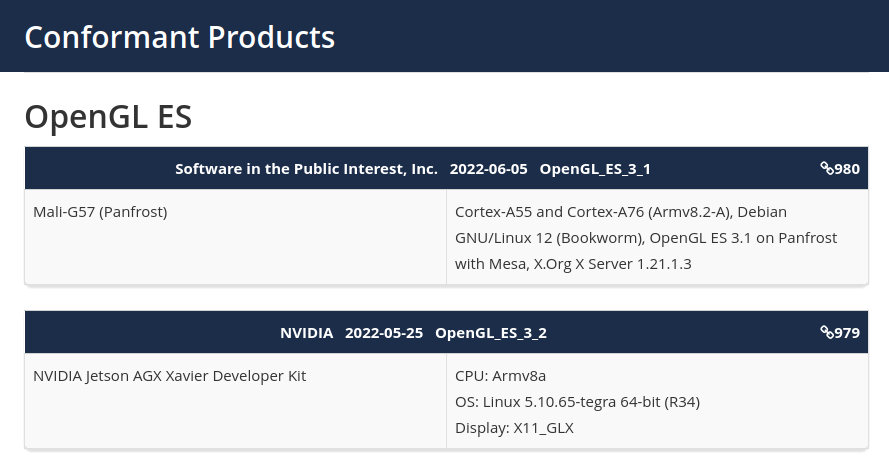
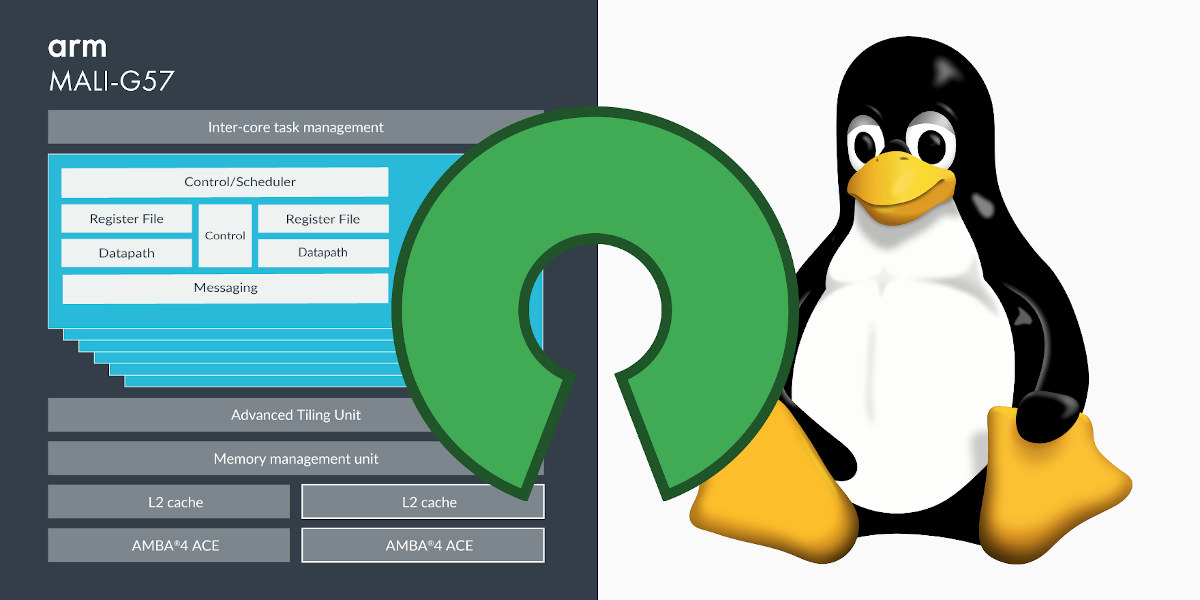
The Mali-G57 GPU part of the Valhall family, and found in several Arm processors such as MediaTek MT8192 and MT8195 SoC powering some Chromebooks, is now supported by the Panfrost open-source driver with a fully-conformant OpenGL ES 3.1 implementation. Last year, Collabora updated Panfrost with support for OpenGL ES 3.1 on Midgard (Mali T760 and newer) and Bifrost (Mali G31, G52, G76) GPUs, and also announced having started working on Valhall GPUs. One part of the work was done in the summer of 2021 with some reverse-engineering work on Mali-G78 GPU’s instruction set, and this has culminated with a fully-conformant OpenGL3.1 for Mali-G57 GPU. Interestingly, it’s not been released by Collabora directly, but through an organization called “Software in the Public Intenerest, Inc.” (or SPI for shorts) which happens to be a non-profit organization incorporated on June 16, 1997, and described as: a non-profit corporation registered in the state of […]