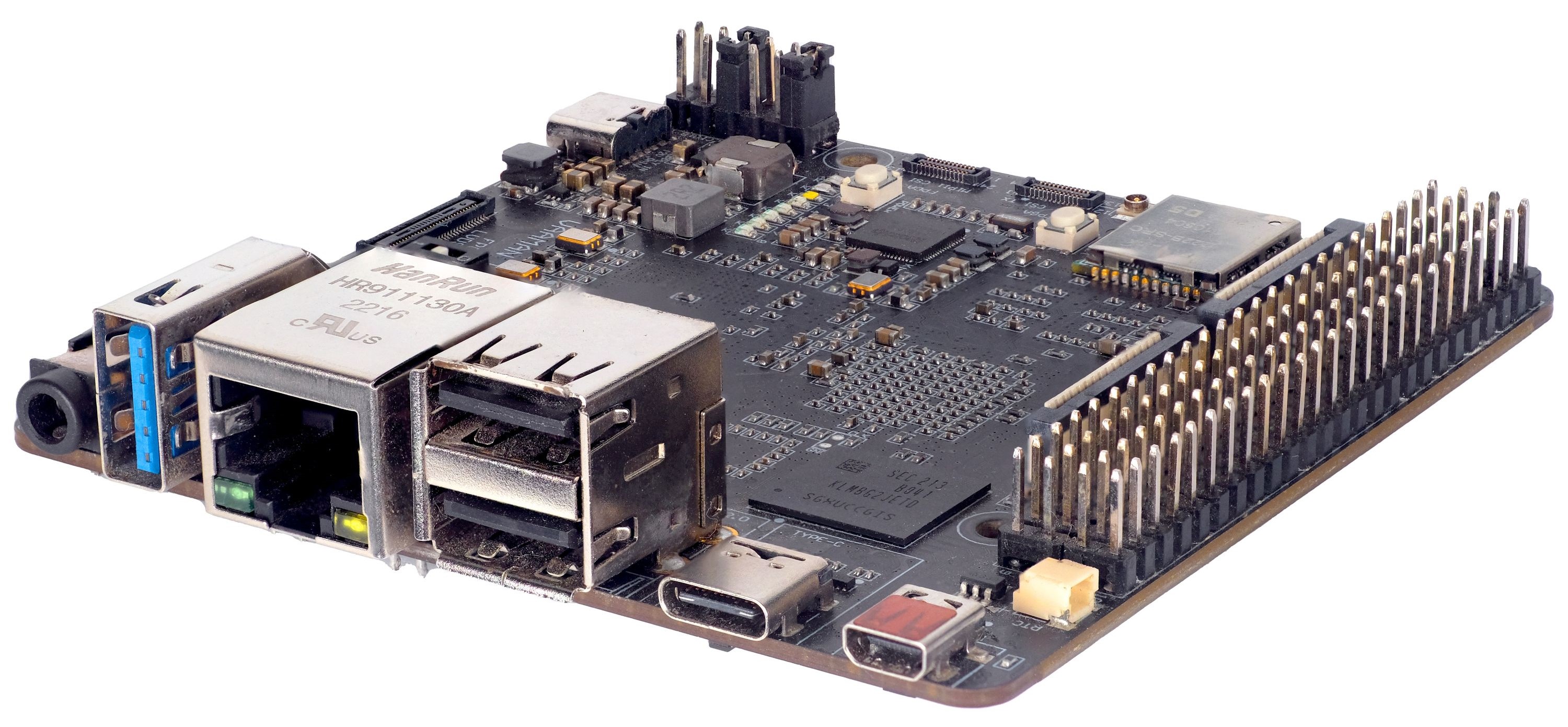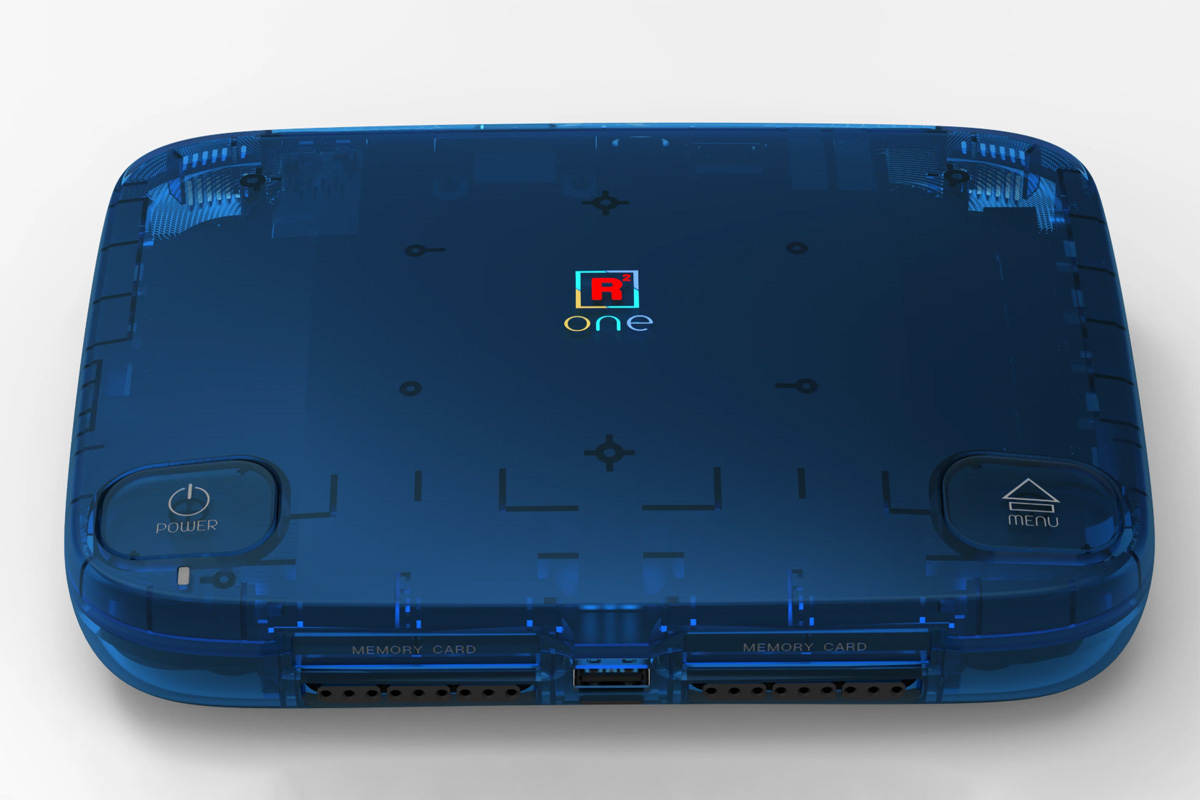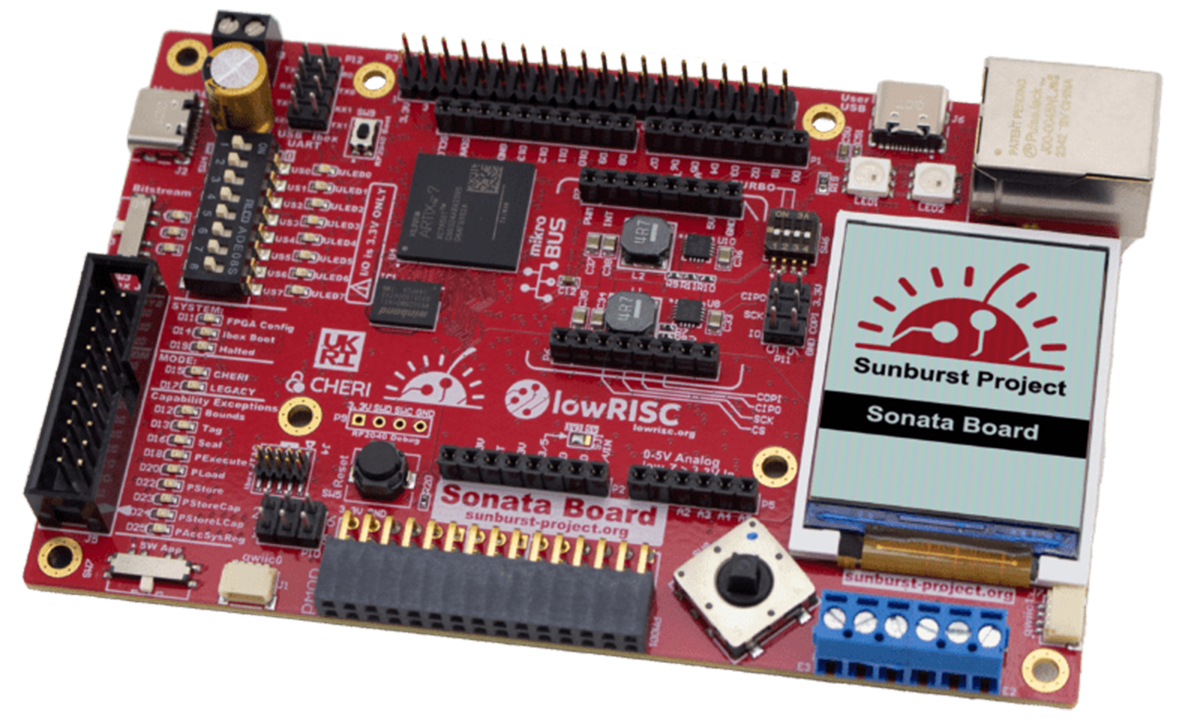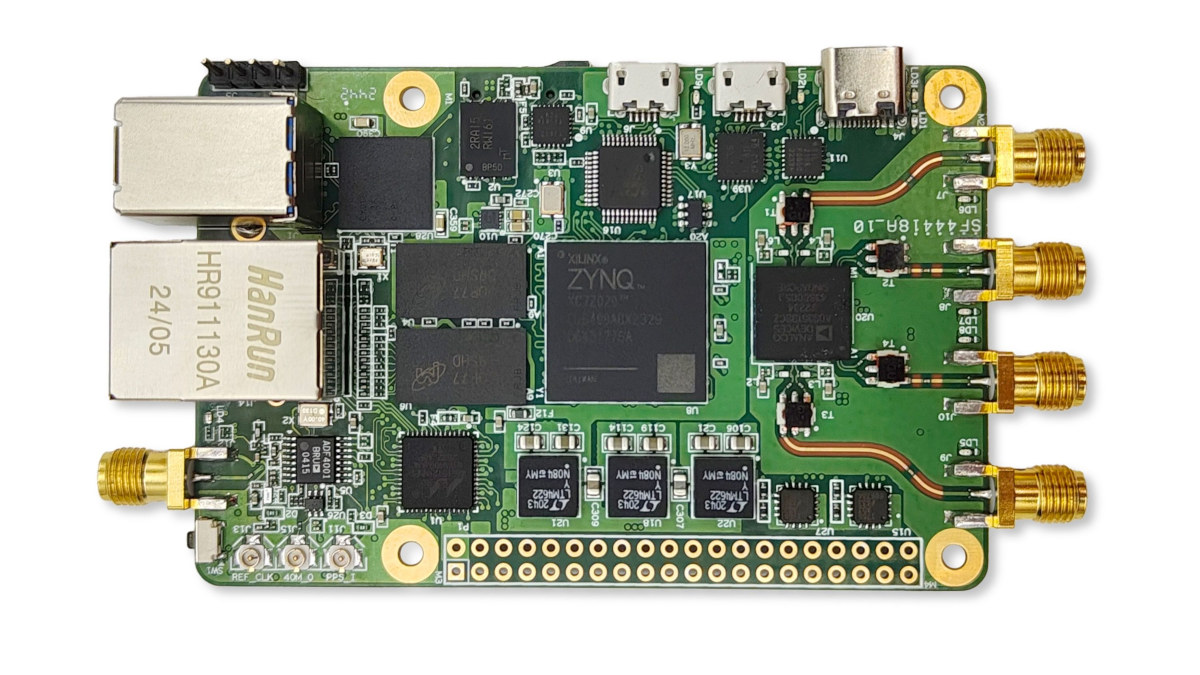
The Icepi Zero is a compact Lattice ECP5 FPGA open-source hardware development board following the Raspberry Pi Zero form factor, and equipped with a microSD card slot, three USB-C ports, a GPDI mini connector for video output, and a 40-pin GPIO header. I was confused at first, since Debashis wrote about the Pico2-ice board a few days ago, but it’s a different design with an RP2350B MCU and a Lattice ICE40U5K FPGA with 5.3K LUTs. Made by Icy Electronics, the Icepi Zero is a pure FPGA board with 24K LUTs, 32MB SRAM, and 16MB QSPI flash that can be used for retro gaming/computer and general FPGA gateware experimentation. Icepi Zero specifications: FPGA – Lattice Semi ECP5U 24k LUTs 112 KiB of RAM 28x 18 x 18 Multipliers Memory – 256 Mbit (32 MB) of 166 MHz SDRAM Storage 128 Mbit (16 MB) of QSPI Flash microSD card slot Video Output […]
Pico2-Ice development board combines Raspberry Pi RP2350B with Lattice iCE40UP5K FPGA
tinyVision.ai has recently released the second-generation ot its open-source hardware pico-ice FPGA development board, upgrading the Raspberry Pi RP2040 to the newer RP2350B along with dedicated user LEDs and buttons for both the MCU and the FPGA. The Pico2-Ice also exposes the RP2350B’s HSTX interface through a 22-pin connector, while keeping the same Lattice iCE40UP5K FPGA. The onboard iCE40UP5K FPGA features 5.3k LUTs, 1 MB SPRAM, and 120 KB DPRAM, along with 4MB SPI flash and 8MB low-power PSRAM. The board also exposes all RP2350 pins and 32 FPGA GPIOs via 2.54mm pitch headers in Pmod format. It includes two RGB LEDs and two pushbuttons (separately mapped to the MCU and the FPGA), and integrates onboard 3.3V/1.2V regulators for power. These features make this board suitable for exploring HDLs, embedded systems, and FPGA programming with open-source tools. Pico2-Ice specifications: Microcontroller – Raspberry Pi RP2350B MCU CPU – Dual-core Arm Cortex-M33 processor @ […]
FPGA-based Modos Paper Dev Kit supports a wide range of E-Ink displays, up to 75 Hz refresh rate (Crowdfunding)
Modos Paper Dev Kit helps users create an open-hardware E-Ink monitor with a fast 75 Hz refresh rate and low latency thanks to a Xilinx Spartan-6 FPGA driver board, and compatibility with a wide and of E-Ink displays between 4-inch and 42-inch in size. The resulting grayscale or color E-ink monitor can be connected through HDMI or USB and works on Linux, macOS, and Windows. Modos Paper driver board specifications: FPGA – AMD/Xilinx Spartan-6 LX16 FPGA running Caster gateware Memory – DDR3-800 framebuffer memory MCU – STMicro STM32H750 Arm Cortex-M7 microcontroller for USB communication, firmware upgrades, and standalone applications. Processing rate up to 133 MP/s when error-diffusion dithering is enabled, and 200 MP/s when disabled Supported Displays – 4-inch to 42-inch E-Ink displays without integrated TCON; See long list on GitHub Video Input USB Type-C DisplayPort Alt-Mode with on-board PTN3460 decoder microHDMI connector for DVI video input with on-board ADV7611 […]
FPGA-based Commodore 64 Ultimate keyboard PC is compatible with original C64 games
The last original Commodore 64 keyboard computer was sold in 1994, and since then, the Commodore brand and assets have been owned by various companies over the years, until YouTuber Christian Simpson (Perifractic) bought all assets earlier this year to revive the brand and launch the Commodore 64 Ultimate. The Commodore 64 Ultimate is based on an AMD Xilinx Artix-7 FPGA coupled with 128MB RAM and 16MB NOR flash, and can emulate the original computer, giving access to over 10,000 games and programs made for the original C64 computer. The new computer is a mix of old interfaces with analog outputs for CRT TVs, cartridges, SID sockets, and disk drives, and more recent ones, such as HDMI, WiFi, USB, and more. Commodore 64 Ultimate specifications: FPGA – AMD Xilinx Artix-7 FPGA System Memory – 128MB DDR2 RAM Storage 16MB NOR flash Internal microSD card slot Support for USB flash drives […]
Red Pitaya STEMlab 125-14 PRO Gen 2 is an AMD Zynq 7010/7020-based board for measurement, control, and signal processing
The Red Pitaya board was first introduced in 2013 as an Xilinx Zynq 7010 SoC FPGA board designed as a high-performance tool acting as an oscilloscope, spectrum analyser, waveform generator, and more. I hadn’t heard about the company much this then, but they must have been doing alright, since Red Pitaya has just started taking pre-orders for the STEMlab 125-14 PRO Gen 2 Starter Kit based on the same AMD Zynq-7010 SoC FPGA, and the STEMlab 125-14 PRO Z7020 Gen 2 Starter Kit with a more powerful Zynq-7020 device. STEMlab 125-14 PRO Gen 2 specifications: SoC FPGA (one or the other) Xilinx Zynq 7010 CPU – Dual-core Cortex-A9 clocked up to 667 MHz FPGA fabric – 28K logic cells, 80x DSP slices Memory – 2.1 Mbit block RAM Xilinx Zynq 7020 CPU – Dual-core Arm Cortex-A9 processor FPGA – 85K logic cells, 220x DSP slices Memory – 4.9 Mbit Block […]
Atum A3 Nano development board combines Agilex 3 FPGA and USB-Blaster III programmer (Crowdfunding)
Terasic’s Atum A3 Nano is a compact FPGA development board built around Altera’s largest Agilex 3 FPGA (A3CZ135BB18AE7S). The FPGA features 135K logic elements, embedded memory blocks (6.89 Mbit M20K, 1.4 Mbit MLAB), and 368 multipliers, making it suitable for demanding applications such as robotics, automotive systems, smart city infrastructure, consumer electronics, and advanced image processing. Measuring just 85 x 70 mm, the Atum A3 Nano board includes 64 MB SDRAM, Gigabit Ethernet, HDMI output, a microSD card slot, and an onboard USB-Blaster III programmer accessible via a USB Type-C port. Expansion options include a 40-pin GPIO header and two PMOD headers, and the board also features user I/Os like LEDs, buttons, and switches. Additionally, it supports add-ons such as displays, cameras, wireless modules, and motor control kits. Atum A3 Nano specifications: FPGA – Altera Agilex 3 A3CZ135BB18AE7S 135,110 logic elements 6.89 Mbit M20K, 1.4 Mbit MLAB 368 18×19 multipliers 4 I/O […]
Sipeed Tang Console – A GOWIN GW5AST/GW5AT board with 60K or 138K LUT for FPGA development and retro gaming
Sipeed Tang Console is an FPGA development based on GOWIN GW5AST SoC FPGA with 138K LUTs and a hard RISC-V core or GW5AT FPGA with 60K LUTs, designed as a generic FPGA development and retro gaming platform. The Tange Console offers HDMI and RGB LCD display connectors, two USB ports for joystick or other peripherals, and plenty of expansion options with two 40-pin headers for SDRAM, GBA, and custom expansion, two PMOD connectors for joysticks or custom modules, and a 16-pin Raspberry Pi PCIe FFC connector. The “Tang Console” is also integrated into the “Tang Retro Console” as a complete gaming console kit with enclosure, joysticks, and accessories. Sipeed Tang Console specifications: SoM(one or the other) Sipeed Tang Mega 138K SoC FPGA – GOWIN GW5AST-LV138FPG484A with 138,240 LUT4 1,080 Kb Shadow SRAM (SSRAM) 6,120 Kb Block SRAM (BSRAM) Number of BSRAM – 340 298x DSP slices 12x PLLs 16x global […]
Tiliqua – An hackable Lattice ECP5 FPGA-based audio multitool for Eurorack (Crowdfunding)
Tiliqua is a Lattice ECP5 FPGA multitool board designed for audio and visual synthesis and compatible with the Eurorack modular synthesizer format. The board features four audio input jacks and four audio output jacks, all of which can be used as touch-sensitive inputs when not connected. Other interfaces include a USB 2.0 Host/Device port, MIDI support, two PMOD expansion connectors, and a display interface to connect the Tiliqua screen for visual effects. All those features make it suitable for audio-rate modulation, low-latency effects, video synthesis, high-speed USB audio, or emulating retro hardware. Tiliqua specifications: FPGA – Lattice ECP5 (LFE5U-25F-6BG256) FPGA supported by the open-source FPGA flow System Memory – 32MB PSRAM (tested up to 200MHz DDR / 400MB/s) Storage 16MB SPI flash for the FPGA 16MB SPI flash for the Raspberry Pi RP2040 2Kbit I2C EEPROM: for storing calibration constants Video Output – Digital video GPDI (General Purpose Differential Interface) […]