XyphroLabs’s UsbGpib is an open-source hardware, inexpensive, and portable USB to GPIB adapter aiming to provide “access to legacy GPIB/IEEE-488 instruments using contemporary hardware and software, with a focus on accessibility, openness, and ease of integration into current workflows”. Initially developed by Hewlett-Packard in the late 1960s/early 1970s, GPIB (General Purpose Interface Bus), also known as IEEE-488 or initially HP-IB (Hewlett-Packard Interface Bus), is a short-range digital communications bus standard designed for connecting and controlling programmable electronic test and measurement instruments such as oscilloscopes, multimeters, and power supplies to computers or controllers. The UsbGpib project helps connect GBIP-compliant equipment to modern host computers with a USB port. UsbGpib key hardware features and specifications: Microcontroller – Microchip ATMega32U4 8-bit AVR microcontroller for 5V I/O compatibility USB – USB Type-C port with full USBTMC (USB Test and Measurement Class) support 24-pin GPIB interface – Fully IEEE-488.1 and IEEE-488.2 enabled, including service request […]
ESP-Scope is a web-based oscilloscope built using the ESP-IDF framework and Gemini 3 LLM
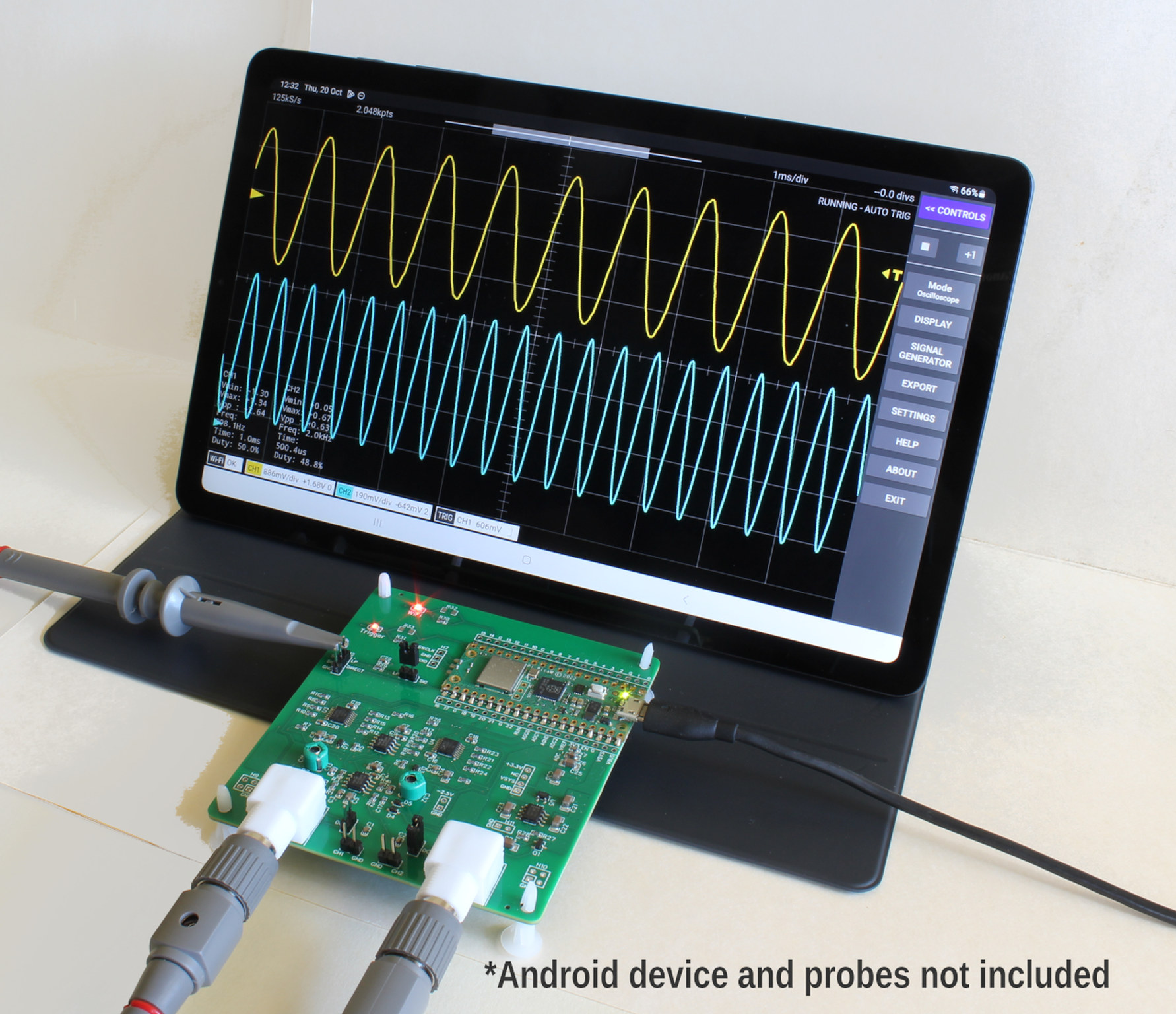
ESP-Scope is an open-source firmware transforming any ESP32 board into an oscilloscope using one of the ADC pins up to 83,333 Hz sample rate (on the ESP32-C6) and visualizing the results over Wi-Fi in a web browser, be it Google Chrome, Mozilla Firefox, or others. It’s not the first ESP32 oscilloscope project we’ve seen, as last year, we covered Bojan Jurca’s “Esp32_oscilloscope” Arduino sketch doing something very similar. The ESP-Scope is a little different, since it’s based on the ESP-IDF framework, and was used to test AI code generators, specifically “Google Antigravity using Gemini 3, with refinements, hints and tips and overall design specified by a human”. It just took a few hours to build. ESP-Score firmware features: Real-time signal visualization on a web browser. Adjustable sample rate (1-83333 Hz) and attenuation. Crosshair functionality for precise measurements Adjustable trigger level Test signal generation Reset functionality to clear settings and reload […]
Digilent Analog Discovery Studio Max – A 14-in-1 portable electronics trainer kit with four breadboards
The Analog Discovery Studio Max (ADS Max) is an all-in-one electronics trainer kit with four breadboards developed by Digilent for academic and engineering experimentation. Designed for both classroom and remote learning, it combines the functionality of 14 essential instruments into one, making it ideal for circuit design, signal analysis, and embedded systems education. The instruments include an oscilloscope, waveform generator, logic and spectrum analyzers, DMM, programmable and static power supplies, and a protocol analyzer. It supports WaveForms software, LabVIEW, C, and Python for control and data analysis. With a 100 MS/s, 14-bit oscilloscope, ±15 V power supplies, 16 digital I/O channels, and WaveForms SDK, it provides a complete learning and experimentation ecosystem. Analog Discovery Studio Max specifications: Core Instruments Oscilloscope 4x single-ended BNC channels, 14-bit resolution (16-bit with averaging) ±25 V input range (50 V p-p max), 50 MHz @ –3 dB bandwidth 100 MS/s per channel, 1 MΩ ‖ […]
Red Pitaya STEMlab 125-14 PRO Gen 2 is an AMD Zynq 7010/7020-based board for measurement, control, and signal processing
The Red Pitaya board was first introduced in 2013 as an Xilinx Zynq 7010 SoC FPGA board designed as a high-performance tool acting as an oscilloscope, spectrum analyser, waveform generator, and more. I hadn’t heard about the company much this then, but they must have been doing alright, since Red Pitaya has just started taking pre-orders for the STEMlab 125-14 PRO Gen 2 Starter Kit based on the same AMD Zynq-7010 SoC FPGA, and the STEMlab 125-14 PRO Z7020 Gen 2 Starter Kit with a more powerful Zynq-7020 device. STEMlab 125-14 PRO Gen 2 specifications: SoC FPGA (one or the other) Xilinx Zynq 7010 CPU – Dual-core Cortex-A9 clocked up to 667 MHz FPGA fabric – 28K logic cells, 80x DSP slices Memory – 2.1 Mbit block RAM Xilinx Zynq 7020 CPU – Dual-core Arm Cortex-A9 processor FPGA – 85K logic cells, 220x DSP slices Memory – 4.9 Mbit Block […]
Haasoscope Pro open-source, real-time sampling USB oscilloscope supports up to 2GHz bandwidth (Crowdfunding)
The Haasoscope Pro is an open-source hardware, high-bandwidth, and real-time sampling USB oscilloscope. Building upon its predecessor, the Haasoscope, the new Pro model offers a bandwidth of 2GHz, 12-bit resolution, and a 3.2GS/s sampling rate. The Haasoscope Pro USB oscilloscope is “designed to be low cost, while maintaining super-fast performance.” While it only comes with 2 channels, the flexible design makes it possible to combine and sync multiple devices (using Cat5 cables) to double the sample rate or add more channels. The oscilloscope works with standard x10 passive probes but a custom active probe, the Haasoscope Pro-be, is also offered. It supports the full 2GHz analog bandwidth and is priced much cheaper than similar probes. The Haasoscope Pro USB oscilloscope’s high sampling rate and bandwidth make it ideal for radio frequency signal analysis and high-speed digital debugging. It is similar to the ThunderScope Thunderbolt and PCIe oscilloscope which offers more […]
ThunderScope is an open-source Thunderbolt and PCIe oscilloscope with a 1 GS/s data sampling rate (Crowdfunding)
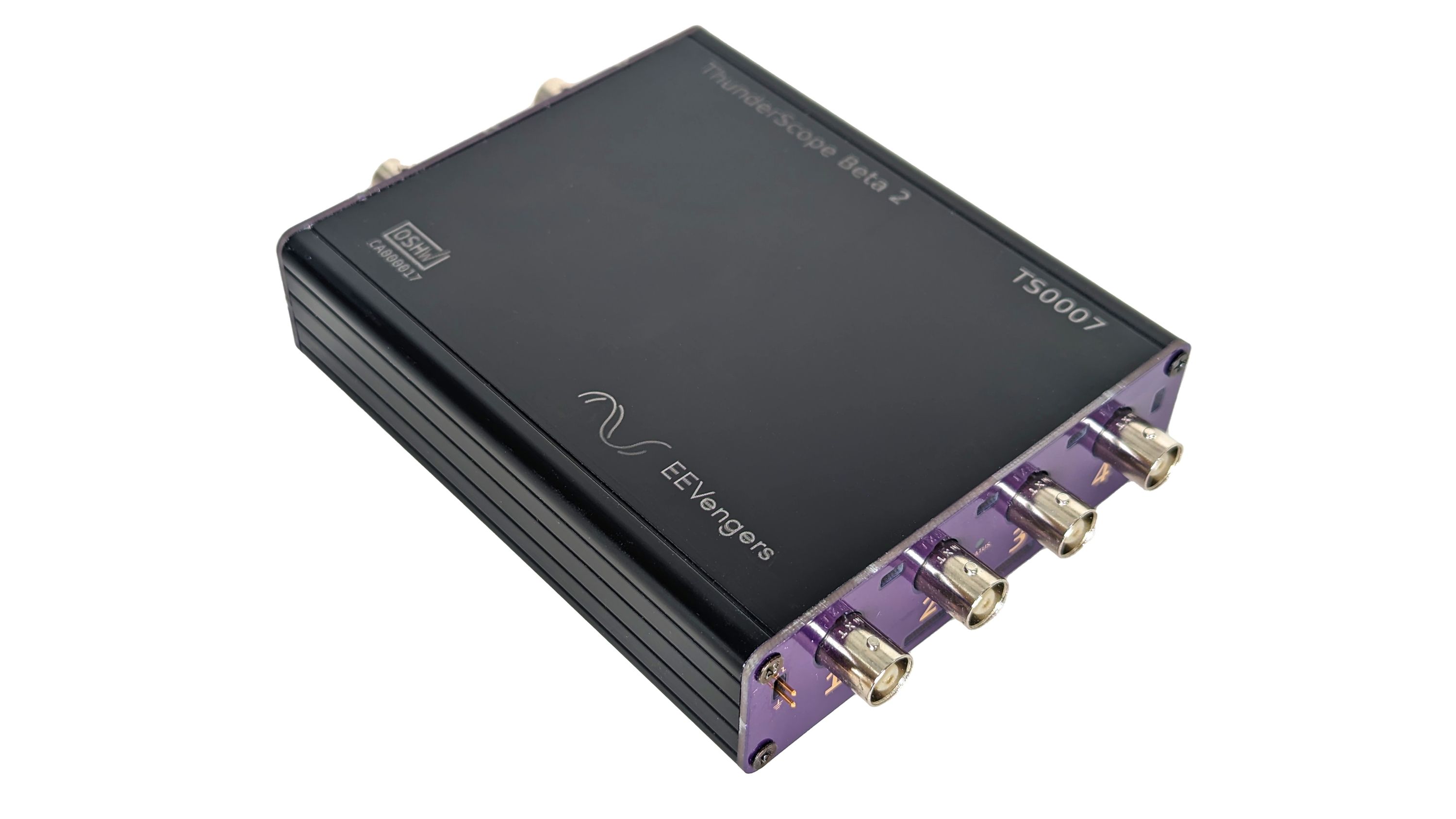
The ThunderScope is an open-source, Thunderbolt/USB4 and PCIe oscilloscope with a sampling rate of up to 1 GS/s. It is portable, presents an affordable, open-source alternative to expensive bench-top and PC-based scopes, and delivers a higher sampling rate than most USB oscilloscopes. ThunderScope streams sample data to your computer for processing and analysis, unlike traditional oscilloscopes which “are limited by their built-in processing capabilities and cramped user interfaces.” It uses the fastest available interface, Thunderbolt, to stream data, allowing it to use your computer’s full potential. ThunderScope is “the only scope that will get better every time you upgrade your computer.” The Thunderbolt oscilloscope is based on AMD’s Artix 7 XC7A35T-2CSG325C FPGA. It supports up to four channels and a full analog bandwidth of 500 MHz (with the anti-aliasing filter disabled). It doesn’t require an external power source, as it is powered via the Thunderbolt port. It comes in a […]
Esp32_oscilloscope Arduino firmware turns your ESP32 board into a web-based oscilloscope
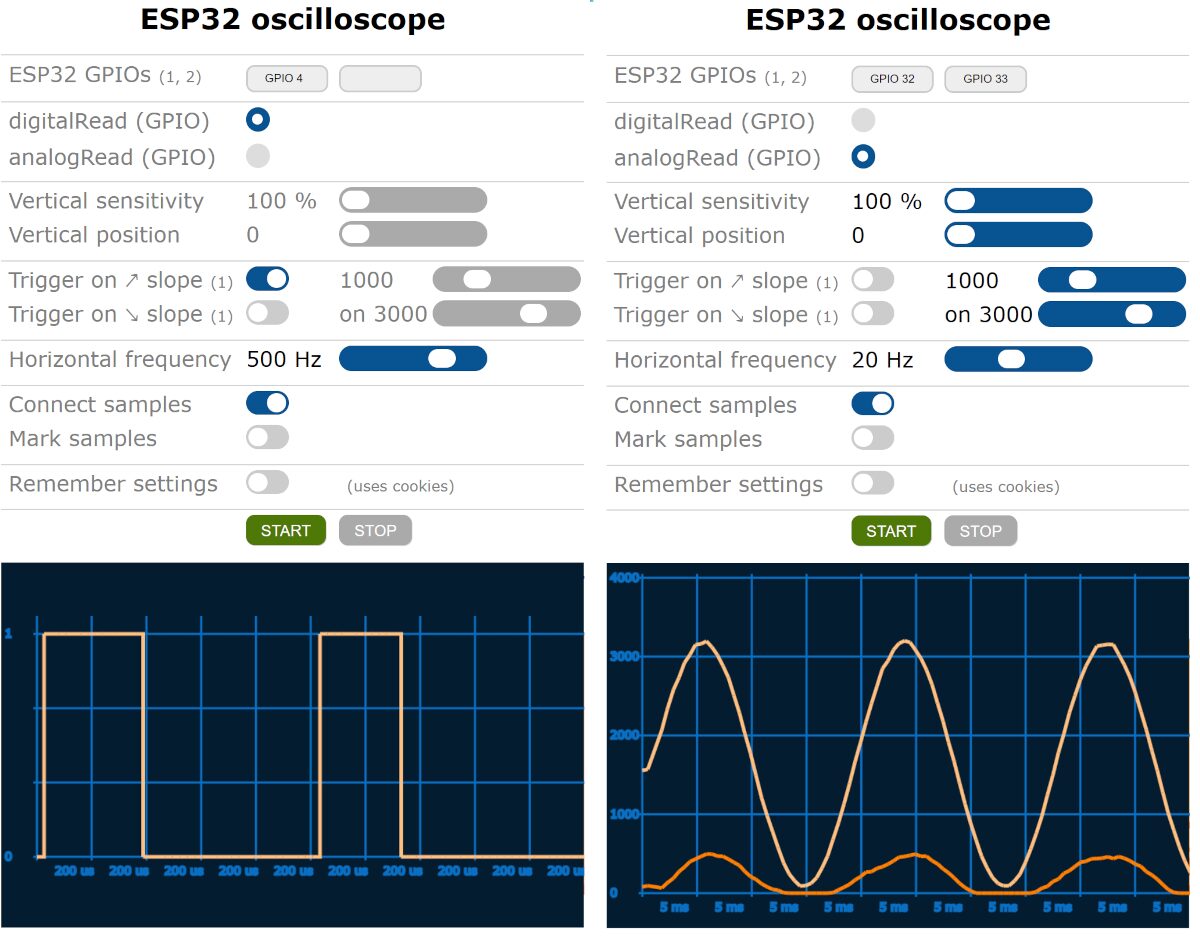
Bojan Jurca’s “Esp32_oscilloscope” is an open-source Arduino sketch that can transform an ESP32 board into a web-based oscilloscope that works over WiFi. We had also written about the Scoppy project to turn the Raspberry Pi Pico W into a 2-channel oscilloscope, but there’s no reason the more powerful ESP32-series microcontroller could not be used for the same purpose, and Bojan’s Esp32_oscilloscope project does just that and works with ESP32, ESP32-S2, ESP32-S3 and ESP32-C3 boards using the I2S interface for fast data sampling. The project was initially designed to demonstrate the multitasking abilities of the ESP32 microcontroller with Arduino, but this evolved into an ESP32 oscilloscope firmware. It works both with output/PWM and input signals, digital (0 or 1) and analog (0 to 4095) signals, and the web interface shows up to 736 samples per screen although the sampling rate may not be completely constant all the time. To install it […]
Analog Discovery 3 – A 125 MS/s USB oscilloscope, waveform generator, logic analyzer, and variable power supply
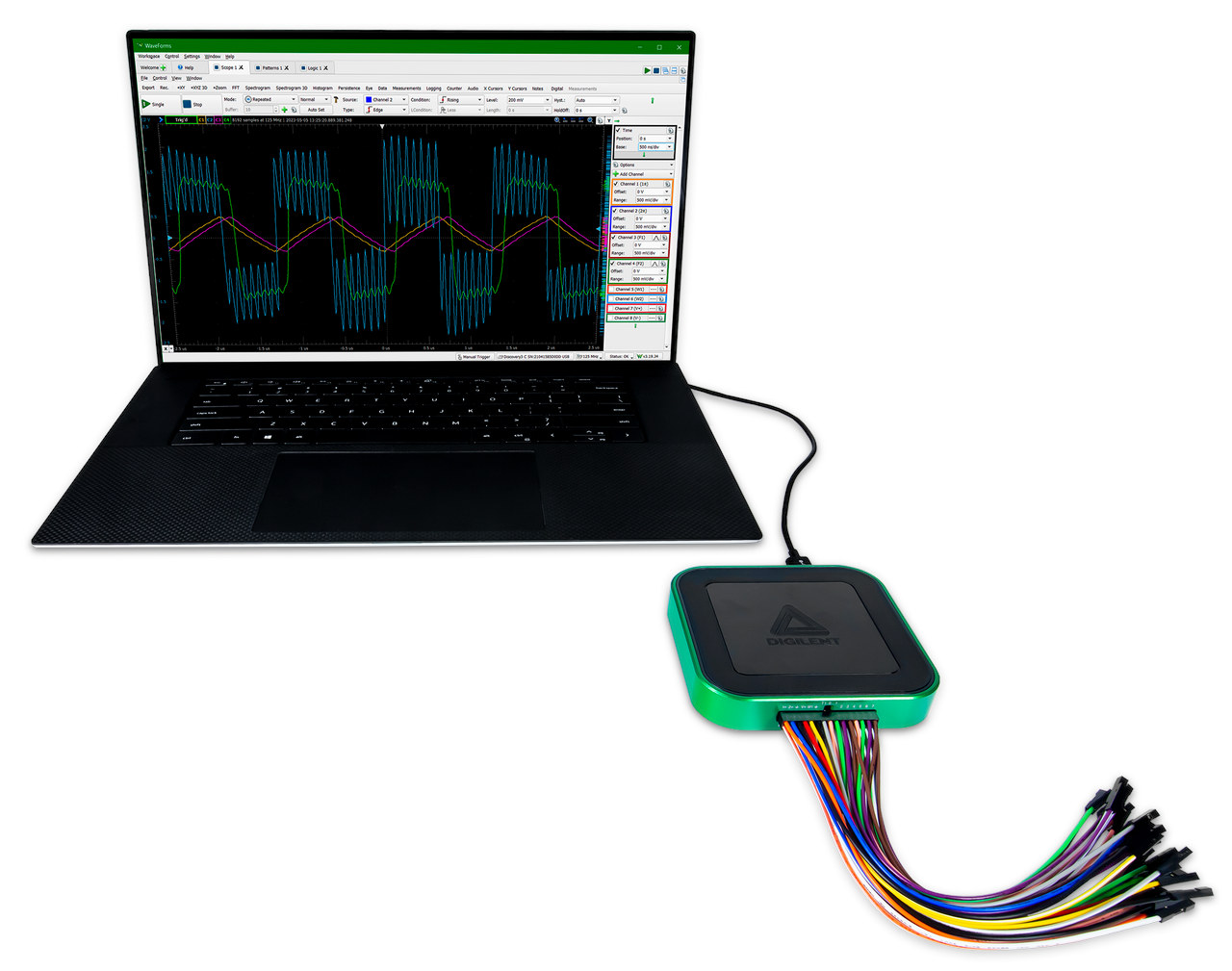
Digilent Analog Discovery 3 is a USB oscilloscope with a sample rate of up to 125 MS/s, that can also be used as a waveform generator, logic analyzer, and/or a variable power supply up to 5V. Several other features are also enabled through its software and the USB-C oscilloscope can also act as a spectrum analyzer, a network analyzer, an impedance analyzer, a protocol analyzer, a data logger, a voltmeter, and supports in-app scripting. Analog Discovery 3 features highlights: Xilinx FPGA-based design Host interface – USB Type-C port Oscilloscope 2x differential channels with 14-bit resolution at up to 125 MS/s per channel with a +/-25 V input range, 30+ MHz bandwidth with BNC Adapter User-configurable input filters and lock-in amplifier FFT, Spectrogram, Eye Diagram, XY Plot views, and more Arbitrary Waveform Generator 2x channels with 14-bit resolution at up to 125 MS/s per channel with a +/-5 V output range, […]