SMHUB Nano Mg24 compact Linux-based Zigbee/Thread Smart Hub combines SG2000 RISC-V SoC with MG24 wireless MCU

SMHUB Nano Mg24

SMLight’s SMHUB Nano Mg24 may look like the company’s earlier SLZB-06p Zigbee to Ethernet/WiFi/USB coordinators, but it’s a more powerful Linux-based Zigbee/Thread Smart Hub that pairs SOPHGO SG2000 RISC-V SoC with Silicon Labs MG24 multi-protocol wireless MCU. Unlike traditional Zigbee/Thread adapters that connect to a host through USB or Ethernet, the SMHUB Nano Mg24 is an all-in-one solution that runs all major automation apps directly on the device, eliminating the need for a Raspberry Pi, Mini PC, or other hardware server. SMHUB Nano Mg24 specifications: SoC – SOPHGO SG2000 CPU cores 1x C906 64-bit RISC-V core @ 1GHz or 1x Arm Cortex-A53 core @ 1GHz (selectable at boot) 1x C906 64-bit RISC-V core @ 700MHz MCU – 8051 8-bit microcontroller core @ 25 to 300 MHz with 6KB SRAM GPU – None VPU – H.265/H.264 video decoding and encoding (5M @ 30fps) ISP – 5M @ 30fps NPU – 0.5 TOPS Memory […]

Banana Pi BPI-CM6 – A SpacemiT K1 RISC-V system-on-module compatible with Raspberry Pi CM4/CM5 carrier boards

Banana Pi BPI-CM6 and carrier board

Banana Pi BPI-CM6 system-on-module (SoM) is powered by a SpacemiT K1 octa-core RISC-V processor and compatible with most carrier boards for the Raspberry Pi CM4 or CM5 modules. It ships with 8GB LPDDR4 and 16GB eMMC flash by default, a Gigabit Ethernet PHY, and a WiFi 5 and Bluetooth 4.1 wireless module. It exposes most interfaces through three 100-pin board-to-board connectors with HDMI 1.4, MIPI DSI, three MIPI CSI, five PCIe 2.1 lanes, USB 3.2/2.0 interfaces, and more. While it can work with Raspberry Pi CM4/CM5 carrier boards using two of the B2B connectors, the company also designed the BPI-CM6 IO carrier board to make full use of all the interfaces, especially the PCIe lanes. Banana Bi BPI-CM6 SoM Let’s check the module itself first. Banana Pi BPI-CM6 specifications: SoC – SpacemIT K1 CPU – 8-core X60 RISC-V (RV64GCVB) processor @ 1.6 GHz (roughly Cortex-A55 equivalent) GPU – Imagination IMG […]

Waveshare ESP32-P4 + ESP32-C6 PoE development board targets HMI and IoT applications

ESP32 P4 WIFI6 POE ETH

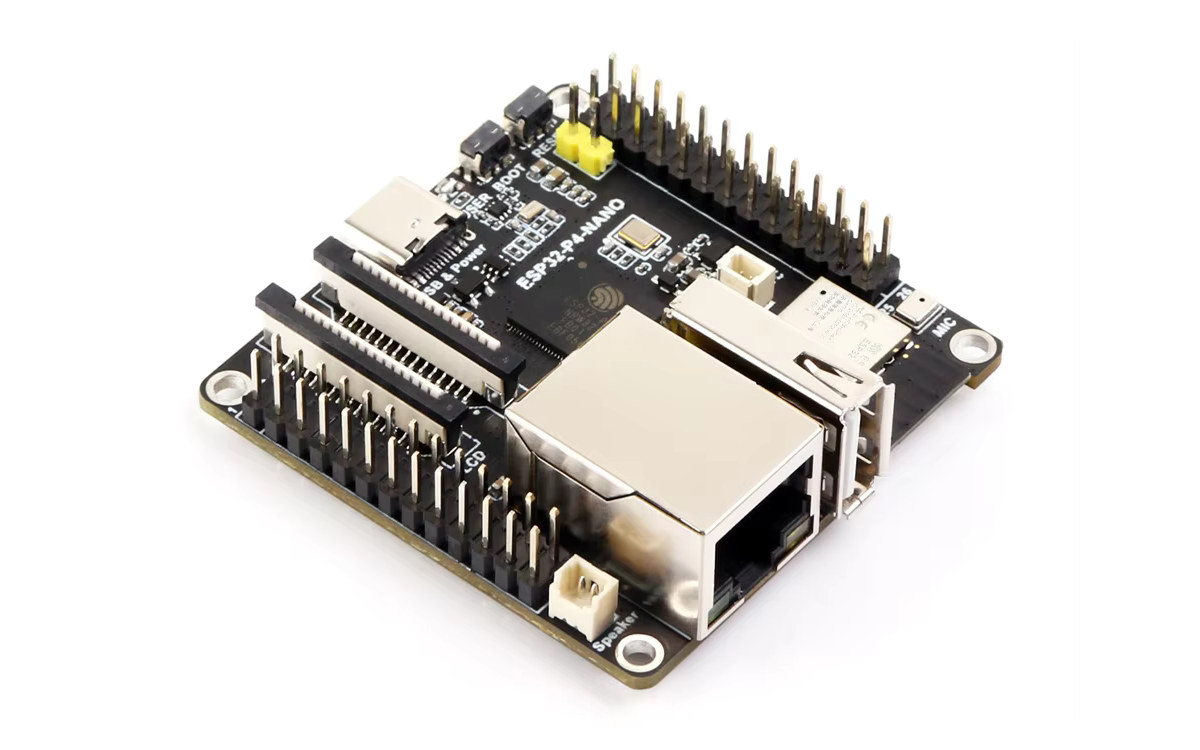
Waveshare has recently launched ESP32-P4-WIFI6-POE-ETH, a compact development board with Wi-Fi 6, Bluetooth 5 (LE), OTG, Ethernet, and PoE support, for various HMI and IoT applications. The board supports 100Mbps Ethernet with PoE, MIPI-CSI, MIPI-DSI, USB 2.0 OTG, audio codec + amplifier, microphone, MicroSD card slot, and 40-pin GPIO expansion. Other peripherals include I2S, I2C, SPI, UART, PWM, MCPWM, RMT, ADC, and TWAI, alongside security features like secure boot, flash encryption, crypto accelerators, TRNG, and privilege separation. These features make it suitable for HMI terminals, smart panels, multimedia control interfaces, local edge AI, and IoT gateways. Waveshare ESP32-P4-WIFI6-POE-ETH specifications: Wireless module – ESP32-P4-Core Microcontroller – ESP32-P4NRW32 MCU Dual-core RISC-V microcontroller @ 400 MHz with AI instructions extension and single-precision FPU Single-RISC-V LP (Low-power) MCU core @ up to 40 MHz GPU – 2D Pixel Processing Accelerator (PPA) VPU – H.264 and JPEG codecs support Memory – 768 KB HP L2MEM, […]

HUSKYLENS 2 – A 6 TOPS LLM and AI vision camera with self-learning capabilities

Huskylens 2 6 TOPS Edge AI camera

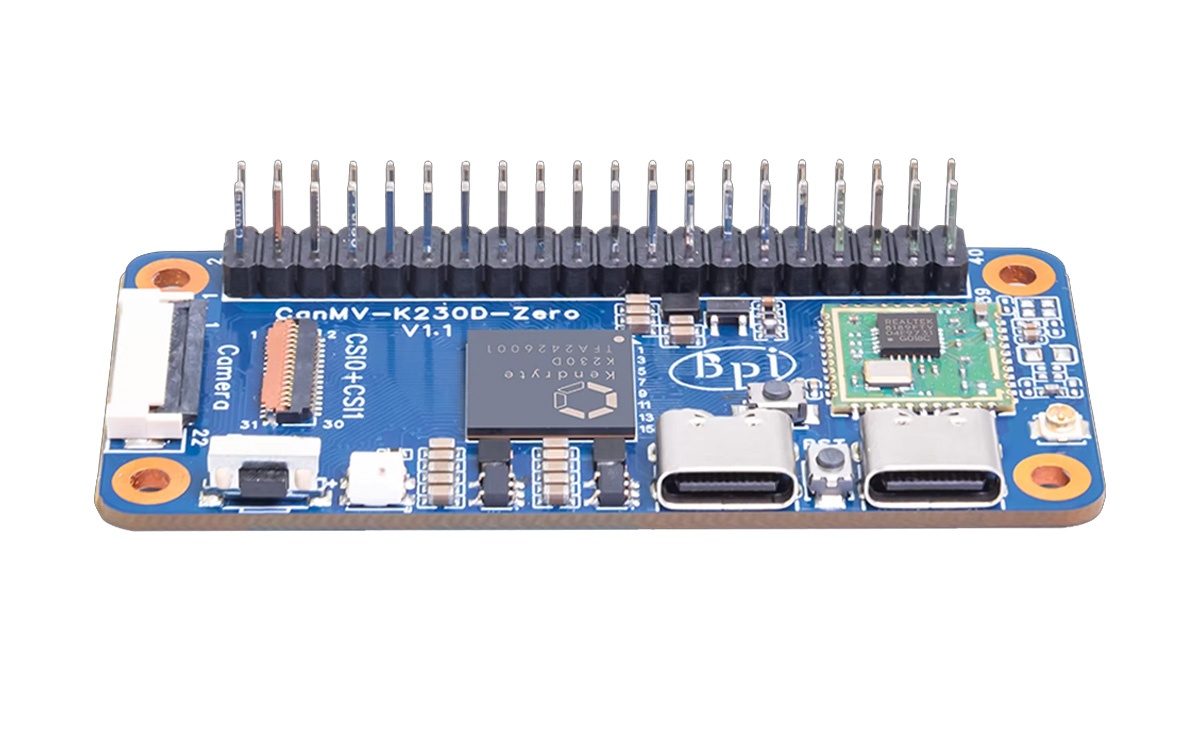
DFRobot HUSKYLENS 2 is an LLM and AI vision camera powered by a Kendryte K230 dual-core RISC-V SoC with a 6 TOPS AI accelerator and designed to be easy-to-use for makers, educators, competition teams, and AI enthusiasts. It provides an upgrade to the HUSKYLENS AI camera introduced in 2019 with the Kendryte K210 SoC. It features 1GB of LPDDR4, an 8GB eMMC flash, a microSD card slot, a 2MP camera sensor, a 4-pin Gravity expansion connector, and a USB-C port for power and programming. The company says the HUSKYLEN 2 comes preloaded with over 20 AI models, including object tracking, hand recognition, and instance segmentation, but users can also train and deploy their own AI models using features like the self-learning classifier. HUSLYLENSE 2 specifications: SoC – Kendryte K230 CPU 64-bit RISC-V processor @ 1.6GHz with RVV 1.0 support 64-bit RISC-V processor @ 800MHz AI accelerator – Up to 6 […]

ESWIN EBC7702 Mini-DTX motherboard offers EIC7702X RISC-V SoC, up to 64GB RAM, Ubuntu 24.04 support

ESWIN EBC7702 Mini DTX motherboard

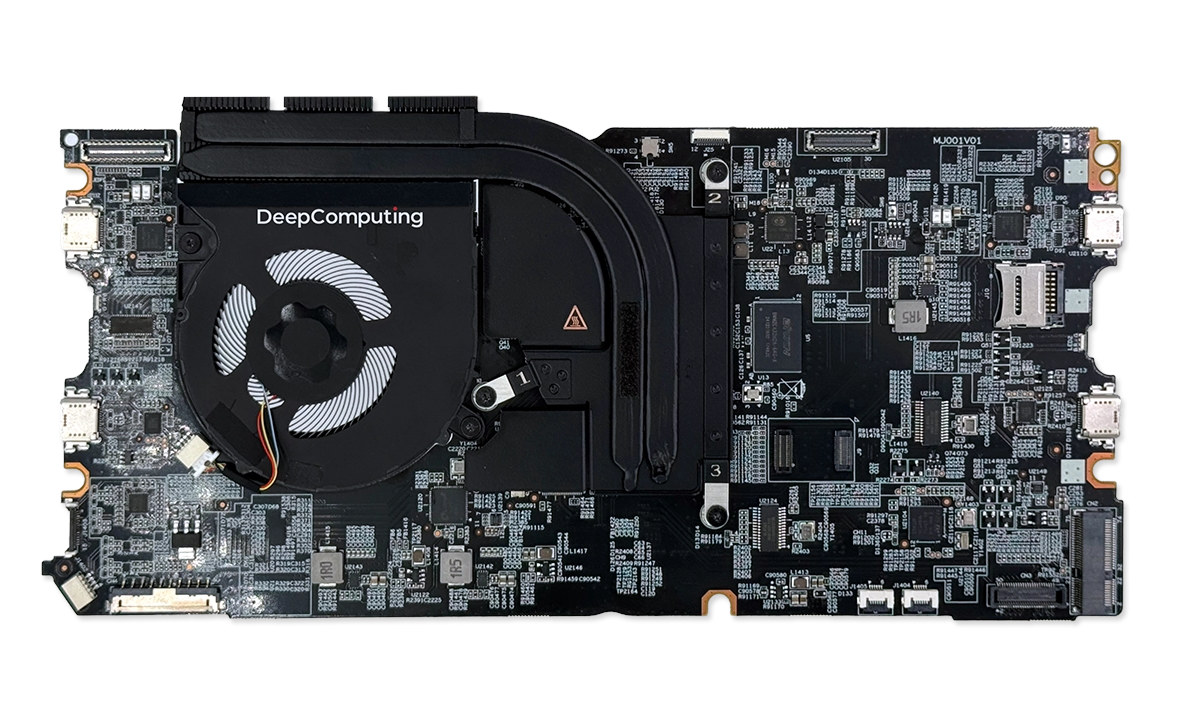
ESWIN Computing, in collaboration with Canonical, has launched the EBC7702 Mini-DTX motherboard, a RISC-V development platform with ESWIN’s new EIC7702X dual-die RISC-V SoC. This board can be considered an upgrade from the previous EBC7700 SBC and is designed for more demanding AI and data processing tasks. The motherboard features an 8-core 64-bit dual-die RISC-V CPU with an integrated AI accelerator delivering up to 40 TOPS (INT8) and 20 TFLOPS (FP16) performance. It supports up to 64GB LPDDR5 memory, 32GB onboard eMMC flash, and multiple storage interfaces, including M.2, SPI Flash, and MicroSD. Connectivity options include four Gigabit Ethernet ports, Wi-Fi, two HDMI outputs, two PCIe Gen3.0 x16 slots, USB 3.0/2.0 ports, and four fan headers. With support for AI, display, and camera modules, the board is designed for video analysis and edge AI workloads. ESWIN EBC7702 specifications: SoC – ESWIN EIC7702X dual-die RISC-V SoC CPU – 8x 64-bit Out-of-Order RISC-V […]

CrowPanel Advance 7-inch ESP32-P4 HMI display supports Zigbee, LoRa, and 2.4GHz radio modules

CrowPanel Advanced 7 inch ESP32 P4 HMI AI Display

The CrowPanel Advance 7.0-inch ESP32-P4 HMI AI display is an ESP32-P4 HMI terminal that is similar to the GUITION 7-inch touchscreen display. It also adds an ESP32-C6 module for WiFi 6, Bluetooth LE, and 802.15.4 connectivity, and is suitable for Smart Home, industrial automation, and AIoT applications. It features a 7-inch 1024×600 IPS capacitive touchscreen and optional AI vision and audio through a 2MP MIPI-CSI camera for face and object recognition, and a speaker header and a dual microphone array for interactive voice applications. The smart display also supports interchangeable wireless expansion for Zigbee/Thread, LoRa, and 2.4 GHz proprietary (nRF2401) connectivity. CrowPanel Advance 7.0-inch display specifications: Microcontroller – Espressif Systems ESP32-P4 CPU Dual-core RISC-V HP (High-performance) CPU @ up to 400 MHz with AI instructions extension and single-precision FPU, 768KB of on-chip SRAM Single-RISC-V LP (Low-power) MCU core @ up to 40 MHz with 8KB of zero-wait TCM RAM Memory – […]

Upbeat introduces UP201 and UP301 ultra-low power RISC-V MCUs with always-on AI processing

Upbeat UP201 and UP301 Series AI MCUs No BG

Upbeat Technology, in collaboration with SiFive, has introduced UP201 and UP301 always-on AI MCUs for ultra-low-power AI and IoT applications such as wearables, drones, and sensor-based systems. The UP201 is designed for compact, battery-driven devices such as smartwatches, hearing aids, and IoT sensor nodes, whereas the UP301 targets AI and vision-based applications for more complex edge systems such as smart glasses, robotics, and industrial AI equipment. Both chips feature a dual-core RISC-V architecture. The SiFive E21 lightweight core is Always-On (AON), managing continuous low-power sensing, whereas the SiFive E34 performance core activates for higher workloads. The MCUs also integrate a 2.5D GPU and various I/O options. UP201 and UP301 MCU specifications: CPU cores (SiFive Essential RISC-V IP cores) E21 core in Always-On (AON) domain for continuous low-power sensing E34 performance core in the Non-AON domain for higher workloads Up to 400 MHz operating frequency Up to 717 DMIPS performance Near-threshold […]

Allwinner T153-based industrial SoM and SBC feature a mix of Arm Cortex-A7 and RISC-V cores

Forlinx FET153 S Allwinner T153 System on Module

Forlinx has recently introduced the Allwinner T153-based FET153-S SoM and the OK153-S SBC. The Allwinner T153 processor features a hybrid architecture that combines a quad-core Arm Cortex-A7 CPU with an XuanTie E907 RISC-V core. The board features up to 1GB DDR3 RAM, 8GB eMMC, triple Gigabit Ethernet, dual CAN-FD, RS-485, and a Local Bus for PSRAM or FPGA expansion. Display options include support for RGB, LVDS, and MIPI DSI interfaces, and camera inputs are offered via parallel or MIPI CSI. Additional I/O include multiple UART, I²C, SPI, I²S, GPADC, and GPIO options, along with Wi-Fi/Bluetooth, a USB Type-C OTG port, and a Mini PCIe socket for 4G modules. Target applications include real-time control and edge computing, industrial automation, IoT gateways, and embedded systems. Forlinx FET153-S system-on-module Specifications: SoC – Allwinner T153 CPU 4x Arm Cortex-A7 cores @ up to 1.6GHz XuanTie E907 RISC-V core @ up to 600MHz GPU – 2D […]

Exit mobile version