STMicroelectronics’ STM32MP21 microprocessor family combines a 1.5 GHz 64-bit Arm Cortex-A35 application core with a 300 MHz 32-bit Arm Cortex-M33 core for real-time processing. It is designed for “cost-aware” edge applications in smart factories, smart homes, and smart cities. The new STM32MP21 is a cost-optimized version of the earlier STM32MP23 and STM32MP25 that does without an AI accelerator (yes, those still exist!), GPU, H.264 decoder and encoder, or PCIe Gen2 / USB 3.0 interfaces. It still offers a MIPI CSI-2 camera interface, two Gigabit Ethernet interfaces with Time-Sensitive Networking (TSN), and strong security targeting SESIP Level 3 and PCI pre-certification. STM32MP21 specifications: CPU – Arm Cortex-A35 core running at up to 1.2 or 1.5 GHz with 128KB L2 cache Real-time MCU – Arm Cortex-M33 core with FPU/MPU running at up to 300 MHz GPU – None VPU – None AI accelerator – None Memory 456 KB SRAM 256KB AXI SYSRAM […]
NVIDIA Jetson T4000 Edge AI embedded system offers 5GbE networking, four PoE camera ports, DIO, CAN Bus, and more
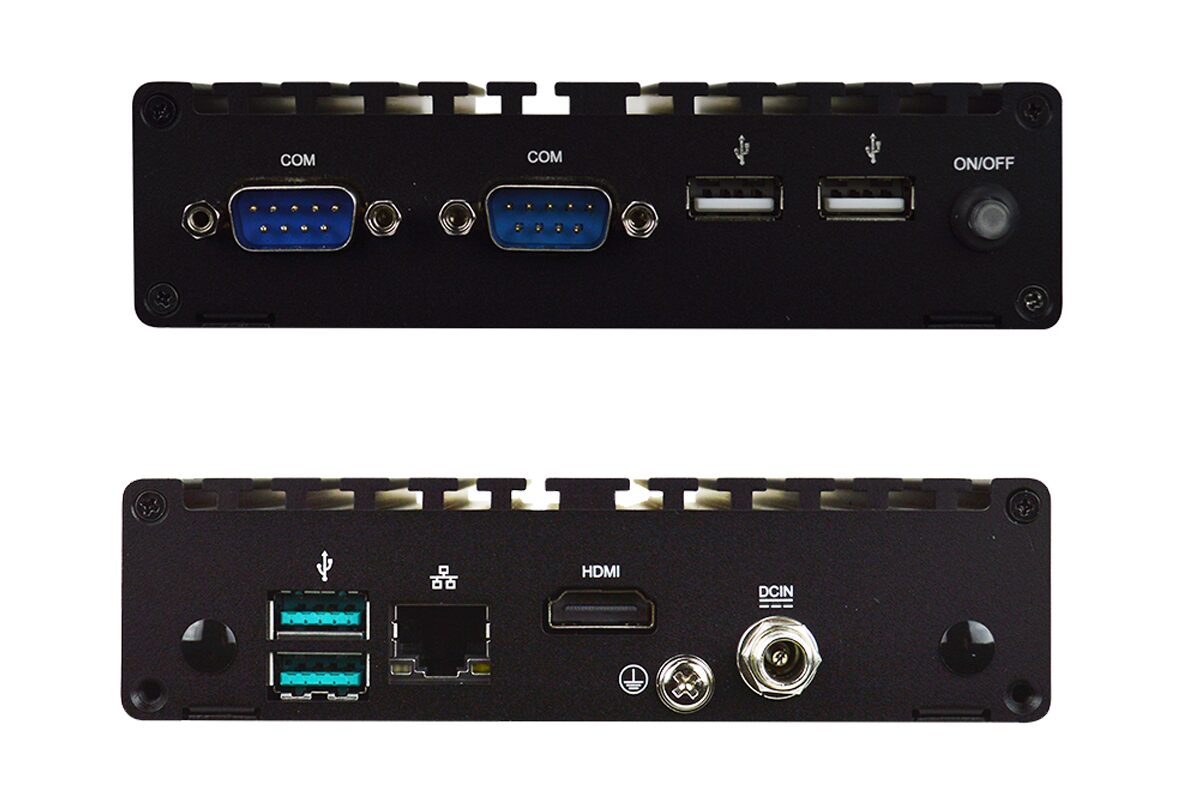
AAEON BOXER-8742AI is a fanless Edge AI embedded system powered by an NVIDIA Jetson T4000 that was unveiled along with the Jetson Thor T5000 module last August, but officially launched at CES 2026. The Jetson T4000 is a weaker variant, but it’s still extremely powerful with up to 1200 TFLOPS of AI computing power against 2070 TFLOPS for the T5000. The BOXER-8742AI features a 5GbE port, four Gigabit Ethernet RJ45 PoE ports suitable for IP cameras, DIO, RS232, RS485, and CAN Bus interfaces, four USB 3.2 Gen 2 ports, HDMI video output, and more. It’s suitable for high-performance edge AI applications such as smart factory automation, AMR, and AI-assisted roadside unit solutions. AAEON BOXER-8742AI specifications: System-on-Module – NVIDIA Jetson T4000 CPU – 12-core 64-bit Arm Neoverse-V3AE GPU – 1536-core NVIDIA Blackwell GPU with 64 Tensor Cores, 6-TPC MIG VPU Video Decode – 4x 8Kp30 (H.265), 10x 4Kp60 (H.265), 22x 4Kp30 […]
ESP32-DIV V1 handheld pentesting tool supports Wi-Fi Attacks, BLE spoofing, 2.4GHz scanning, and Sub-GHz jamming
Designed by Cirket open-source hardware in China, the ESP32-DIV V1 is a handheld wireless pentesting and experimentation tool with Wi-Fi, BLE, generic 2.4 GHz (NRF24), and Sub-GHz RF (CC1101) communication. The device targets hardware hackers and cybersecurity researchers for learning and testing wireless vulnerabilities across multiple frequency bands. The device features a modular “sandwich” design consisting of a Main Board and a Shield Board connected via a 20-pin header. The Main Board integrates an ESP32 microcontroller, a 2.8-inch ILI9341 TFT display with XPT2046 touch controller, SD card slot, battery charging and power management, and navigation controls. The Shield Board hosts the RF hardware, including three NRF24L01 modules, a CC1101 Sub-GHz transceiver, and multiple SMA antenna connectors. ESP32-DIV (V1) specifications: Wireless Module – ESP32-WROOM-32U SoC – ESP32 dual-core wireless microcontroller CPU – Dual-core Xtensa 32-bit microprocessor @ 240MHz Memory – 520KB internal SRAM Wireless – Wi-Fi 802.11b/g/n, and Bluetooth (4.2 and […]
Lockzo AL501 3-in-1 smart door lock review with the Tuya mobile app
We’ve received a review sample of the Lockzo AL501 3-in-1 smart door lock system (Smart Lock + Video Camera + Doorbell). It supports 2.4GHz Wi-Fi and integrates a 2K resolution camera with a wide 180° field of view, a doorbell, AI motion detection, and infrared night vision. It supports multiple unlocking methods, namely physical key, AI fingerprint scanning, keypad PIN code, and the Tuya mobile app, which enables the user to check the live video, talk to visitors, and unlock the door in real time from anywhere via your smartphone, as well as voice control through Amazon Alexa or Google Assistant. The included 10,000 mAh rechargeable battery is designed to last approximately 6 months per charge, and the device has an IP65 dust and water resistance rating. In this review, we’ll go through an unboxing, show how we installed it on a wooden door, connect it to WiFi through the […]
ASUS IoT PE3000N – An MIL-STD-810H-grade, modular NVIDIA Jetson T5000 Edge AI platform for robotics and automation solutions
Debashis just wrote about the Firefly EC-ThorT5000 embedded PC powered by an NVIDIA Jetson Thor T5000 system-on-module yesterday, and the ASUS IoT PE3000N is another rugged, modular Edge Platform powered by the 2,070 FP4 TFLOPS SoM offering MIL-STD-810H compliance, 12-60V input, 25GbE links, and support for up to sixteen GMSL cameras. The PE3000N features one HDMI 2.0 video output, GbE and 10GbE RJ45 ports, M.2 sockets for storage and wireless expansion, a PCIe x4/x8 slot, and several USB ports, as well as four 25GbE links and AGX CSI connector for up to 16x GMSL cameras for “high-bandwidth sensor fusion and advanced machine vision”, even in the most challenging environments. The Jetson T5000 embedded system also offers a scalable chassis and modular I/O layers that support interfaces such as PoE, GMSL, CAN, and QSFP28 within a compact 2U height. ASUS IoT PE3000N specifications: SoM – NVIDIA Jetson Thor T5000 module CPU […]
ST launches 800 MHz STM32V8 Arm Cortex-M85 high-performance MCU manufactured with 18nm FD-SOI process
ST has just launched its most powerful STM32 microcontroller so far, with the STM32V8 family, the first equipped with a Cortex-M85 core (clocked at up to 800 MHz) and manufactured with an 18nm FD-SOI process. It’s a non-pin compatible update to the STM32H7 family that delivers up to 5,072 CoreMarks, greatly improves Edge AI performance thanks to Arm Helium and MVE, integrates up to 4MB eNVM (Embedded NVM), operates up to 140°C, and adds PCM (phase-change memory) radiation immunity. Two main parts have been launched in different configurations and packages: STM32V863 and STM32V873. STM32V863/873 specifications: Core – 32-bit Arm Cortex-M85 CPU @ up to 800MHz with Arm Helium, Arm MVE, TrustZone…; up to 5,072 CoreMarks Multimedia accelerators – Chrom-ART 2D GPU, and JPEG hardware accelerator Memory/Storage 1.5 MB system SRAM with ECC (partial) 8 KB backup RAM 192 KB zero-wait state TCM Up to 512 KB TCM with ECC Up […]
CRA-ready Grinn Genioboard Edge AI SBC features MediaTek Genio 510 or 700 System-on-module
Grinn has launched a credit card-sized SBC powered by its MediaTek Genio 510 or Genio 700 Cortex-A78/A55 SoM, and designed for Edge AI applications with support for the Thistle Security Platform via an on-board Infineon OPTIGA Trust M hardware security module to enable compliance with the EU’s Cybersecurity Resilience Act (CRA). With a form factor similar to the Raspberry Pi 3 model B, the Genioboard features 4GB RAM, 16GB eMMC flash, a Gigabit Ethernet port, four USB 3.0/2.0 ports, HDMI and DisplayPort video outputs, two MIPI CSI camera connectors, a 40-pin GPIO header, a USB-C debuig port, USB-C PD power, and on the bottom side, two M.2 sockets for AI accelerators and wireless modules. Genioboard specifications: System-on-Module – Grinn GenioSOM-510 or Grinn GenioSOM-700 SoC MediaTek Genio 510 (MT8370) hexa-core Arm Cortex-A78/A55 processor up to 2.2 GHz, Arm Mali-G57 MC2 GPU, 4Kp60 video decoding, 4Kp30 video encoding, up to 3.2 TOPS […]
Bluetooth 6.2 gets more responsive, improves security, USB communication, and testing capabilities
Bluetooth 6.2 specification has just been released with a range of new features to enhance responsiveness with shorter connection intervals, strengthen security against amplitude-based RF attacks, and improve communication with a new “Bulk Serialization Mode” that’s especially useful for USB Bluetooth LE audio applications. The new Bluetooth Core 6.2 specification also introduces various BLE Test Mode enhancements. If you feel like Bluetooth specifications are released more often than in the past, that’s normal because the Bluetooth SIG switched to a bi-annual release schedule. For instance, the Bluetooth 6.1 specification was just published last May, or about 6 months ago… Bluetooth 6.2 highlights: Bluetooth Shorter Connection Intervals (SCI) reduce the minimum Bluetooth LE connection interval from 7.5 ms to just 375 µs for faster responsiveness. The change will especially impact high-performance HID devices, real-time human-machine interfaces (HMIs), and latency-sensitive sensors. AR/VR and gaming applications will particularly benefit from the lower latency. […]