LX Group, an Australian company specializing in electronics design and embedded systems, has introduced three wireless modules for IoT and wearables which they call “LX IoT Cores”, and embeds various wireless protocol such as Bluetooth LE/Ant+, 2G/3G connectivity, WiFi, Lora, Sigfox, Taggle, etc… Let’s go though the main technical specs for the three modules, one of which it itself modular (hence the max and min size) depending on your requirements. LX Cellular Core (Right) MCU – STMicro STM32F217IGH6 ARM Cortex-M3 MCU @ 120 MHz with 1MB flash, 128kB RAM Storage – 1x micro SD card reader Communication Interfaces Radios – 2G/3G, WiFi, BLE, ANT+, provision for LoRa, Taggle, SigFox, optional GPS via daughter board Wired – USB, RS485, UART, SPI, I2C, Digital IO, ADC Sensors – Ambient Luminosity, accelerometer, gyroscope, magnetometer, temperature, humidity, air pressure, microphone USB – 1x micro USB port Misc – Reset and 2x user buttons, 2x […]
Tibbo Project System is a Modular Linux IoT Prototyping Platform based on TI Sitara Cortex A8 Processor
If you’ve found yourself needing to quickly demo a system that does not look like a mess of wire to a customer, or your project is requires low production volumes, making the cost of designing your own and mass-producing the hardware prohibitive, Tibbo Project System might be worth looking into. It features an almost bare board powered by Texas Instruments Sitara processor, and a large area for Tibbit blocks to add features as needed, as well as an enclosure. Size 3 Linux Project PCB (LTPP3) specifications: SoC – Texas Instruments Sitara AM335x Cortex A8 processor up to 1.0 GHz System Memory – 512 MB DDR3 Storage – 512 MB NAND flash, 2KB EEPROM, optional micro SD slot Connectivity – 10/100M Ethernet (RJ45), optional WiFi (via LW1000 module) and GPRS connectivity (via Tibbit #47) Expansion – 51 I/Os: 7x tiles 14x sockets for Tibbit module including 4x with UART capability up […]
SmartEverything is a Feature-Packed IoT Board with SigFox, Bluetooth LE, NFC and GPS Connectivity, Plenty of Sensors
Atmel MCU Madness is an informal competition on Twitter where people vote for their favorite development boards. We are now at the quarter finals, and beside the usual suspects such as Raspberry Pi and ESP8266 boards, I also noticed one board that I had never heard of: AXEL Elettronica’s SmartEverything based on Atmel SAM D21 Cortex M0+ and featuring SigFox, BLE, NFC, and GPS connectivity, as well as various sensors such as humidity and temperature, 9-axis motion sensor, and so on. SmartEverything board specifications: MCU – Atmel SAM D21 ARM Cortex-M0+ MCU @ 48 MHz with 256KB Flash, 32KB SRAM Connectivity SIGFOX via Telit LE51-868 S SIGFOX 868 MHz Wireless Module with 12 months of network access included Bluetooth 4.0 LE via TDK SESUB-PAN-T2541 module based on Texas Instruments CC2541 NFC via NXP NT3H1101FHK NFC with separate antenna (included) GPS/GNSS via Telit Jupiter SE868-A GPS/GNSS module with integrated antenna. Supports […]
BPI-GSM Arduino Compatible Board Integrates a GSM & GPS Module, Sensors and an OLED Display
Banana Pi team has come up with another board, but this time it does not run Linux or Android, as they’ve made an Arduino compatible board called BPI-GSM based on Atmel ATmega2560 MCU with a light sensor, DHT22 temperature and humidity sensor, and a GSM/GRPS & GPS module powered by a LiPo battery. BPI-GSM board specifications: MCU – Atmel ATmega2560 8-bit AVR MCU @ 16 MHz with 256 KB flash, 8KB SRAM, 4KB EEPROM Connectivity – Simcom SIM808 GSM, GPRS, and GPS module + SIM card slot + Sensors – DHT22 temperature and humidity sensor, light sensor Display – OLED display Expansion headers – 54x digital I/O (including 14x PWM), 16x analog input, 4x UART. Max DC current per I/O: 40 mA. Misc – Reset button, LEDs Power Supply 5V via micro USB port 3.7V LiPo battery (2,500 mAh battery included in kit) Dimensions – TBD The board can be […]
Embedded Linux Conference 2016 and OpenIoT Summit 2016 Schedule
The Embedded Linux Conference 2016 and the OpenIoT summit 2016 will take place on April 4 – 6, 2016 in San Diego, California, and over 800 attended will meet including kernel & system developers, userspace developers, and product vendors. The Linux Foundation has recently published the schedule, so I’ve had a look at some of the talks, and designed my own virtual schedule to find out more the current development focus although I won’t attend. Monday April 4 10:40am – 11:30am – Linux Connectivity for IoT by Marcel Holtmann, Intel OTC There are many connectivity solutions that available for IoT. For example Bluetooth Low Energy, 802.15.4, Zigbee, OIC, Thread and others. This presentation will provide and overview of the existing technology and upcoming standard and how they tie into the Linux kernel and its ecosystem. 11:40 – 12:30 – BoF: kernelci.org: A Million Kernel Boots and Counting by Kevin Hilman, […]
uRADMonitor Aims to Crowdsource Air Pollution Measurements Worldwide (Crowdfunding)
Some projects such as the World Air Quality Index project are already generating a pollution world map using data from the countries’ respective “Environmental Protection Agency (EPA)”, but a Romanian startup aims to allow individuals to monitor pollution around the world with their uRAMonitor project, effectively crowd-sourcing pollution monitoring. For this purpose, the company created environmental monitors with various features and price points, include the higher-emd Model D with the following specifications: Color LCD with touchscreen LND712 made in the USA for Alpha, Beta and Gamma Radiation Bosch BME680 to measure air temperature, barometric pressure, humidity and VOC (volatile organic compounds) Sharp photoelectric sensor to measure dust, pollen, soot, smoke and other particulate matter 1500mAh rechargeable battery for 8 hours of continuous use Wireless 802.11b/g/n connectivity mini USB connector for charging or data Internal audible alarm when pollution readings are high There’s also model A measuring temperature and radiation, connected […]
Wio Link is an ESP8266 Board Designed to Make IoT Projects Easier (Crowdfunding)
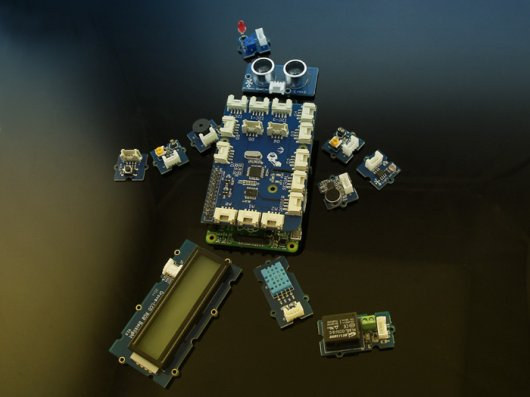
There are already plenty of board or modules based on Espressif ESP8266 WiFi SoC, but if you don’t like soldering, or would rather avoid breadboards and some cables for your or your kids’ projects, Wio Link may be interesting, as all you need to is to connect Grove modules required for your applications to get started, and Seeed Studio also took care of the low level software part and a drag-and-drop mobile app is provided, so software programming has been made easy too. Wio Link hardware specifications: SoC – Espressif ESP8266EX Tensila SoC Storage – 4MB flash Connectivity – 802.11b/g/n WiFi, with WEP/TKIP/AES encryption support Expansion – 6x Grove connectors: 3x digital, 1x analog, 1x UART and 1x I2C (3.3V I/Os) Power Supply 5V via micro USB port 3.4 ~ 4.2V via external battery Output DC Current – 1000mA MAX Charge Current: 500mA MAX Dimensions – 55mm*48mm Weight – 26g […]
Thunderboard Wear is a $75 Smartwatch Development Board by Silicon Labs
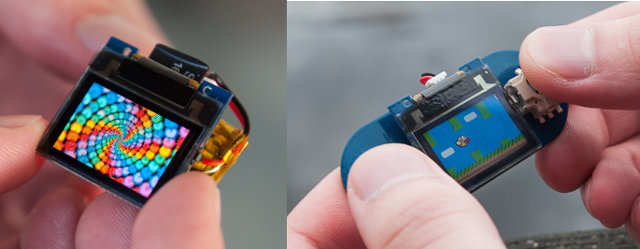
A few days ago I watched an ARMDevices.net’s video about an ARM’s smartwatch reference design running mbed OS 3.0, powered by a Silicon Labs EFM32 Giant Gecko Cortex M3 MCU, and promising up to 2 months battery life on a 160 mAh battery. While I could not find the full details about the reference design, I noticed Silicon Labs also launched a development board called Thunderboard Wear, based on the same platform, just quite bigger, and still wearable… (Sort of) Thunderboard Wear specifications: MCU – Silicon Labs EFM32GG995F1024 ARM Cortex-M3 MCU up to 48 MHz with 128 kB RAM,1 MB Flash External Memory – 256 kB external SRAM External Storage – micro SD card slot Display – 128×128 pixel Memory LCD from Sharp Connectivity – Bluetooth 4.1 smart module (Silicon Labs BGM111), upgradeable to Bluetooth 4.2 Sensors Ambient Light Sensing (ALS) and Proximity/Gesture via Silicon Labs Si1141. Optical hear-rate monitoring […]