augmented reality News - Page 4 of 6 - CNX Software - Embedded Systems News

Qualcomm Releases Augmented Reality Vuforia SDK 1.5 for Android and iOS

Announced in January, Vuforia is the new name of Qualcomm’s Augmented Reality platform. Qualcomm has just announced the commercial release of Vuforia SDK 1.5 for Android and iOS. Applications built using this SDK can now be distributed and promoted on the Android Market and Apple App Store. Developers can also build 3D AR application using Qualcomm’s extension for the Unity 3 cross-platform game engine. The Vuforia SDK 1.5 supports Android devices running on Android 2.2 and above, as well as the iPad 2, iPhone 3GS, iPhone 4 and iPod touch (4th Generation) running iOS 4 and above. Vuforia SDK 1.5 brings the following features and improvements: Ability to swap datasets at runtime: You no longer have to upgrade your app to change the target dataset, and you can now build AR experiences that work on a large number of images. If your app needs to augment more than 60 images, […]

Metaio To Introduce Augmented City Platform at MWC 2012

Metaio has unveiled plans to add 3D Object Tracking and Visual Search to its free mobile Augmented Reality SDK for Android and iOS, part of the Augmented City platform. This  SDK is optimized by major ARM chipset providers, and assembles technologies necessary for creating interactive and immersive AR experiences, such as the overlay of virtual information on building facades, city streets and almost any 3D real world object or device, says the company. Metaio Mobile SDK is specifically optimized for Texas Instruments OMAP4460/4470 and ST Ericsson NovaThor processors using respectively PowerVR SGX540, SGX544 and Mali-400 GPUs. The metaio Augmented City platform consists of diverse mobile and web software packages that use computer vision technology to insert 3D and digital information into the real world. Whereas  many existing Augmented Reality (AR) platforms limit experiences to GPS mapping and the anchoring of graphics to simple, 2D surfaces,  metaio platform can deliver real-time […]

Parrot AR.Drone 2.0: Linux based Augmented Reality Helicopter

Parrot announced a revised version of its Linux-based Parrot AR Drone “quadricopter” flying drone at CES 2012. The drone can now be operated with any Android device such as smartphones and tablets, whereas the previous version could only be controlled by an iPhone or iPad. Another new software features is the auto-pilot. The quadricopter body has been redesigned and reinforced, and fitted with a new 720p HD front-facing navigational camera which can record video and help the pilot navigating the drone. There is also a vertical camera that was present in the first generation. Here are the technical specializations of the Drone’s motherboard: 1 GHz 32-bit ARM Cortex A8 processor (Maybe OMAP3?) 800Mhz video DSP (TMS320DMC64x) 1GB DDR2 RAM USB 2.0 WiFi b/g/n . 3-axis accelerometer 3-axis gyroscope 3-axis magnetometer Pressure sensor for altitude measurement (altitude > 6m) Ultrasound sensor for ground altitude measurement (lower altitude) 60fps vertical QVGA camera […]

Vuforia: Qualcomm Augmented Reality Platform

Qualcomm named its Augmented Reality Platform “VuForia” at CES 2012. I was a bit confused reading the press release and thought it was a new product. Actually, it is the augmented reality platform whose Beta SDK has been released in December 2011. Qualcomm explains that “Vuforia’s computer vision functionality will recognize a variety of 2D and 3D visual targets. With support for iOS, Android, and Unity 3D, Vuforia will allow you to write a single native app that can reach over 400 models of smartphones and tablets.” To showcase the AR platform, Qualcomm and Sesame Workshop, the producer behind Sesame Street, have joined forces to explore augmented reality experiences for children and created a prototype playset that brings physical toys to life. Jean-Luc Aufranc (CNXSoft)Jean-Luc started CNX Software in 2010 as a part-time endeavor, before quitting his job as a software engineering manager, and starting to write daily news, and […]

Metaio Releases Mobile Augmented Reality SDK

Yesterday Qualcomm released QCAR SDK 1.5 Beta, and today Metaio announces its Mobile SDK 3.0 for augmented reality application development on Android and iOS. The metaio Mobile SDK brings with it patented gravity-awareness and visual tracking technology for 2D and 3D objects, now three times more robust than the previous version. These features combined will ensure AR experiences that are more natural, more intuitive, and more realistic, says the company. Metaio recently announced formal collaborations with ARM, ST-Ericsson and Texas Instruments to fully take advantage of the GPU hardware provided by those companies and the Mobile SDK is optimized for ARM Mali GPU (both graphics and compute), ST Ericsson Nova and NovaThor mobile processors and TI OMAP processors. The metaio Mobile SDK also includes its own 3D rendering engine – now with advanced shader support – and a plugin to make use of Unity3D (3D game engine). You can watch […]

Qualcomm Releases Augmented Reality SDK 1.5 Beta for Android

Qualcomm has just announced the availability of QCAR SDK version 1.5 Beta 1 for Android. is now available for download. The Key features and improvements in this version of the QCAR SDK include: Video background texture access: The SDK now provides a simple and streamlined way of accessing the video background texture. Developers can now write custom special effects using powerful shaders resulting in far more exciting application experiences. Swapping datasets at runtime: If your app needs to augment more than 60 images, you can now create multiple datasets – using the web-based Target Management System (My Trackables tool)- and load the appropriate dataset at runtime. You no longer have to upgrade your app to change the target dataset, and you can now build AR experiences that work on a large number of images. Improved tracking performance: The new SDK features several enhancements that reduce jitter in the augmentations, speed […]

Midgard architecture for Embedded GPUs (Mali-T604 / Mali T658)

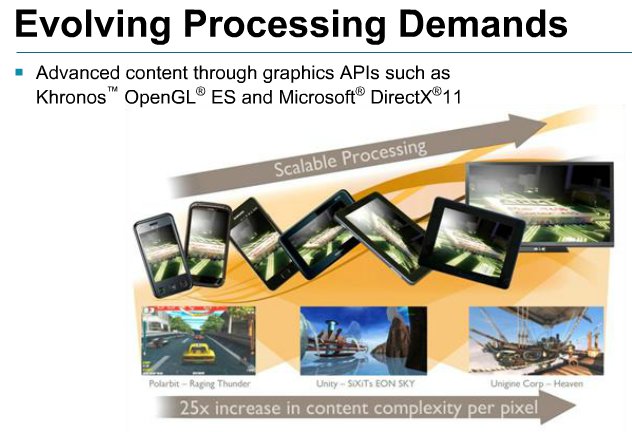
I’ve attended a webinar entitled “Harness the power and flexibility of the Midgard architecture for Embedded GPUs” presented Steve Steele, Product Manager at ARM Media Processing Division and sponsored by EETimes. Steve starts to talk about the current GPU architecture “Utgard” used in Mali-200, Mali-300 and Mali-400MP which allows resolutions up to 1080p and are used in many smartphones today including Samsung Galaxy S2 (Mali-400MP) which provides great graphics performance. He then explains how mobile devices are used today and what performance we may except in the future: Mobile As Main compute platform: New UI and Augmented Reality Social Networks and emails Content Creation/consumption 1 Device to multiple screen (e.g LCD screen and TV via HDMI) Evolving Processing Demand: Graphics Complexity multiplied by 25 Increase in screen size (1080p resolution support). Graphics API: Khronos OpenGL ES, Microsoft DirectX 11 Compute API: OpenCL, Renderscript Compute and Direct Compute. After this overview, […]

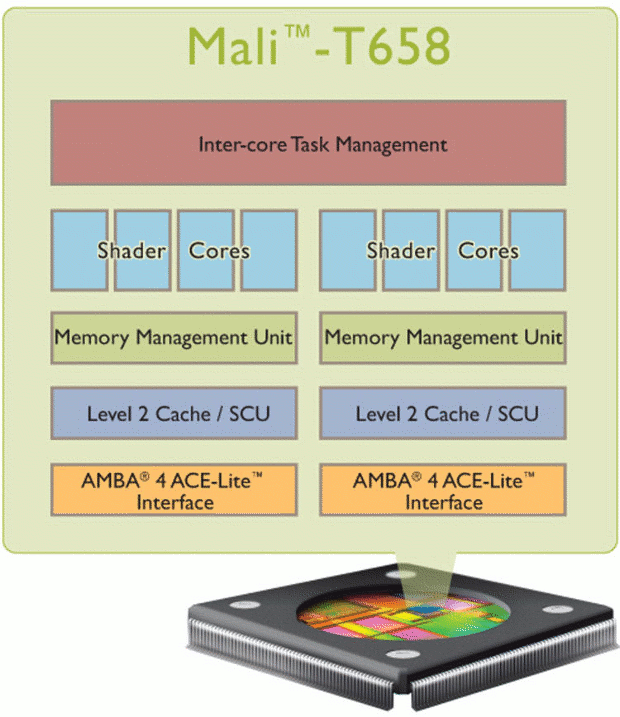
ARM Announces New Mali-T658 GPU

About one year ago, ARM announced the Mali-T604 GPU which has yet to be used in current products. Yet today, ARM announced an even more powerful GPU called Mali-T658 in Tokyo at Japan ARM Technical Symposium. Mali T658 is based on Midgard GPU architecture (as is Mali T604) which allows great GPGPU capabilities thanks to three types of pipeline (‘tri-pipe’) optimized repetitively for arithmetic, load/store and texturing. The GPU will also support standard graphics APIs such as Khronos OpenGL ES, OpenVG andMicrosoft DirectX® 11) as well as Compute APIs such as Khronos OpenCL (Full Profile), Google RenderScript compute and Microsoft DirectCompute. Performance-wise, Mali-T658 has twice as many shader cores and double the arithmetic pipelines per core which means the GPU can offer up to 10 times the performance of the Mali-400 MP GPU. On the compute side, Mali-T658 provides 4 times the processing power of Mali-T604. Mali-T658 will work with […]