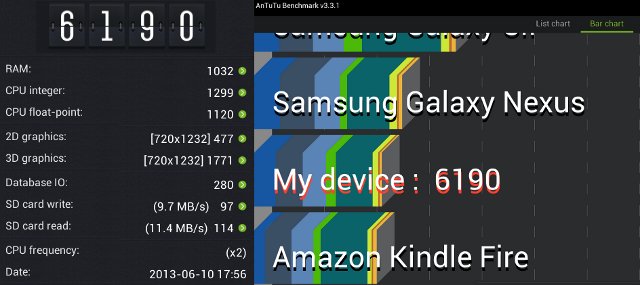
Since last time I tried Android and Ubuntu on the Wandboard, a few things happened. I’m not talking about Wandboard Quad announcement, but instead I received a Class 10 SD card, which makes the system so much responsive, and a RS232 to USB adapter so that I can access the serial console. So today, I’ll publish some benchmark results on Wandboard Dual since none appear to be available, and play a little with the serial console. A few things also happened on the operating systems side with more distributions now available for the board. Prerequisites I ran benchmark in Android, so I installed the latest Android 4.1.2 image (11th of April 2012) to my new SD card (ADATA 16 GB Class 10), and contrary to my poor experience on a 4GB Class 4 micro SD, everything was very fluid. I’ve also installed Google Play in order to install the applications. […]
Emcraft Systems STM32F4 SoM and Starter Kit Run uCLinux From On-Chip Flash
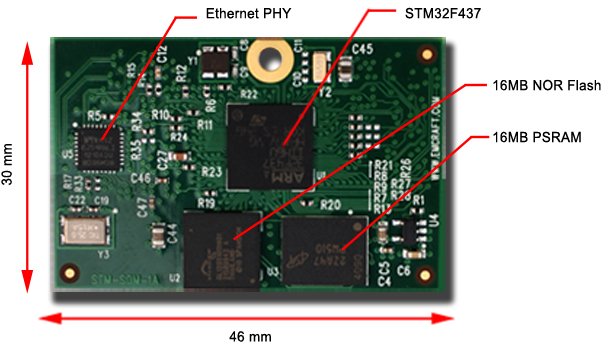
Emcraft has recently announced a new system-on-module based on STMicro STM32F437 Cortex M4 micro-controller, as well as a starter kit based on the module that can run uCLinux directly from STM32F437’s 2MB on-chip flash, allowing a faster boot time, and AFAIK, this is the only Linux-ready STM32 platform available on the market. Here are the specifications of Emcraft Systems SOM-STM32F4: MCU – STMicro STM32F437 Cortex M4 @ 168 MHz with 256KB RAM and 2MB flash External Memory – 16MB PSRAM External Storage – 16MB NOR Flash Ethernet PHY (Optional) Connectors – 2x SoM Connectors with access to I/Os: USB, Ethernet, I2C, SPI, UART, LCD I/F, ADC, DAC, GPIO… Dimensions – 30 mm x 46 mm To speed-up development and for evaluation, the company also provides a starter kit composed of the STM32F4 SoM, and a baseboard (SOM-BSB-EXT) with the following main features: USB interface using USB-UART bridge connected to UART […]
VIA Unveils VAB-600 Pico-ITX Board Powered by WM8950 Processor
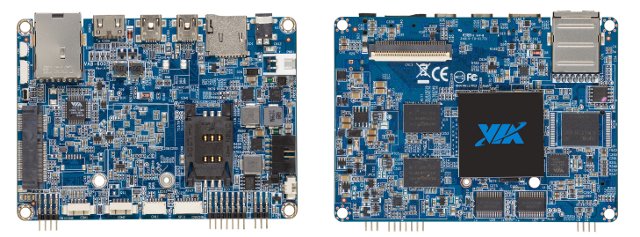
VIA Technologies has recently announced the VAB-600 Pico-ITX embedded board featuring WonderMedia WM8950 ARM Cortex A9 SoC clocked at 800MHz. VIA targets in-vehicle infotainment as well as mobile and healthcare applications for the board despite an operating temperature range between 0°C and 60°C. Here are the key features of this embedded board: SoC – Wondermedia WM8950 Cortex-A9 @ 800MHz + Mali-400 GPU System Memory – 1GB DDR3 SDRAM Storage – 4GB eMMC Flash memory + 512KB SPI Flash for Boot Loader + microSD slot Video Output – Mini HDMI, on-board DVO (Digital Video Output) for TTL or LVDS display Video Codecs – MPEG2 MP@HL, MPEG4, H.264 BP/MP/[email protected], VC-1 SP/MP/AP, VP8 and JPEG/MJPEG. USB – 2x mini USB 2.0 host ports Connectivity – 10/100M Ethernet (VT6113), 3G (SIM card slot) and optional WiFi support (VIA VNT9271B6050 WiFi module shared with one USB port) On-board Connectors: 2x COM connectors 1x RTC battery […]
Yocto Project 1.4 “Dylan” Release
The Yocto Project Release 1.4 has just been announced. This release codenamed “Dylan” and based on Poky 9.0.0 is the sixth release of the project. The Yocto Project is a framework that creates embedded Linux distributions, and has been getting more and more traction with silicon vendors such as Intel, Freescale and Texas Instruments. Yocto Project 1.4 bring the following new features and updates: Major performance improvements – The overall build time has been reduced by more than 10%. Kernel build time is reduced by about 25%. With rm_work enabled, 40% less storage will be used for the tmp directory. Smart, a replacement for zypper Support for read-only rootfs Wayland support, an X replacement. Systemd support, a replacement for the system V init daemon. Usability improvements to HOB, bitbake, yocto-bsp and other tools, including UI improvements, new features and bug fixes. Documentation improvement/update and a new kernel development manual and […]
SILICA Pengwyn Low Cost Open Industrial Development Platform Powered by Sitara AM3354 Processor
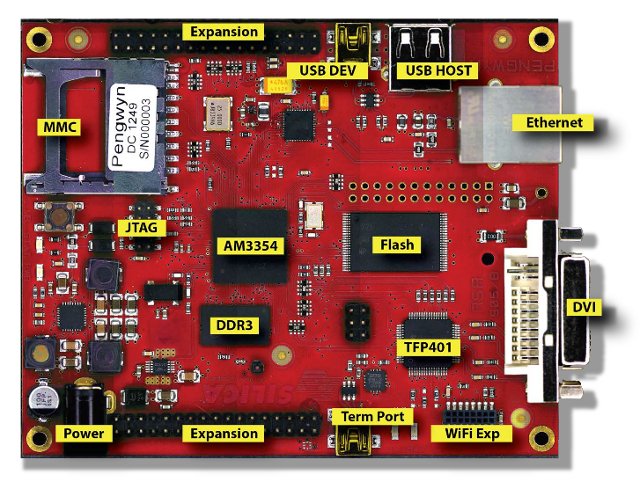
At the end of January, SILICA, an Avnet subsidiary, announced the Pengwyn, a single board computer based on Texas Instruments Sitara AM3354 Cortex A8 processor. The board targets industrial customers, and the company promotes it as “an open platform to develop applications under Linux or Windows Embedded operating systems”. Here are the specifications of the Pengwyn board: Texas Instruments Sitara AM 3354 ARM Cortex-A8 MCU @ 720 MHz System Memory – 256 MB DDR3 Storage – 1 GB Nand Flash, 32 MB SPI Flash Memory, and microSD slot (if not used with Wi-Fi/Bt modules) Connectivity and expandability USB Host and Device Ports RJ-45 Ethernet Port Connector for optional 1 GB Ethernet Port 2x connectors for generic expansions modules SDIO/MMC Port (can be used for optional WI-FI/bluetooth modules) DVI Display Port Silica will provide Linux (Arago Project, an OpenEmbedded based Distribution) and Windows Embedded Compact 7 BSP and images, as well as […]
U-boot, Linux Kernel, and Android Patches for Freescale i.MX6 HDMI TV Dongles
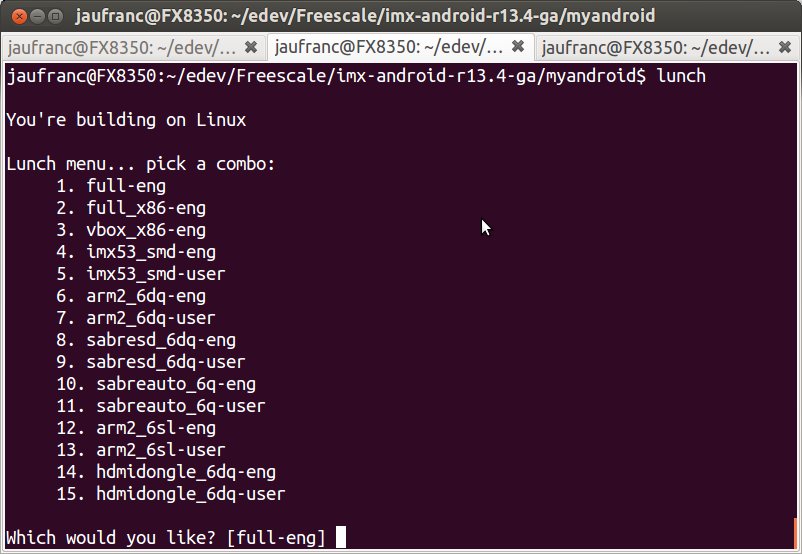
We can now get some quad core Android mini PCs (e.g. Hi802, GK802) featuring Freescale i.MX6Q processor, Freescale has released full documentation and source code its development platforms, Hi802 / GK802 HDMI TV dongles are easily hackable, and there’s even an Ubuntu image for the devices. So it looks pretty good ,right? Well almost.. there are some patches and config for GK802 that have not been released by Richtechie, so we can’t modify the bootloader and Linux kernel. But this may change, as ARMTvTech forum user hste noticed some Freescale i.MX6 HDMI dongle patches om IMX Community website. Even though I’m not sure those are fully compatible with Hi802 / GK802, this could be a starting point. Today, I’ll provide the instructions to build u-boot, the linux kernel and Android ICS with those patches in a machine running Linux 12.04 64-bit. Patch Sets Descriptions There are two set of patches that […]
Variscite VAR-SOM-MX6 Freescale i.MX 6 Solo, Dual and Quad System on Modules Start at $59
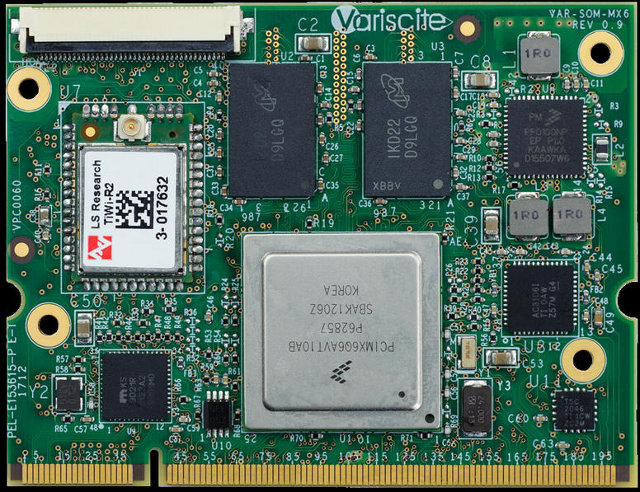
Variscite has unveiled a new series of system on modules powered by Freescale i.MX6 Solo, Dual, DualLite and Quad processors with 512 to 2048 MB DDR3 RAM, and 128 to 1024MB SLC NAND Flash. Here are the modules key features: SoC – Freescale i.MX 6 series SoC (Single/Dual /Quad ARM® Cortex™-A9 Core, 1.2 Ghz) System Memory • Up to 16 Gb DDR3 RAM Storage – Up to 8 Gb NAND Flash for storage memory/boot Video Output: 2 x LVDS display interface HDMI V1.4 i nterface 1 x MIPI DSI Touch panel interface Camera – Parallel & serial camera interface (CSI) Connectivity On-board 10/100/1000 Mbps Ethernet PHY WLAN (802.11 b/g/n) Bluetooth 2.1 + EDR USB – 1 x USB 2.0 host, 1 x OTG Audio – Stereo line -In/out, digital & analog microphone, and S/PDIF In/Out Other interfaces: 2 x SD/MMC Serial interfaces ( SPI , I2C, UART, I2S,) 2x CAN […]
The Yocto Project Release 1.3
The Yocto Project Release 1.3 has just been announced. This release codenamed “Danny” and based on Poky 8.0 is the fifth release of the project. The Yocto Project is a framework to assist developers in creating embedded Linux distributions. New features and updates for the Yocto Project 1.3 Improved terminal UI, which makes it easy to see the tasks that are currently executing, and avoids burying any warnings that are printed. Eliminated intermediate step when building cross compiler toolchain Relocatable SDK Large number of usability improvements in the Hob image building UI Upgraded eglibc to version 2.16 Upgraded gcc to version 4.7 Upgraded Linux kernel version to 3.4.11 Added yocto-bsp script for automating the initial parts of creating a new BSP Python functions now consistently use four spaces for indentation – no more having to try to match the mix of tabs and spaces in your recipes Disabled sharing shared […]