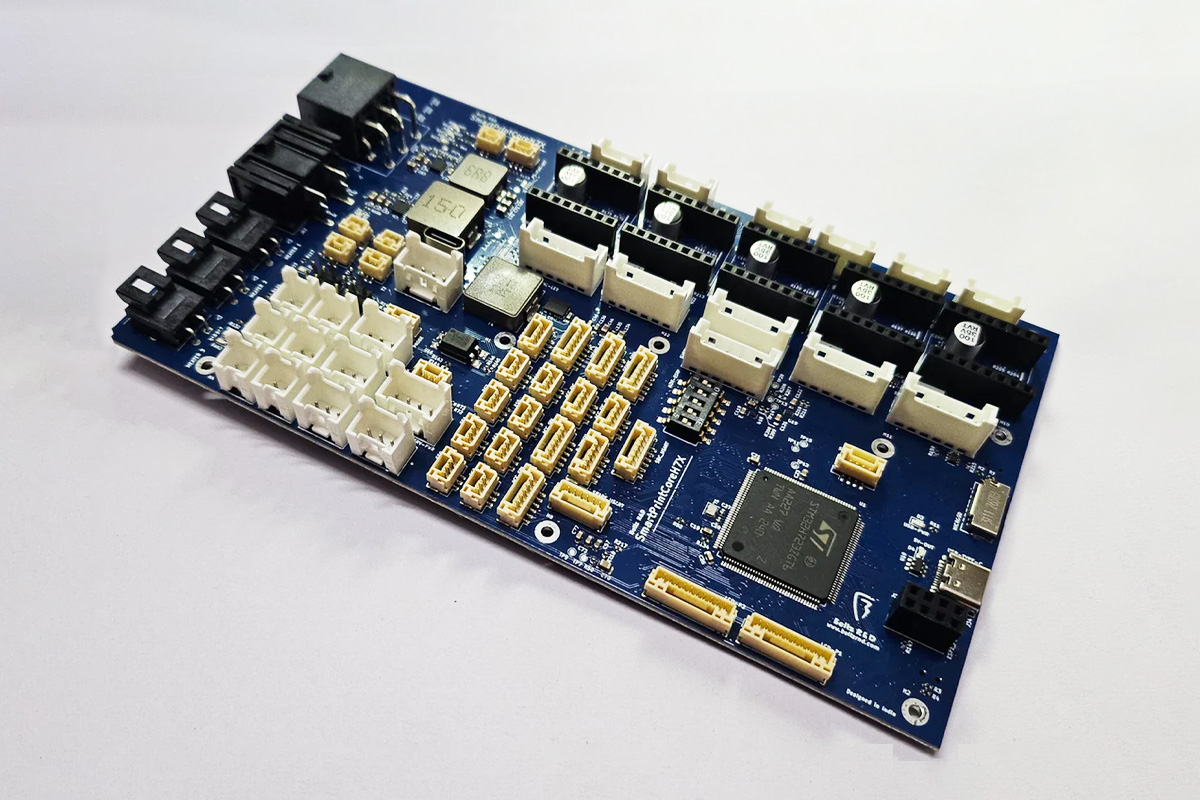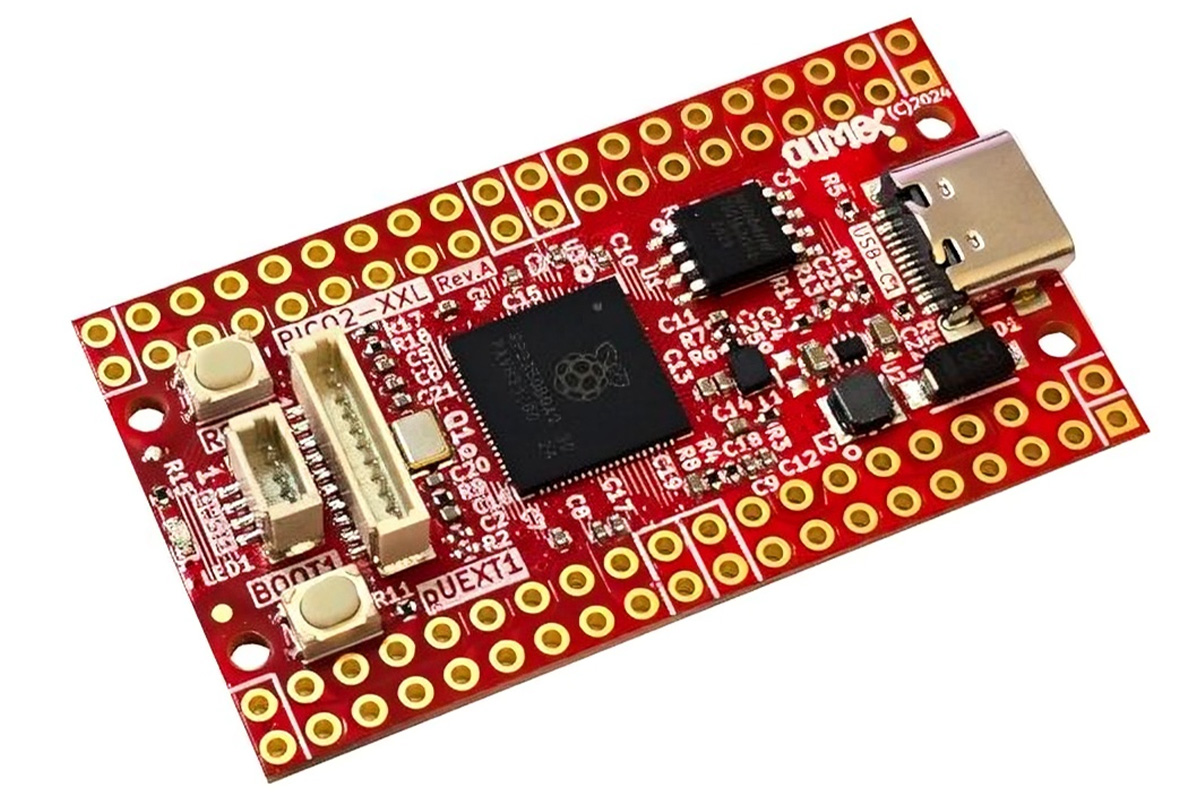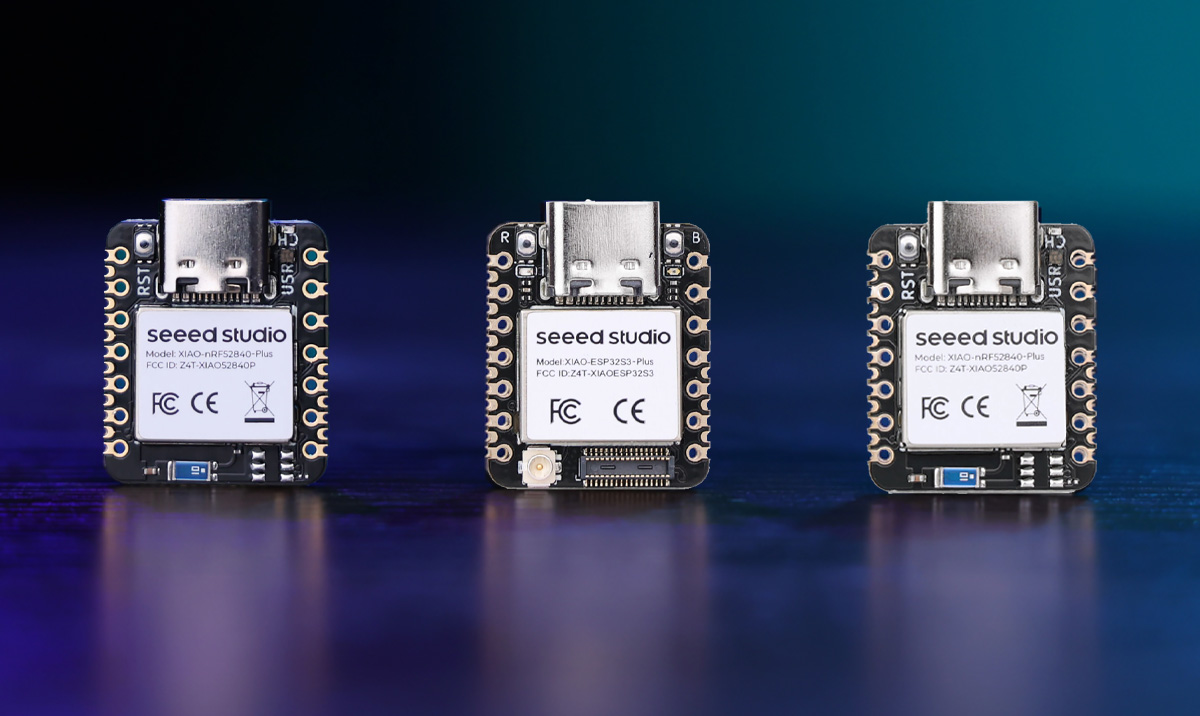
STM32U3B5/C5 ultra-low-power MCU features 640 KB RAM, 2 MB Flash, and HSP accelerator to run AI without batteries

STM32U3B5 STM32U3C5 block diagram

STMicroelectronics has added two members to the STM32U3 ultra-low-power Arm Cortex-M33 microcontroller family: the STM32U3B5 and STM32U3C5 MCUs get more resources with up to 640 KB SRAM and 2 MB flash, as well as an HSP (hardware signal processor) accelerator to run AI/ML workloads without batteries, just using energy harvesting. The new chips are still clocked at up to 96 MHz, benefit from a near-threshold design (down to 0.65 V), allowing a power consumption of just 117 Coremark/mW in active mode, and can operate up to 105°C ambient temperature. They come with one additional group of interfaces, bringing the total to four SPI and I2C, two I3C and CAN-FD, and five UARTs, as well as five more 16-bit timers, for a total of 10. The STM32U3C5 also includes a cryptocore to accelerate encryption and decryption operations, and supports the CCB (Coupling and Chaining Bridge) hardware security feature, both of which […]

Renesas RA0E3 Arm Cortex-M23 MCU is a stripped-down RA0E1 for cost-sensitive applications

FPB RA0E3 RA0E3 Fast Prototyping Board

Back in 2024, Renesas first released the RA0E1, an ultra-low-power Cortex-M23 MCU designed for cost-sensitive applications, followed by the RA0E2, with extended temperature range support (-40°C to +125°C). The company has expanded its lineup with the RA0E3, a stripped-down version of the RA0E1 with less memory, fewer peripherals, and fewer GPIOs, designed for small and budget-focused applications for sensing, motor assist, safety, and basic system control. The MCU retains the same 32 MHz Arm Cortex-M23 (Armv8-M) core but now comes with 16KB flash and 2KB SRAM. It features an 8-channel 16-bit TAU timer, a 32-bit interval timer, a 10-bit ADC with a temperature sensor, a Data Transfer Controller, and serial interfaces including SPI, I²C, and UART (with LIN support). Additionally, it comes with up to 17 GPIOs, pull-ups, open-drain support, and built-in clock sources. It has an operating voltage range of 1.6V to 5.5V and supports −40°C to +125°C operation […]

STMicroelectronics Stellar P3E quad-core Arm Cortex-R52+ automotive MCU features Neural-ART AI accelerator

Stellar P3E AI automotive MCU Block Diagram

STMicroelectronics has introduced the Stellar P3E, the first automotive MCU with an embedded Neural-ART AI accelerator, designed to simplify X-in-1 Electronic Control Units (ECUs) by consolidating powertrain functions like the inverter, on-board charger (OBC), and DC-DC converter into a single module. The MCU enables smart sensing, predictive maintenance, and virtual sensor applications without the cost and complexity of a separate SoC. The microcontroller features four 500 MHz Arm Cortex-R52+ cores with 19.5 MB of xMemory, which is based on phase-change memory (PCM), offering roughly twice the density of embedded flash. The chip integrates multiple ADC channels for precise sensing, high-resolution PWM down to 102 ps for fine motor control, and 10 timer modules for deterministic real-time operation. Connectivity options include Gigabit Ethernet and CAN-XL, for high-speed, low-latency in-vehicle communication. Stellar P3E (SR6P3EC4/SR6P3EC6) specifications: MCU – SR6P3EC4 / SR6P3EC6 CPU Cores – 4x Arm Cortex‑R52+ cores at up to 500 MHz; […]

Texas Instruments unveils MSPM33C321A mixed-signal Cortex-M33 microcontroller with 256KB SRAM, 1MB flash

MSPM33C321A mixed signal MCU

Texas Instruments MSPM33C321A is a new Arm Cortex-M33 mixed-signal microcontroller clocked at 160MHz, with up to 1MB of flash with ECC and 256kB SRAM with ECC, and a range of digital and analog peripherals. Those include 9.4MSPS dual SAR ADCs and comparators, QSPI, UART, SPI, I2C, I2S/TDM, & CAN-FD interfaces, and the company also highlights a separate VBAT power domain with RTC, integrated watchdog, and tamper I/O, as well as low power consumption with a 16µA standby current with 64kB SRAM and CPU/register retention. The MSPM33C321A also has a little brother with 512KB flash called the MSPM33C3219. MSPM33C321A specifications: MCU core – 32-bit Arm Cortex-M33 CPU @ 160MHz with TrustZone, FPU, and DSP extensions Memory – 256kB of SRAM with ECC Storage Up to 1MB of flash memory with error correction code (ECC); dual-bank with address swap EEPROM operations using 32kB high-endurance data flash Quad SPI (QSPI) for external memory […]

Texas Instruments to acquire Silicon Labs

Texas Instruments acquires Silicon Labs

Texas Instruments will acquire Silicon Labs for $231.00 per share, representing a total enterprise value of approximately $7.5 billion. The transaction is expected to complete in the first half of 2027, subject to receipt of regulatory approvals and other conditions. Silicon Labs wireless chips are fairly popular in Smart Home applications with Zigbee, Thread, and Matter connectivity, as well as low-power Bluetooth LE wearables and industrial Sub-GHz or 2.4 GHz IoT applications. I can still remember when Silicon Labs purchased Energy Micro in 2013, taking over the EFM32 Gecko MCU family, and about 13 years later, the company is changing hands again. Texas Instruments explains the rationale behind the solution as follows: The acquisition will create a global leader in embedded wireless connectivity solutions by combining Silicon Labs’ strong portfolio and expertise in mixed signal solutions with Texas Instruments’ leading analog and embedded processing portfolio and internally owned technology and […]

Microchip PIC32CM PL10 Cortex-M0+ microcontrollers are pin-to-pin compatible with AVR MCUs, support 5V operation

Microchip PIC32CM PL10

Microchip has added the PIC32CM PL10 MCUs to its PIC32C Arm Cortex-M0+ microcontroller family. Pin-to-pin compatible with AVR MCUs, the new PL10 MCUs feature a range of Core Independent Peripherals (CIPs), 5V operation, and functional safety (FuSa) compliance. The microcontrollers notably integrate a 12-bit ADC with strong noise immunity, a Peripheral Touch Controller (PTC) for responsive touch applications, and two serial communication interfaces with USART, I2C, and/or SPI support. Target applications include industrial control, building automation, consumer appliances, power tools, and sensor-based systems. Microchip PIC32CM PL10 specifications: MCU core – Arm Cortex-M0+ core up to 24 MHz Memory –  Up to 16 KB SRAM (8 KB in current datasheet) Storage – Up to 128 KB Flash (64 KB in current datasheet) I/Os and peripherals Up to 55x programmable I/O pins Up to 16x external interrupts Multi-Voltage I/Os (MVIO), removing the need for external level shifters Peripheral Touch Controller (PTC)  with […]

MicroPythonOS graphical operating system delivers Android-like user experience on microcontrollers

MicroPythonOS user interface

Yesterday, I wrote about Ariel OS RTOS for microcontrollers written in Rust, but there’s another interesting open-source operating system for microcontrollers that will be covered at FOSDEM 2026: MicroPythonOS. While Ariel OS is designed for secure, memory-safe, networked IoT applications on microcontrollers, MicroPythonOS targets applications with graphical user interfaces and is heavily inspired by Android and iOS, with an appstore, an LVGL-based touchscreen and button UI with plenty of widgets, gestures and theme support, and a wifi manager, as well as over-the-air (OTA) firmware updates. You’ll probably be astonished to learn that MicroPythonOS is written in… MicroPython. It’s comprised of a Thin OS which handles hardware initialization, multitasking, and UI, and everything else is an app, including system features like WiFi configuration and OS updates. MicroPythonOS highlights: Native MicroPython foundation Runs on ESP32 microcontrollers, but the FOSDEM 2026 talk mentions that it can run on anything that supports MicroPython, including […]

Geehy G32R430 Arm Cortex-M52 Encoder MCU features Arctangent accelerator, dual 16-bit ADC for industrial motion control systems

Geehy G32R430 Cortex M52 Encoder MCU

Last year, Geehy introduced the industry’s first dual-core Cortex-M52 real-time MCU, and has now followed up with the G32R430, an Arm Cortex-M52 Encoder MCU with two 16-bit ADCs and a hardware ATAN (arctangent) accelerator for sub-1 µs electrical angle computation in high-precision encoder and motion control systems. The MCU is clocked at 128 MHz and uses ITCM/DTCM tightly coupled memory for deterministic, zero-wait-state execution, alongside a 4KB cache for low-latency control loops. It integrates two 16-bit high-precision ADCs with support for synchronous sampling, along with an extra 12-bit ADC, multiple analog comparators, DACs, and an on-chip temperature sensor, allowing encoder designs to be built with very few external analog components. It also supports various encoder protocols, including BiSS-C, SSI, Tamagawa, and SPI, and includes generic interfaces like USART, SPI, and I²C. With a –40°C to +105°C industrial operating range, this MCU is suitable for servo motors, industrial robots, absolute and incremental […]

Exit mobile version