Calixto Systems has recently introduced the SL1680 OPTIMA, an industrial SoM built around the Synaptics SL1680 quad-core Arm Cortex-A73 SoC with a 7.9+ TOPS secure NPU for Edge AI and advanced multimedia applications. They also announced an evaluation kit (EVK) for rapid product development. The SoM offers up to 4GB LPDDR4 RAM, up to 16GB eMMC flash, an onboard Gigabit Ethernet PHY, and a wide range of interfaces through compact Hirose connectors, including dual MIPI CSI camera inputs, MIPI DSI, HDMI 2.1 Tx/Rx, PCIe 2.0, USB 3.0/2.0, SDIO, RS485, CAN-FD, and various GPIOs. The EVK further expands connectivity with MikroBUS, display and camera interfaces, and industrial I/O, making the platform suitable for AI-enabled vision systems, smart HMIs, automation equipment, and other edge computing applications. SL1680 OPTIMA SoM specifications SoC – Synaptics SL1680 (Astra Series) CPU – Quad-core Arm Cortex-A73 processor @ 2.1 GHz GPU – Imagination PowerVR Series9XE GE9920 GPU with […]
Google’s open-source, RISC-V-based Coral NPU is integrated into Synaptics SL2610 Edge AI SoCs
Google has very recently introduced Coral NPU full-stack, open-source RISC-V-based platform for always-on AI on low-power edge devices and wearables. The first chip to integrate the Coral NPU is the upcoming Synaptics Astra SL2610 family. Google Coral NPU The Coral NPU aims to address the software fragmentation on entry-level AI accelerators that makes them difficult to program. By releasing an open-source NPU and associated source code, Google hopes its design will be adopted by silicon vendors, reduce software fragmentation over time, and help machine learning (ML) developers bring products to market faster. Building on the works on the Coral platform, the new, open-source Coral NPU is comprised of three main components: A scalar core – A lightweight, C-programmable RISC-V core that manages data flow to the back-end cores. It uses a simple “run-to-completion” model for ultra-low power consumption and traditional CPU functions. A vector execution unit – A single instruction […]
5 Ways Embedded AI Processors are Revolutionizing Device Performance (Sponsored)
Artificial intelligence (AI) is moving from cloud-first architectures to edge-first designs, so more processing now runs on phones, cameras, and embedded controllers. Running inference on-device cuts latency and keeps sensitive data local. This momentum is reshaping product roadmaps, all due to different revolutions driven by edge AI. The Core Revolutions Driven by Edge AI Instead of routing every model and signal to the cloud, devices are processing more data locally to act faster and protect sensitive information. Because edge AI is changing where intelligence runs, IDC estimates global spending on edge computing reached about $261 billion in 2025. This rapid enterprise investment is due to several reasons. 1. Enabling Real-Time, On-Device Decisions Eliminating the cloud round-trip lets devices turn sensor input into action in milliseconds. This capability is essential for industrial automation and control loops because embedded AI processors run optimized models on-device, so decisions happen continuously. 2. Strengthening Privacy […]
Synaptics Astra SR series Arm Cortex-M55 MCUs feature Arm Ethos-U55 NPU, low-power Cortex-M4 core with microNPU
Synaptics unveiled an extension to its Astra Native AI platform with the new SR series of MCUs. This new product family, unlike the Astra SL series released last year, isn’t comprised of Linux-capable application processors. Instead, the Arm Cortex-M55 microcontrollers focus on providing high-performance, AI-native processing for Edge AI applications leveraging a built-in Arm Ethos-U55 NPU. Built on the Arm Cortex-M55 core and the Arm Ethos-U55 neural processing unit (NPU), these MCUs are optimized for multimodal applications, including vision, audio, and voice processing. As indicated in the MCU’s block diagram (see below), the SR series also features an optional low processing SoC unit featuring an Arm Cortex-M4 @ 100MHz and a Synaptics micro NPU engine. Such a provision in this MCU is what allows the three operation tiers the company offers with the MCU series: performance, efficiency, and ultra-low-power modes, allowing intelligence across various power levels. The MCU can switch […]
Synaptics SYN20708 low-power IoT SoC features Bluetooth, Zigbee, Thread, Matter, and advanced coexistence
Synaptics has recently introduced the SYN20708 low-power IoT SoC designed to handle simultaneous Bluetooth 5.4 Classic/Low Energy and IEEE 802.15.4 radios with Zigbee, Thread, and Matter protocols. The SoC integrates power and low-noise amplifiers and two separate radios enable simultaneous multiprotocol operations. The SoC is based on a 160 MHz Arm Cortex-M4 processor with user-accessible OTP memory for configuration. Built using a 16-nm FinFET process, it has very low power consumption, and advanced features like high-accuracy distance measurement (HADM), angle-of-arrival (AoA), and angle-of-departure (AoD). These features with versatile antenna support make this SoC suitable for industrial, consumer, and IoT applications. Synaptics SYN20708 specifications CPU – Arm Cortex-M4 processor @ 160 MHz Memory/Storage 544 KB System RAM 1664 KB Code RAM 1640 KB ROM 256 bytes OTP Connectivity Dual-radio Bluetooth 5.4 Bluetooth Classic, Bluetooth Low Energy Supports Bluetooth 6.0 features like HADM (high accuracy distance measurement) Bluetooth Class 1 and Class […]
Synaptics Veros SYN4383 and SYN43756(E) SoCs support tri-band WiFi 6E, Bluetooth 5.3/5.4, and 802.15.4 connectivity
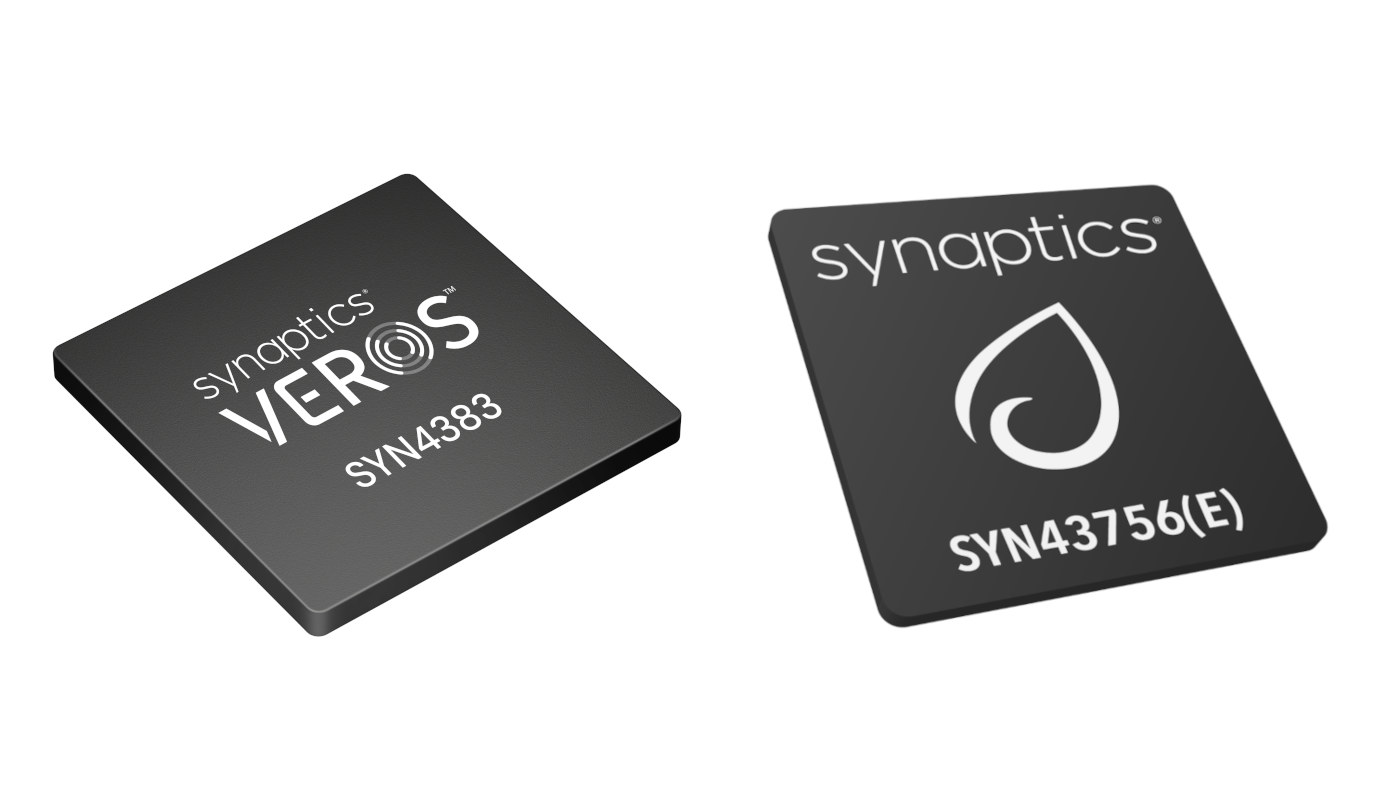
Synaptic has unveiled the SYN4383 and SYN43756(E) high-performance “Veros” SoCs with tri-band Wi-Fi 6E, Bluetooth 5.3/5.4, and an optional 802.15.4 radio. The SYN4383 is an upgrade to SYN4382 SoC that supports 1,200 Mbps 2×2 MIMO Wi-Fi 6E, Bluetooth 5.4, and 802.15.4 for Zigbee and Thread support. It supports real simultaneous dual-band (RSDB) operation and offers “greater system integration”. The SYN43756(E) is similar but lacks an 802.15.4 radio and RSDB support. SYN4383 “Triple Combo 3” Wi-Fi 6E, Bluetooth 5.4, 802.15.4 SoC Synaptics Veros SYN4383 key features: Tri-band 2×2 MIMO Wi-Fi 6E (802.11ax) up to 1200 Mbps throughput, RSDB with 2.4 GHz radio and either 5 or 6 GHz radio, and support for legacy 802.11a/b/g/n/ac WiFi Bluetooth 5.4 (Bluetooth 6.0 compatible) with LE Audio, Channel Sounding for accurate positioning 802.15.4 radio for Thread and Zigbee Application-layer support for Matter-compliant security and interoperability Smart Co-Ex for WiFi/Bluetooth coexistence in the 2.4 GHz band […]
Synaptics Astra platform takes SL1620, SL1640, or SL1680 Arm CPU module for Edge AI applications
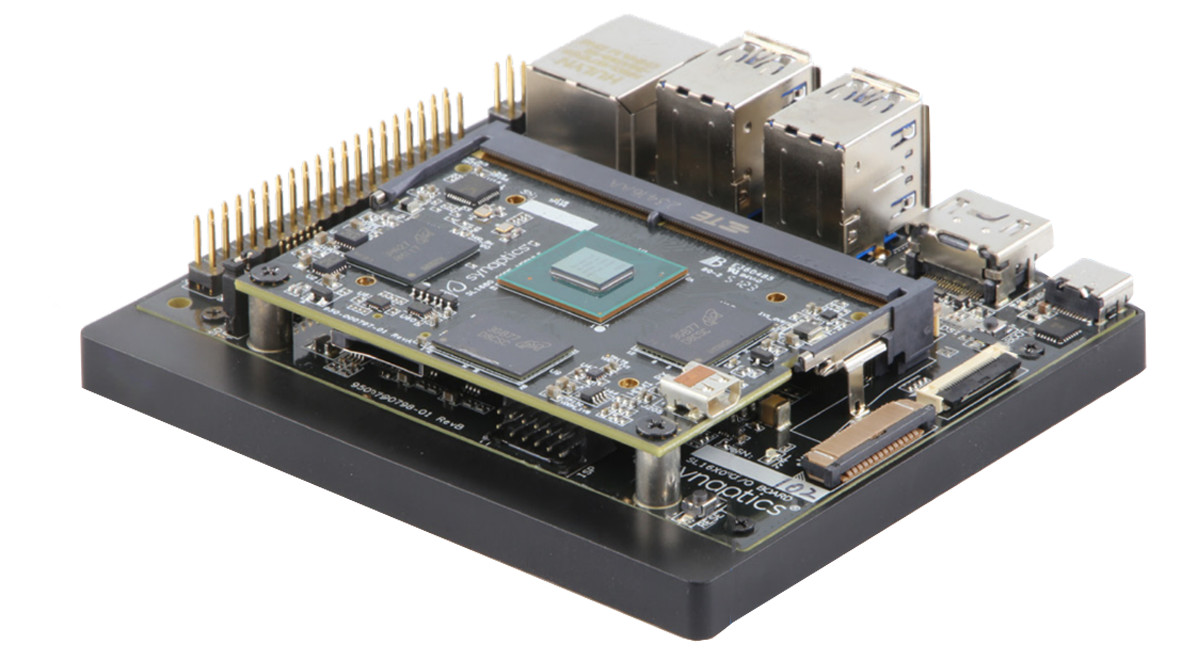
Synaptics has unveiled its new Astra platform with a range of SoC and a development kit for edge AI applications. These new processors and a supporting development kit are built to provide out-of-the-box AI capabilities for IoT devices, reducing reliance on cloud-based AI. This new Synaptics Astra Platform is built around three main SoCs. The SL1680 is built for multi-modal IoT applications and features a quad-core Arm Cortex-A73 CPU, dedicated 7.9 TOPS NPU, and 4K video. The SL1640 is a cost and power-optimized SoC with a quad-core Cortex-A55 CPU and 1.6+ TOPS NPU. Finally, the SL1620 is a graphics and AI accelerator with a quad-core Cortex-A55 CPU and dual-core Imagination BXE-2-32 GPU but does not feature an NPU. The development kit features a module design where the new swappable compute modules allow flexible configurations. The devkit will support open Yocto Linux distribution and Synaptics AI toolkit for quick AI integration. […]
Banana Pi BPI-M6 SBC features SenaryTech SN3680 quad-core Cortex-A73 AI processor
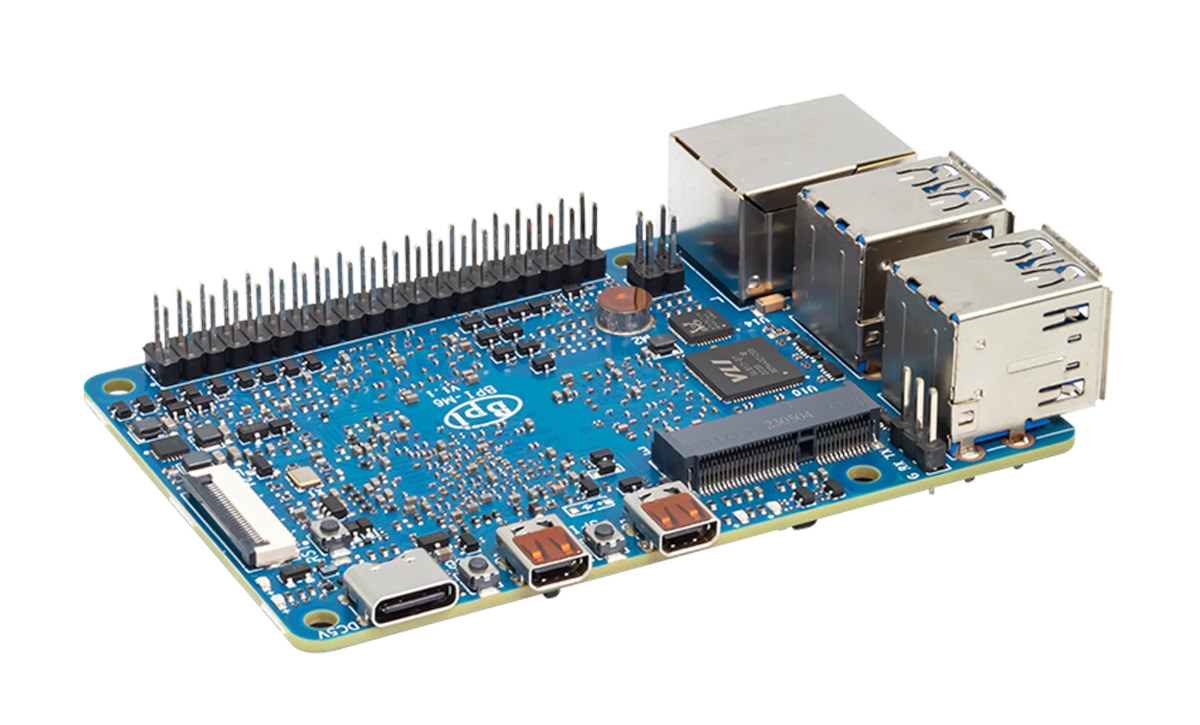
Banana Pi BPI-M6 is a credit-card single board computer based on SenaryTech SN3680 SoC comprised of a quad-core Arm Cortex-A73 processor, an Arm Cortex-M3 real-time core, an Imagination GE9920 GPU, and an NPU delivering up to 6.75 TOPS. The board ships with 4GB LPDDR4 RAM and 16GB eMMC flash. Its layout is fairly similar to the one of the Raspberry Pi 4 with four USB ports, Gigabit Ethernet, a 40-pin GPIO header, a USB Type-C port for power, and two micro HDMI ports. However, only one of those is for HDMI output, as the second is for HDMI input, and there’s also an M.2 Key-E socket for expansion. Banana Pi BPI-M6 specifications: SoC – SenaryTech SN3680 (also known as Synaptics VS680) with CPU – Quad-core Arm Cortex-A73 processor up to 2.1GHz MCU – Arm Cortex-M3 real-time security core @ 250MHz GPU – Imagination PowerVR Series9XE GE9920 GPU VPU – 4Kp60 […]