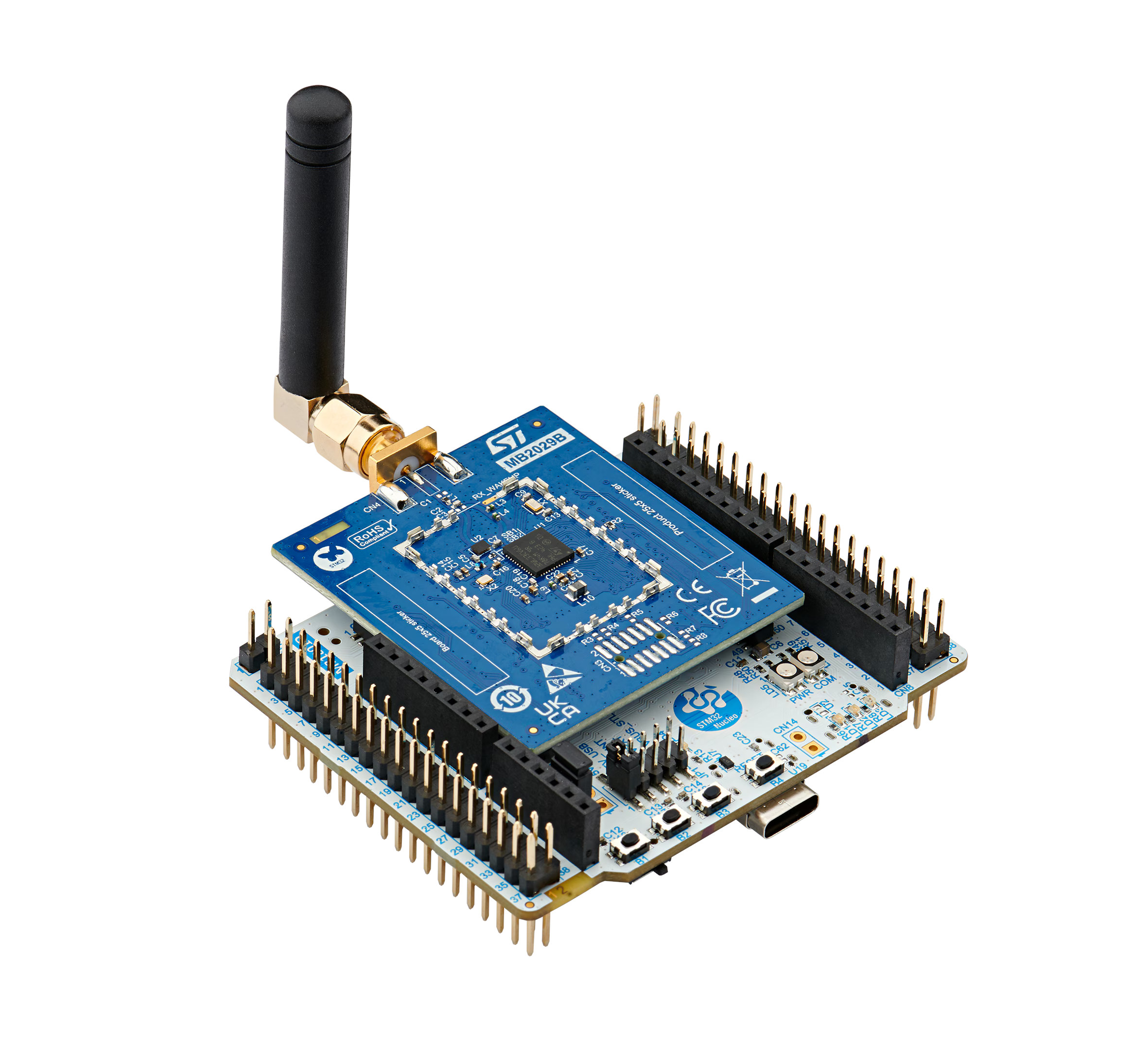
Seeed Studio Wio-LR1121 is a tiny, multi-band LoRa module based on LR1121 RF transceiver, a low-cost version of LR1120 without GNSS or Wi-Fi scanning capabilities, that supports sub-GHz, S-Band (1.9-2.1GHz), and 2.4GHz frequency bands. We had previously seen the LR1121 used in the MuRata Type-2GT module and a LILYGO module as an option for the T-Eth Elite board. The Wio-LR1121 offers another option that’s easy to solder, thanks to castellated holes and pads. Wio-LR1121 specifications: RF Transceiver – Semtech LR1121 Frequency bands – 863 to 928MHz and 2.4 to 2.5GHz frequencies; Note: The LR1121 also supports S-Band at 2.1 to 2.3 GHz, but it’s not mentioned in the specifications of the module, and only briefly in the title and description Output Power Up to 20.4dBm @ 868/915 MHz Up to 11dBm max @ 2.4GHz Receiver Sensitivity RxBoost ON: -126dBm @ SubG,BW=125KHz, SF = 7 -140dBm @ SubG, BW=125KHz, SF = […]
Maduino Zero Wi-Fi HaLow – An 802.11ah board programmable with the Arduino IDE
Makerfabs Maduino Zero Wi-Fi HaLow is an Arduino Zero-compatible Wi-Fi HaLow (802.11ah) development board designed for low-power, long-range wireless communication in smart agriculture, industrial automation, and remote monitoring applications. The board is built around the Microchip ATSAMD21G18 Cortex-M0+ MCU to manage I/O, system control, and interface with the TXW83xx-based WiFi HaLow module. It operates in the 730–950 MHz sub-GHz band, features a microSD card slot for storage, and two GPIO headers. The board gets power through a USB Type-C port or a 3.7V LiPo battery (chargeable via USB) and includes an external antenna for long-range connectivity. Maduino Zero Wi-Fi HaLow specifications: MCU – Microchip ATSAMD21G18A Arm Cortex-M0+ microcontroller @ 48 MHz with 256KB flash memory, 32KB RAM Storage – MicroSD card socket Wi-Fi HaLow TXW83xx series based on IEEE 802.11ah Frequency Range – 730 MHz to 950 MHz bands Channel bandwidth – 1/2/4/8MHz Data Range – 150 Kbps to 32.5 […]
M5Stack Stamp-S3A WiFi and BLE IoT module benefits from optimized antenna design, lower power consumption
M5Stack Stamp-S3A, also known as M5StampS3A, is an update to the M5Stamp S3 ESP32-S3 module introduced in 2023 with an optimized antenna design, lower power consumption, a larger user button, and a different logic for the RGB LED control. Other features remain the same with 8MB Flash, RGB LED, input button, and 23 GPIOs all in a tiny 26 x 18mm form factor. Two versions are available: the Stamp-S3A without pre-soldered headers and the Stamp-S3A PIN1.27 with headers soldered on the board and an orange heat-resistant cover. M5Stamp-S3A specifications: WiSoC – Espressif Systems ESP32-S3FN8 CPU Dual-core 32-bit Xtensa LX7 microcontroller with AI vector instructions up to 240MHz RISC-V ULP co-processor Memory – 512KB SRAM Storage – 8MB flash Wireless – 2.4GHz WiFi 4 (802.11b/g/n), Bluetooth 5.0 LE + Mesh Connectivity 2.4 GHz WiFi 4, 20 MHz and 40 MHz bandwidth, IEEE 802.11 b/g/n protocol, up to 150 Mbps Bluetooth 5, […]
ThinkNode M1/M2 Review – Getting started with Meshtastic
I’ve been writing about Meshtastic firmware and hardware since 2020, but I never had the opportunity to test it myself. This has now changed as Elecrow sent us the ThinkNode M1 and ThinkNode M2 Meshtastic nodes for review. Both rely on Semtech SX162x radios, but the M1 is based on a Nordic Semi nRF52840 Bluetooth MCU with a 1.54-inch E-Ink display and GPS, and the smaller M2 is based on an ESP32-S3 chip and a 1.3-inch OLED but lacks a built-in GPS module. Since I’ve never used Meshtastic before, this “review” will be more like a Getting Started Guide from a beginner’s perspective. After an unboxing and a teardown, I’ll test messaging, GPS sharing, and the range I can get in a suburban environment in Thailand. ThinkNode M1/M2 unboxing Both packages look similar, with a plastic case and a white cover. The ThinkNode M1’s main features include a high-gain antenna, […]
Raspberry Pi Radio Module 2 (RM2) is officially available for $4
Raspberry Pi has just announced the general availability of the Radio Module 2 (RM2) wireless module with WiFi 4 and Bluetooth LE connectivity for $4. The Raspberry Pi RM2 wireless module was already available to some select partners, which explains why the Raspberry Pi RM2 was found in the Pimoroni Pico Plus 2 W and SparkFun Thing Plus – RP2350 since the end of last year. The latest announcement just means it’s available to anybody, and documentation like the datasheet has been released publicly. Raspberry Pi Radio Module 2 (RM2) specifications: Chipset – Infineon CYW43439 combo chip 2.4 GHz Wi-Fi 4 (802.11b/g/n) up to 96 Mbps PHY rate, support for 20 MHz channels Bluetooth 5.2 Classic and LE SISO (Single Input, Single Output) configuration (1×1) Castellated edge pads 3x GPIO gSPI (general SPI) interface to Raspberry Pi microcontroller using PIO Power On/Reset pins Antenna – Shared 2.4 GHz antenna for […]
MEEPO V5 electric skateboard review – Unboxing, teardown, features and performance testing
I’ve just received an electric skateboard for review: the MEEPO V5. I initially thought I would skip that one since it’s not super relevant to the usual topics covered on CNX Software, but seeing bolts on the photos, I figured out it might still be interesting to do a teardown of the skateboard to see how it works. So here I am. I’ll also go through an unboxing first, and check its features and performance. MEEPO V5 unboxing The package was quite larger and longer than I expected. That’s partially because there were two packages: one for the electric skateboard itself, and the other for a helmet. The skateboard is also quite bigger and heavier (8kg) than the skateboards I tried to use when I was a child. The build quality looks excellent. There are some marks and dust on the wheels and deck because I tried it before taking […]
The Future of Asset Tracking: IoT at Scale with LTE-M technology
CNXSoft: This is a guest post by Ohad Peled, Product Marketing Manager at Sony Semiconductor Israel, about the challenges of tracking a large number of IoT assets and how LTE-M can help businesses scale tracking solutions. Over the last few years, asset tracking has emerged as a critical business function and is estimated to grow to a $34.5B market by 2032, according to Custom Market Insights. Whether businesses are monitoring a global supply chain or keeping tabs on expensive equipment, knowing where assets are at all times is essential. It enables businesses to optimize supply chains, prevent theft, and reduce operational downtime. There are several technical and commercial challenges in deploying such a solution, which could result in failure to deliver the promised value. Some solutions struggle to maintain accurate tracking as assets move within or across different facilities, especially if they go through an indoor environment. Others suffer from […]
ESP32-C61-DevKitC-1 development board features ESP32-C61 low-cost WiFi 6 and Bluetooth LE 5.0 SoC
The ESP32-C61-DevKitC-1 is a development board based on the ESP32-C61 low-cost WiFi 6 and Bluetooth LE 5.0 SoC that was first unveiled in January 2024, and has just entered mass production this month (June 2025). The board is offered with two USB-C ports, two buttons, an RGB LED, and GPIO headers. In my 2024 year in review report, I noted that Espressif would likely launch the ESP32-C5 dual-band WiFi 6 SoC in 2025, but I completely forgot about the ESP32-C61, which is basically a cost-down version of the ESP32-C6. The ESP32-C61-DevKitC-1 development board and ESP32-C61-WROOM-1 module are now available, so let’s have a closer look. ESP32-C61-DevKitC-1 specifications: Wireless module – ESP32-C61-WROOM-1 SoC – ESP32-C61HR2 CPU – Single 32-bit RISC-V core clocked up to 120MHz Memory – 320KB SRAM, 2MB PSRAM Storage – 256KB ROM Wireless – WiFi 6 and Bluetooth LE 5.0 Storage – 8MB QSPI flash Antenna – PCB […]