

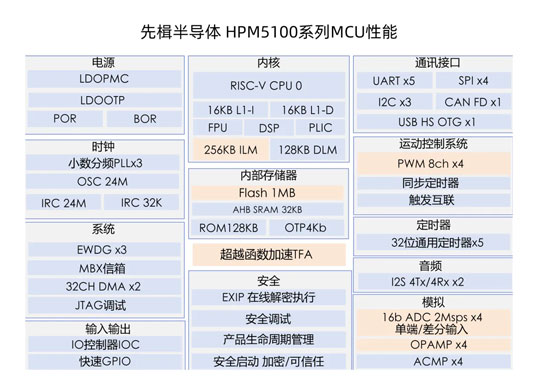
HPMicro has introduced the HPM5100 series, a family of 32-bit RISC-V mixed-signal MCUs, starting with the HPM5151 parts. It features a 400 MHz RISC-V processor, 416 KB SRAM, 1 MB flash, four 16-bit ADCs, four operational amplifiers, and four analog comparators.
It also includes a high-speed USB 2.0 OTG interface with an integrated PHY, CAN FD, multiple UART/SPI/I2C interfaces, and 32 PWM channels for motor control. The chip supports hardware floating-point operations and DSP instructions, while the integrated analog peripherals reduce the need for external ADCs and signal-conditioning circuits.

HPMicro HPM5100 specifications:
- MCU core – Single-core 32-bit RISC-V processor @ 400 MHz (up to 480 MHz in high-performance mode with external power supply)
- Hardware FPU, SIMD, and DSP instruction support
- 16 KB L1 instruction cache and 16 KB L1 data cache
- Up to 3.57 CoreMark/MHz
- Memory
- 416 KB SRAM
- 256 KB instruction local memory (ILM)
- 128 KB data local memory (DLM)
- 32 KB AHB SRAM
- Storage
- 1 MB SiP flash
- 128 KB Boot ROM and 4 Kbit OTP memory
- XPI interface supporting external serial NOR/NAND flash, HyperFlash, HyperRAM, and PSRAM
- Analog peripherals
- 4x 16-bit SAR ADCs at up to 2 MSPS, configurable to 12-bit resolution at up to 4 MSPS, with support for differential inputs
- 4x operational amplifiers configurable as programmable gain amplifiers (PGA)
- 4x analog comparators with internal 12-bit DAC reference generation
- USB – 1x USB 2.0 high-speed OTG interface with integrated PHY
- CAN Bus – 1x CAN controller supporting CAN FD at up to 8 Mbps
- Other interfaces
- 5x UART, 4x SPI, 3x I2C
- 2x I2S interfaces (not available on the QFN32 variant)
- Up to 79x GPIO
- Security – Secure boot, JTAG protection, 128-bit unique ID, and AES-128 CTR encrypted execution from external NOR flash
- Misc
- 4x 8-channel PWM modules (32 channels total)
- 3x general-purpose timer modules, each containing four 32-bit counters
- 3x watchdog timers
- Trigger routing and synchronization peripherals
- 2x 32-channel DMA controllers
- Power
- 3.0V to 3.6V main supply
- Selectable 1.8V/3.3V I/O banks
- Integrated LDO regulators and low-power wait, stop, and shutdown modes
- Package
- HPM5151IPEX – 14 × 14 mm LQFP100
- HPM5151IN8X – 8 × 8 mm QFN68
- HPM5151IN6X – 6 × 6 mm QFN48
- HPM5151IN5X – 5 × 5 mm QFN32
- Temperature range – −40°C to +105°C ambient temperature, with a maximum junction temperature of +125°C under rated operating conditions

Officially, the HPM5100 is a 400 MHz chip, but it actually features a 480 MHz “extreme” mode. To use it, you need to hook up an external power supply, and you can’t let the room get hotter than 70°C. The company also mentions that you shouldn’t run it that fast 24/7. HPMicro recommends sticking to 400 MHz or less for longer life.
On the software side, the HPM5100 is supported by HPMicro’s open-source HPM SDK, which includes low-level drivers, middleware, and software components such as FreeRTOS and TinyUSB. Support for the HPM5100 and HPM5100EVK was added in SDK version 1.13.0, released in September 2026. Developers can use Segger Embedded Studio for RISC-V, while HPMicro also provides development documentation and example applications through its SDK repository and online documentation.

The company also released the HPM5100EVK evaluation board, which includes an HPM5151 MCU, external QSPI NOR flash, an ES8389 audio codec, a CAN transceiver, and an onboard HPM5301 debugger supporting JTAG and serial communication. The board also features two USB Type-C ports for debugging and USB OTG, a motor control connector, dedicated ADC and OPAMP connectors, and a Raspberry Pi-compatible 40-pin expansion header. For power, an onboard jumper lets you select an internal LDO or an external DC-DC supply. More information about the development board is available in the documentation section.
Previously, we wrote about the HPMicro HPM64G0, a 1 GHz RISC-V microcontroller with a 2D graphics engine and dual Gigabit Ethernet, as well as the HPM6800 series, which offers a 600 MHz RISC-V CPU and optional Vivante 2.5D GPU for HMI and display applications. Compared to the previous MCUs, the HPM5100 series features analog sensing and motor control, with four 16-bit ADCs supporting up to 2 MSPS, up to 48 analog input pins, and four 8-channel PWM controllers.
The HPM5100 series is currently in mass production, with the HPM5151IN61 (QFN48), HPM5151IN81 (QFN68), and HPM5151IPE1 (LQFP100) available from Huaqiu Mall for ¥15.60, ¥16.90, and ¥19.50, respectively ($2.33,$2.52, and $2.91). The HPM5100EVKREVB evaluation board is also available for ¥258 (about $38.50). These prices include domestic Chinese taxes and exclude shipping. Check out the product page for details. [CNXSoft note: the hqchip website blocks some user agents, and doesn’t seem to like Linux hosts. I could enter the website using Chrome on Ubuntu with Surface Pro 10 user agent].

Debashis Das is a technical content writer and embedded engineer with over five years of experience in the industry. With expertise in Embedded C, PCB Design, and SEO optimization, he effectively blends difficult technical topics with clear communication
Support CNX Software! Donate via cryptocurrencies, become a Patron on Patreon, or purchase goods on Amazon or Aliexpress. We also use affiliate links in articles to earn commissions if you make a purchase after clicking on those links.


If it’s targeting industrial motor control (which fits with the CAN and ADCs), why the I2S? Why do all the China micros use sip flash rather than on-die? That extreme mode doesn’t seem to fit with industrial motor control reliability, either. Odd chip.
I would like to see how the timers work. I’m tired of 32 bit micros with 16 bit capture peripherals.
They show a transcendental accelerator…I wonder if it’s designed for FOC?
[ … ‘tired of 16bit capture peripherals’, just mentioning Tesla Roadster 🙂 … (thx) ]