Machdyne’s FERRIT is a modular USB F-RAM storage device with a capacity of up to 256 MB and capable of storing data for up to 200 years with a virtually unlimited number of writes and high-radiation resistance. It builds upon the earlier Blaustahl F-RAM storage device that only offers 8KB capacity. The FERRIT device supports 8 MB to 256 MB by combining up to 256 individual 1 MB F-RAM ICs. The prototype below is housed in a metal frame and looks like a typical cluster solution. FERRIT specifications and key features: FERRIT-CY controller based on Raspberry Pi RP2040 MCU with USB-FS Type-C port FERRIT-M8 removable ferroelectric memory cards with up to 16MB capacity using 16x 1MB F-RAM ICs (double-sided: 2x 8 chips) FERRIT-16 backplane with slots for FERRIT-CY and 16x FERRIT-M8 connected over SPI/QSPI bus Max capacity – 256 MB+ through up to 256x memory devices (16 memory cards with 16 chips) […]
ESP32-P4 security key features 2-inch touchscreen, 3,000+ password capacity (Crowdfunding)
MiixKeyPro (previously MiixKey) is a compact, offline ESP32-P4-based hardware security key and password manager that securely stores passwords, passkeys, NFC cards, and smart card credentials in a single portable device. It features a 2-inch touchscreen and is designed for users, developers, enterprises, government staff, and cybersecurity professionals who need secure offline credential management without relying on cloud services or smartphone apps. Previously, we wrote about security keys like the YubiKey and Google Titan Security Key, which are great for FIDO2 and U2F login, but they don’t have a display or user interface, so managing passwords or switching credentials usually requires a phone or computer. MiixKeyPro fixes this by adding a touchscreen and allowing the user to manage over 3,000 passwords fully offline. MiixKeyPro specifications: Main SoC – Espressif Systems ESP32-P4 CPU Dual-core 32-bit RISC-V HP (High-performance) CPU @ up to 400 MHz with AI instructions extension and single-precision FPU Single-RISC-V LP (Low-power) MCU core @ […]
Blaustahl USB storage device features 8KB FRAM with up to 200 years of data retention
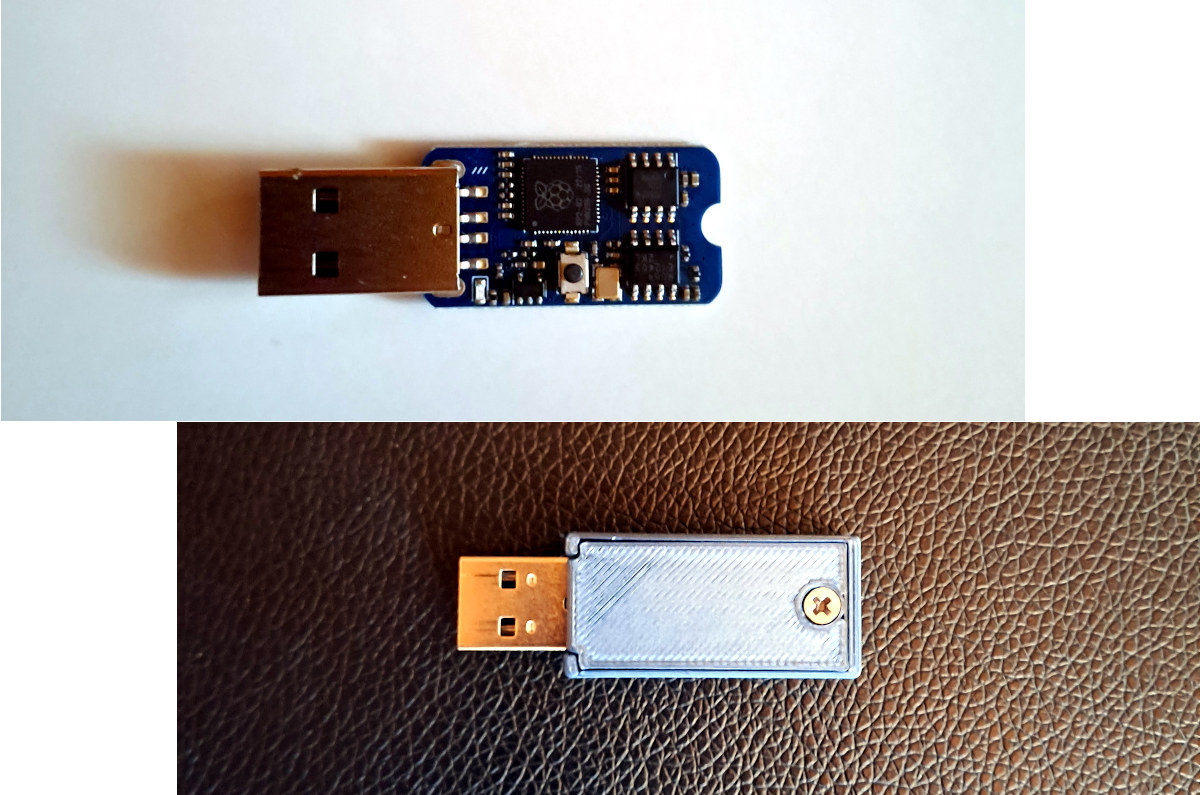
Machdyne’s Blaustahl is a USB storage device equipped with a Raspberry Pi RP2040 MCU and 8KB of FRAM with a potential lifespan of over 200 years and designed for long-term storage of text up to about 8,000 characters. FRAM (Ferroelectric RAM) has been around for years delivering ultra-low power consumption, faster writes, and ultra-long write endurance (one million billion read/write cycles) compared to EEPROM or NOR flash, but the cost is quite higher and it’s mostly used in applications that require ultra-low power consumption and non-volatile storage write capabilities such as data logging, sensor networks, batteryless applications. The Blaustahl storage device and USB text editor is one of those. Blaustahl speciications: Microcontroller – Raspberry Pi RP2040 dual-core Cortex-M0 processor at 133MHz and 264kB RAM. Storage 4MB (32Mbit) NOR flash for firmware 8KB (64Kbit) FRAM (Fujitsu MB85RS64) Lifespan – 95 years @ +55°C, over 200 years @ +35°C Endurance – 10^12 […]
The New IoT Device Security Specification 1.0 unifies various standards into one
The Connectivity Standards Alliance has recently introduced its IoT Device Security Specification 1.0, a way to defragment many security standards into one. This common scheme and certification standard will ensure that devices meet local requirements in each country. With this approach, a single test from the alliance ensures that the product can be sold globally without any compliance issues. IoT Device Security Specification 1.0 at a glance: Unified Security Standard – Integrates the major cybersecurity baselines from the United States, Singapore, and Europe into one comprehensive framework. Product Security Verified Mark – A new certification mark that indicates compliance with the IoT Device Security Specification, designed to enhance consumer trust and product marketability. No Hardcoded Default Passwords – Ensures all IoT devices utilize unique authentication credentials out of the box, improving initial security. Unique Identity for Each Device – Assigns a distinct identity to every device, crucial for traceability and secure […]
Kryptor FPGA – Tiny MAX10 FPGA board works as a hardware security module (Crowdfunding)
Kryptor FPGA, sometimes just called Kryptor, is a compact Intel/Altera MAX10 FPGA development board mostly designed for encryption, and acting as a dedicated Hardware Security Module (HSM) with a custom soft-core from Skudo OÜ. But obviously, you could also use the FPGA board for other purposes. Hardware encryption can be quite more secure than software-based encryption with reduced attack surfaces, especially since data processing can be done in the FPGA RAM. The HSM can be used to encrypt files, videos, emails, IoT messages, etc… from various hardware platforms including Arduino and Raspberry Pi boards. Contrary to closed-sourced commercial solutions, the soft-core is open-source and as such can be verified by third parties to make sure there aren’t any backdoors or security flaws. Kryptor FPGA specifications: FPGA – Intel/Altera MAX10 8K LE ( 10M08DAF256C8G) FPGA @ 100 MHz with 8000 logic elements (LE), 1376 Kb flash, 378 Kb total RAM, up […]
Linux 5.8 Release – Main Changes, Arm, MIPS, and RISC-V Architectures
Linus Torvalds has just released Linux 5.8: So I considered making an rc8 all the way to the last minute, but decided it’s not just worth waiting another week when there aren’t any big looming worries around. Because despite the merge window having been very large, there really hasn’t been anything scary going on in the release candidates. Yeah, we had some annoying noise with header file dependencies this week, but that’s not a new annoyance, and it’s also not the kind of subtle bug that keeps me up at night worrying about it. It did reinforce how nice it would be if we had some kind of tooling support to break nasty header file dependencies automatically, but if wishes were horses.. Maybe some day we’ll have some kind of SAT-solver for symbol dependencies that can handle all our different architectures and configurations, but right now it’s just a manual […]
Seeeduino Crypto Board Combines Microchip ATmega4809 MCU and ECC608 Crypto Chip
With the advance of IoT, security has become critical since devices are often connected to the Internet. There are several ways to improve security and one of them is to implement hardware security via crypto chips. One of those chips is Microchip ECC608 (aka ATECC608A) secure element which we previously found in Linux based hardware such as USB Armory MK-II USB Linux computer, and the official Arduino Nano 33 IoT Board. Seeed Studio has now introduced a new Arduino compatible board with Microchip ECC608 crypto chip: Seeeduino Crypto board powered by a Microchip ATmega4809 8-bit AVR MCU. Seeeduino Crypto specifications: MCU – Microchip ATMEGA4809-AFR 8-bit AVR microcontroller @ 16 MHz with 48KB flash, 6,144 Bytes RAM USB – 1x USB Type-C port Expansion Arduino Uno headers with 6x analog inputs, 14x digital I/O pins, 5x PWM 2x I2C Grove headers 1x UART Grove header HW Security – Microchip ECC608 secure […]
Linux 5.0 Release – Main Changes, Arm, MIPS & RISC-V Architectures
Linus Torvalds has just released Linux 5.0: Ok, so the last week of the 5.0 release wasn’t entirely quiet, but it’s a lot smaller than rc8 was, and on the whole I’m happy that I delayed a week and did an rc8. It turns out that the actual patch that I talked about in the rc8 release wasn’t the worrisome bug I had thought: yes, we had an uninitialized variable, but the reason we hadn’t immediately noticed it due to a warning was that the way gcc works, the compiler had basically initialized it for us to the right value. So the same thing that caused not the lack of warning, also effectively meant that the fix was a no-op in practice. But hey, we had other bug fixes come in that actually did matter, and the uninitialized variable _could_ have been a problem with another compiler. Regardless – all […]