hailo News - CNX Software - Embedded Systems News

Raspberry Pi AI HAT+ 2 review – A 40 TOPS AI accelerator tested with Computer Vision, LLM, and VLM workloads

Raspberry Pi AI HAT+ 2 review VLM chat test

Raspberry Pi sent me a sample of their AI HAT+ 2 generative AI accelerator based on Hailo-10H for review. The 40 TOPS AI accelerator is advertised as being suitable for LLMs (Large Language Models) and VLM (Vision Language Models), while delivering about the same performance as the first-generation AI HAT+ (Hailo-8) for AI vision/computer vision models. After going through an unboxing, I’ll assemble the AI HAT+ 2 to a Raspberry Pi 5 with 2GB of RAM fitted with a Raspberry Pi Camera Module 3, before quickly checking whether AI vision models work as expected, and spending more time on testing LLM and VLM samples. Raspberry Pi AI HAT+ 2 unboxing My sample had a somewhat long and rough trip from the UK to Thailand, and the package did not look that good when DHL delivered it. But luckily, nothing was damaged, and I got the AI HAT+ 2 with a […]

Raspberry Pi AI HAT+ 2 targets generative AI (LLM/VLM) with Hailo-10H accelerator

Raspberry Pi AI HAT+ 2 Hail 10H

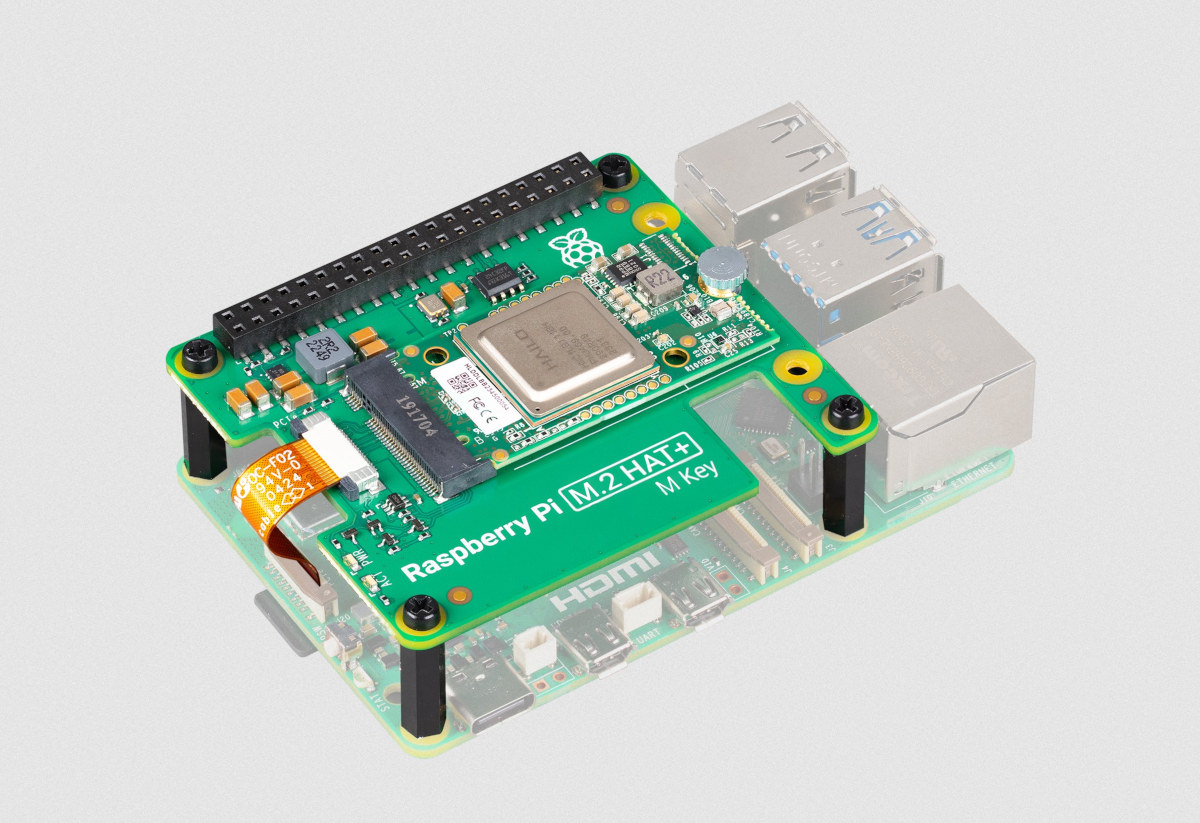
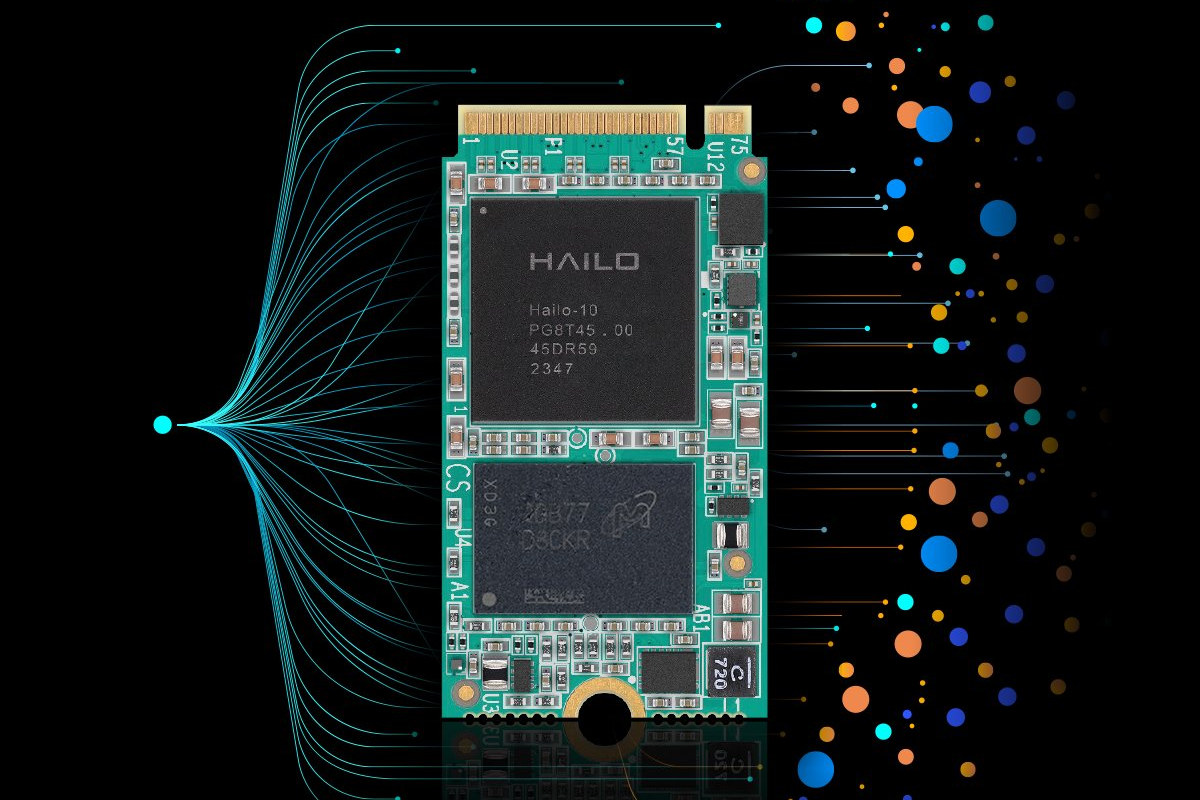
The Raspberry Pi AI HAT+ 2 is an add-on board based on the 40 TOPS Hailo-10H AI accelerator with 8GB of dedicated on-board RAM that brings generative AI capability to Raspberry Pi 5. While it delivers similar computer vision performance as the first-generation Hailo-8-based Raspberry Pi AI HAT+, the AI HAT+ 2 also adds support for large language models (LLMs) and vision-language models (VLMs) running locally without the need for Internet access. Target applications include offline process control, secure data analysis, facilities management, and robotics. Raspberry Pi AI HAT+ 2 specifications: AI accelerator – Hailo Hailo-10H AI accelerator delivering 40 TOPS (INT4) inferencing performance Performance for computer vision models comparable to the Raspberry Pi AI HAT+ (26 TOPS) 8GB on-board RAM Host interface PCIe Gen3 x1 FPC connector to Raspberry Pi 5 40-pin GPIO header (no signal used by the Hailo-10H, it only extends the GPIO header on the Pi) […]

UP Squared Pro TWL AI Dev Kit Review – Intel N150 + Hailo-8L accelerator tested on Ubuntu 24.04

Intel N150 SBC Hailo-8L module with Heatsink

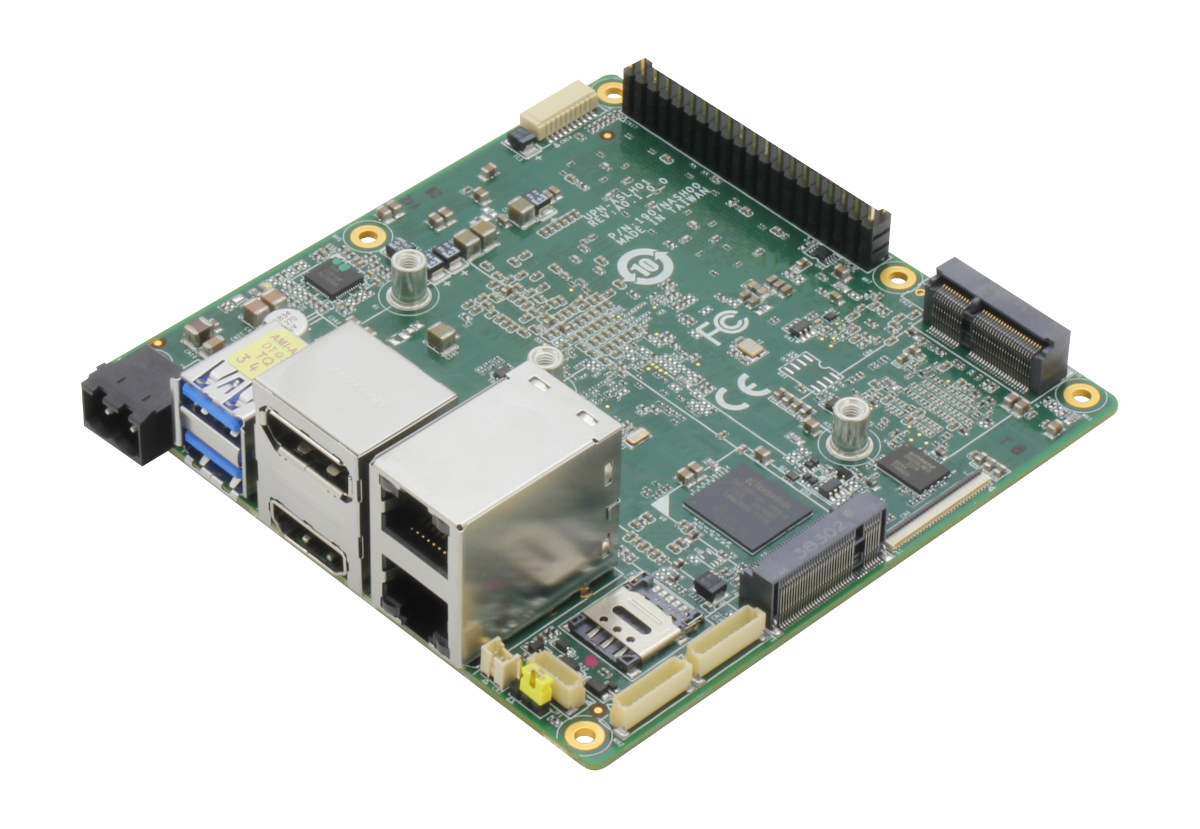
I’ve been asked to review three Intel-based UP AI development kits running Ubuntu 24.04 Pro. Last time, I tested the UP TWL SBC with Nx Meta and UP AI Toolkit, and most AI workloads would pass, but since these were running on the Intel N150 CPU or GPU, the performance was not optimal for most. I’ll now switch to the UP Squared Pro TWL “mid-range” AI devkit review with another Intel Processor N150 SBC fitted with a 13 TOPS Hailo-8L M.2 AI accelerator. Both the UP TWL and UP Squared Pro TWL come with a 64GB eMMC flash, and I found out it was rather tight since AI software and models can take a lot of space. The UP Squared Pro TWL has a few M.2 sockets, so I’ll install an NVMe SSD to expand storage before installing the UP AI toolkit. As usual, I’ll run a few benchmarks and […]

Review of Intel-based UP AI development kits – Part 1: Unboxing and first boot to Ubuntu Pro 24.04

UP AI Development Kits review

AAEON sent me three Intel-based UP AI development kits for review, namely the credit card-sized, Intel N150-based UP TWL, the Intel N150-based UP Squared Pro TWL with M.2 expansion slots and a Hailo-8L module, and the more powerful UP Xtreme ARL equipped with a 14-core Intel Core Ultra 5 225H processor. They offer entry-level, mid-range, and high-end x86-based alternatives to the AAEON NV8600-Nano AI developer kit I reviewed last August, equipped with an NVIDIA Jetson Orin Nano 8GB. All three models ship with Ubuntu Pro 24.04 and support the UP AI Toolkit and Network Optix’ Nx Meta IP video management platform. I’ll review all three models independently, but in this first part, I’ll go through the hardware and quickly try one of the boards. Unboxing Those are development kits that ship with not only the board, but also the same USB VGA camera provided with the NV8600-Nano kit, power supplies, […]

Pironman 5 Max Review – A fancy Raspberry Pi 5 Tower PC enclosure with dual M.2 PCI sockets for SSD and/or AI accelerator

Pironman 5 Max Tower PC review

SunFounder has sent me a review sample of the Pironman 5 Max Tower PC case for the Raspberry Pi 5 SBC. We had already reviewed the Pironman 5 last year, but the new Max model has various improvements, including a sleeker design made of black aluminum and semi-transparent black acrylic panels, a dual NVMe PiP expansion board for two M.2 NVMe SSDs (optionally in RAID 0/1 configuration), or one NVMe SSD and one AI accelerator module, a Tap-to-Wake feature for the OLED information display, and programmable RGB LEDs for the two fans. So the Pironman 5 Max deserves another review of its own.  I’ll be doing an unboxing, going through the assembly instructions and software installation, before testing the new features, and finally, the cooling efficiency of the solution. Pironman 5 Max unboxing I received the Pironman 5 Max in its retail package along with a Raspberry Pi AI Kit […]

PCIe3.0 to Dual M.2 HAT+ for Raspberry Pi 5 features ASMedia ASM2806 PCIe 3.0 switch

PCIe 3.0 to dual M.2 HAT for Raspberry Pi 5

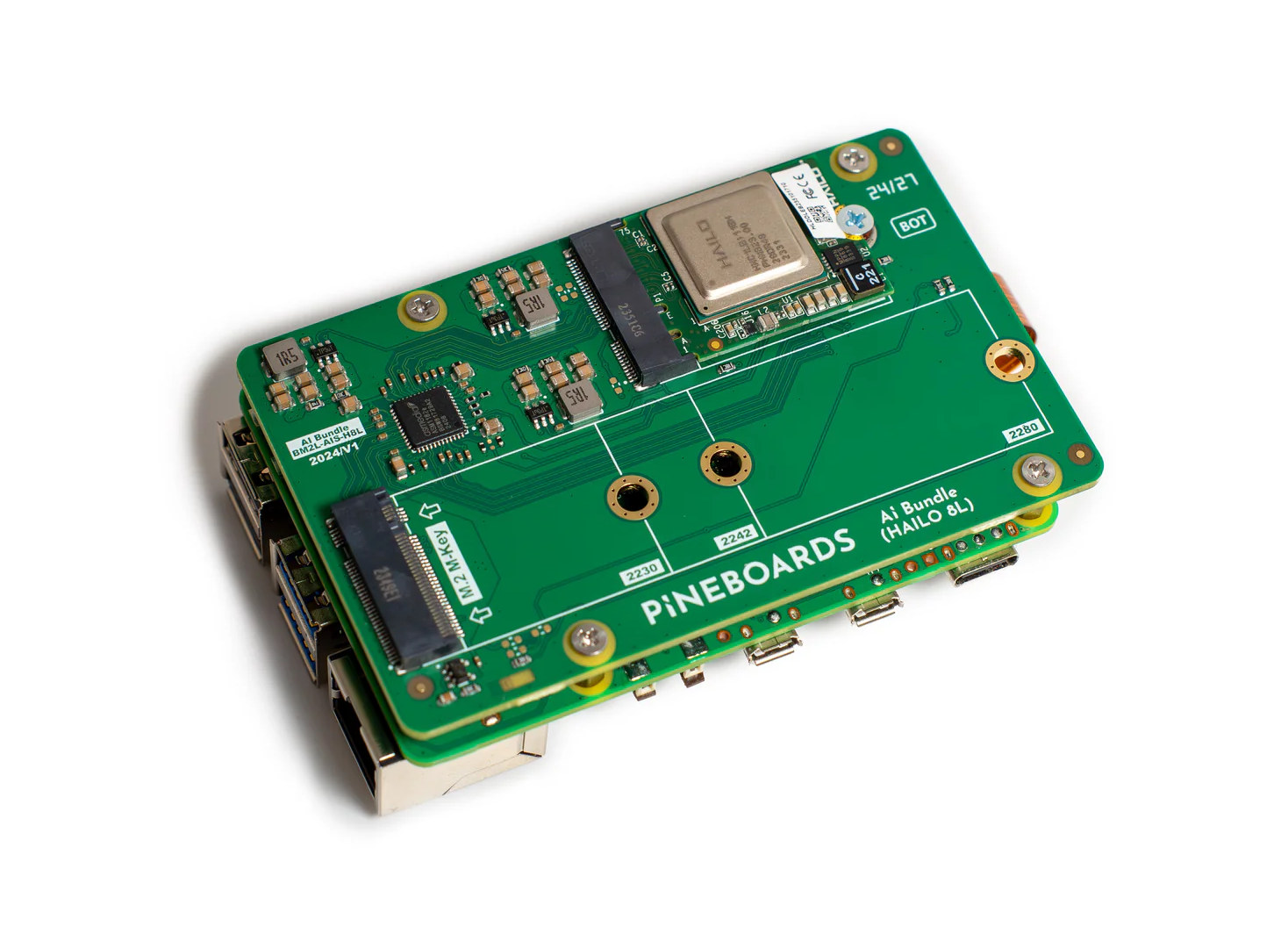
We’ve already covered Raspberry Pi HAT+ boards with multiple M.2 sockets with various keyings including the Geekworm X1004 HAT+, Pineboards HatDrive! AI, and  HatDrive! Dual with two sockets, and the Geekworm X1011 with four M.2 Key-M sockets. So when I saw Seeed Studio introduced a dual M.2 HAT+ board I initially thought it was uninteresting being a very similar board. However, all aforementioned PCIe to M.2 HAT+ boards are based on either the ASMedia ASM1182e or ASM1184e PCIe Gen2 x1 packet switches with 5GT/s shared bandwidth, and Seeed Studio’s PCIe3.0 to Dual M.2 HAT+ for Raspberry Pi 5 features instead an ASMedia ASM2806 PCIe 3.0 switch supporting up to 8GT/s shared bandwidth through the Raspberry Pi 5’s PCIe Gen3 x1 interface. Seeed Studio PCIe 3.0 to Dual M.2 HAT+ key features and specifications: Supported SBC – Raspberry Pi 5 and potentially other SBCs with a PCIe FFC connector like the […]

Raspberry Pi 5 edge AI computer ships with 8GB RAM, Hailo-8 AI module, supports Frigate NVR

Raspberry Pi 5 Edge AI computer

Seeed Studio’s reComputer AI R2130-12 is an Edge AI computer with a Raspberry Pi 5 SBC with 8GB RAM and a Hailo-8 module with 26 TOPS of AI performance, suitable for video analytics, machine vision, and intelligent edge computing. The computer comes with a HAT+ with two M.2 sockets, one occupied by the Hailo-8 AI accelerator and the other available for an M.2 NVMe SSD. In some ways, it’s just a nicely packaged Raspberry Pi 5 SBC with Hailo-8 AI accelerator that we reviewed last year. reComputer AI R2130-12 specifications: SBC – Raspberry Pi 5 with 8GB RAM AI Processor – Hailo-8 M.2 AI accelerator module with 26 TOPS Storage microSD card slot, with support for high-speed SDR104 mode Optional M.2 NVMe SSD via M.2 PCIe 3.0 slot Video Output – 2x micro HDMI ports up to 4Kp60 Camera/Display I/F – 2x 4-lane MIPI camera/display transceivers Networking Gigabit Ethernet RJ45 […]

Getting Started with Raspberry Pi AI HAT+ (26 TOPS) and Raspberry Pi AI camera
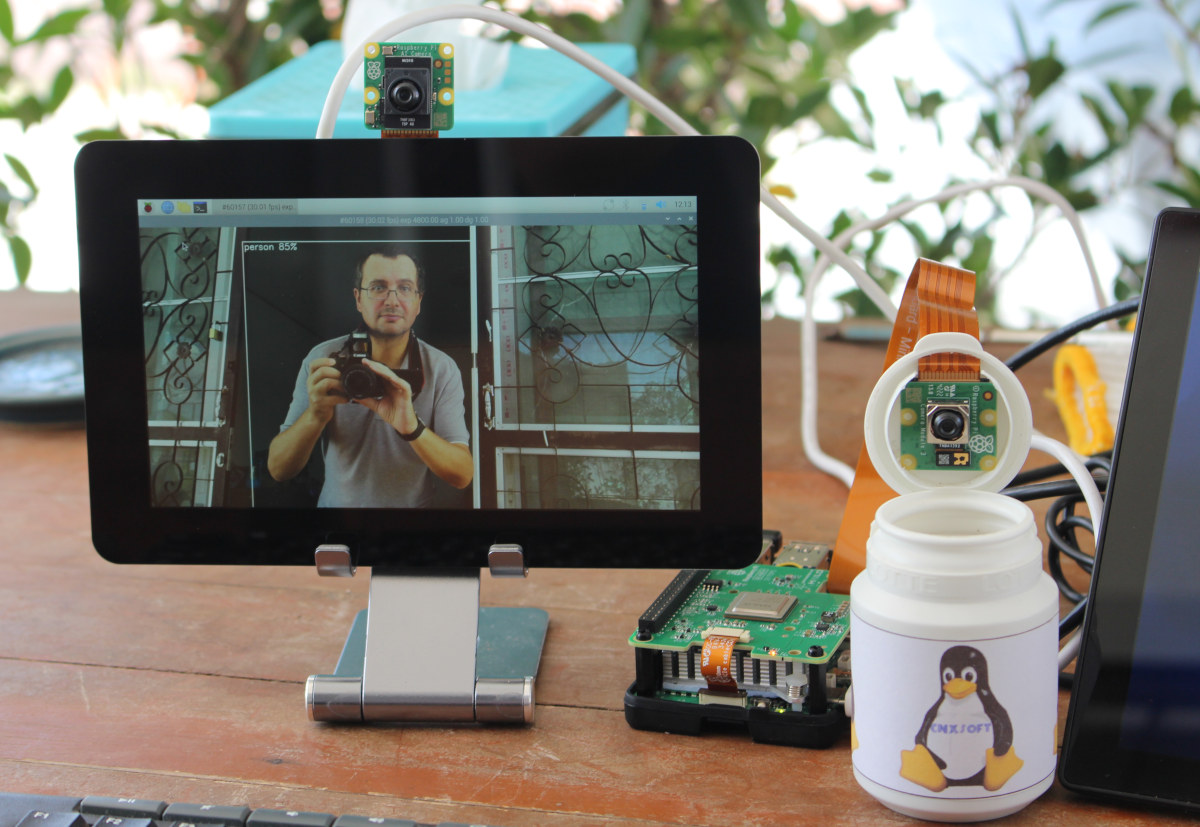
Raspberry Pi AI HAT+ and AI camera review

Raspberry Pi recently launched several AI products including the Raspberry Pi AI HAT+ for the Pi 5 with 13 TOPS or 26 TOPS of performance and the less powerful Raspberry Pi AI camera suitable for all Raspberry Pi SBC with a MIPI CSI connector. The company sent me samples of the AI HAT+ (26 TOPS) and the AI camera for review, as well as other accessories such as the Raspberry Pi Touch Display 2 and Raspberry Pi Bumper, so I’ll report my experience getting started mostly following the documentation for the AI HAT+ and AI camera. Hardware used for testing In this tutorial/review, I’ll use a Raspberry Pi 5 with the AI HAT+ and a Raspberry Pi Camera Module 3, while I’ll connect the AI camera to a Raspberry Pi 4. I also plan to use one of the boards with the new Touch Display 2. Let’s go through a […]