The DFRobot LoRaWAN Control Terminal is a compact, DIN-rail mountable industrial IIoT terminal that features long-range LoRaWAN connectivity with local sensing and control capabilities. It’s designed for industrial, agricultural, and building-automation scenarios that need reliable, low-power wireless communication up to 4 km. The terminal supports the standard LoRaWAN protocol (OTAA/ABP, Class A/C) with up to 4 km line-of-sight range and works with private gateways or public networks like TTN. It integrates a 0–10V analog input, optically isolated digital inputs, and RS485/Modbus sensor support, along with a built-in relay output for direct actuation. There’s also support for visual rule-based automation for relay switching, RS-485 commands, or uplink messages; the device continues operating offline using preset logic. The unit operates from 12–24V, includes adjustable transmission parameters, and supports firmware upgrades and factory resets. DFRobot LoRaWAN Control Terminal specifications: SoC/Main Controller – TBD Wireless LoRaWAN 863–870 MHz, 16 dBm Tx power (EU, DFR1120-868) LoRaWAN […]
EBYTE ECM50-A industrial ESP32-S3 controller offers RS232, RS485, DI/DO, Ethernet, and 4G LTE or LoRa connectivity
EBYTE ECM50-A is a compact, industrial-grade programmable controller built around the ESP32-S3 wireless SoC designed for IoT and edge control applications, such as environmental monitoring and remote telemetry in the smart industry, energy, and utilities sectors As it’s built around the ESP32-S3, it features Wi-Fi and Bluetooth LE, but the controller also supports Fast Ethernet, 4G LTE or LoRa connectivity, and offers RS232/RS485, two digital inputs, two digital outputs/relays, and two analog inputs (4–20 mA/12-bit), as well as a microSD card slot for data logging. The ECM50-A also implements various communication protocols like TCP/IP, HTTP, MQTT, and Modbus TCP master/slave. The industrial controller is designed to operate in the -40°C to 85°C temperature range. EBYTE ECM50-A specifications: Wireless Module – ESP32-S3-WROOM-1 SoC – Espressif Systems ESP32-S3R8 CPU – Dual-core Tensilica LX7 up to 240 MHz with vector extension for AI/ML workloads RAM – 512KB SRAM, 8MB PSRAM ROM – 284KB Wireless […]
80 GHz mmWave liquid level detection sensor supports ModBus, offers 40m range
I’ve just come across a no-name non-contact, high-precision 80 GHz mmWave radar sensor for liquid level detection with a 40m range, ±5mm accuracy, and Modbus communication over UART. We had seen 24 GHz and 60 GHz mmWave sensors mostly for precise motion detection, but it’s the first time I’ve seen an 80 GHz mmWave sensor, or more exactly, 79 GHz. It operates on the same principle of Frequency Modulated Continuous Wave (FMCW) radar as most other mmWave sensors and connects to an Arduino or other board over UART. It targets applications such as smart water management, industrial process control, and environmental disaster prevention/monitoring. Specifications: MCU – GigaDevice GD32F405 Arm Cortex-M4F microcontroller @ 168 MHz with 192KB SRAM, 3MB flash, 1MB code-flash Transmit frequency – 77–81 GHz (79 GHz mid frequency), 4 GHz bandwidth Output power (EIRP) – 13 to 20dBm Beamwidth (-3dB) Horizontal ±25°, Vertical ±25° With external lens: Horizontal […]
ESP32 Modbus gateway handles RTU, TCP/IP, and MQTT for industrial IoT
Designed by Namnam in Vietnam, the ESP32 Modbus gateway is built to communicate with PLCs and industrial sensors over Modbus RTU (RS-485) or Modbus TCP/IP (Ethernet/Wi-Fi). Designed for use in farms, factories, and electrical cabinets where reliable communication, remote monitoring, and control are required. Key features of this industrial IoT board include Modbus RTU/TCP master and slave support, automatic Wi-Fi/Ethernet switching, multi-Wi-Fi handling, watchdog timer, deep sleep, and FOTA updates via FTP. The board supports a wide input voltage range and can be programmed over USB. ESP32 Modbus gateway specifications Wireless Module – ESP32-WROOM-32 module with ESP32 dual-core processor @ 160 MHz, 520 Kbytes SRAM, 4 Mbit Flash Connectivity 10/100Mbps Ethernet RJ45 port via LAN8720A controller Wifi and WiFi 802.11 b/g/n, Bluetooth 4.2 via ESP32 RS485 – SP485EE transceiver (Serial2, auto DERE) USB – USB Type-C port for programming and power Misc Onboard Red, Blue, and Pwr LED User and […]
DIN rail-compatible industrial relay board features 4 outputs, 4 analog/digital inputs, RS-485 interface
The ESC3B04 is a compact DIN rail-compatible relay board built around the ESP32-C3 Super Mini module for building Wi-Fi remote switches, voltage monitoring systems, motor control, timed automation, and RS-485-based setups. The board features four 10A relay outputs, four 0–5V/10V analog voltage inputs (also configurable as 12–24V PNP digital inputs), an RS-485 interface, and a push-button input. It operates on a 7–25V DC supply and supports direct installation in control panels or DIN-rail enclosures. ESC3B04 relay board specifications: Wireless module –16-pin ESP32-C3 Super Mini module SoC – Espressif Systems ESP32-C3FH4, single-core 32-bit RISC-V microcontroller @ up to 160 MHz; 400 KB SRAM; 4MB flash USB – 1x USB Type-C port for programming Ceramic antenna I/Os and expansion 4x relays (10A/240VAC) 4x 0-5V/0-10V analog voltage inputs (can be used as 12-24V digital inputs) Serial – RS-485 interface for Modbus or custom protocol communication Misc User button Power LED Power Supply 7-25V […]
PD.Charger-GSM v2.5 – An industrial solar MPPT charger with Wi-Fi, LTE/GPS, and RS485
The PD.Charger-GSM v2.5 is an industrial-grade solar and LiFePo4 charger/controller with MPPT support, designed for 2–4 cell Li-Ion/LiFePo4 batteries. With various connectivity options and a cryptographic co-processor, it’s ideal for IoT, remote solar power systems, and battery-powered industrial applications. The device features a dual-MCU architecture where the STM32 handles battery charging and monitoring, and an ESP32 manages WiFi and Bluetooth connectivity, as well as LTE/NB-IoT GSM/GPS, and RS-485 with ModBUS support. The board also offers two solar inputs with MPPT, a DC adapter input, automatic buck/boost control, SMA connectors for all RF interfaces, a USB Type-C for programming, and expansion headers for prototyping. A hardware crypto co-processor handles secure key storage, TLS encryption, and secure boot. PD.Charger-GSM v2.5 specifications: SoCs STM32L051xx MCU for battery management and monitoring ESP32-D0WDQ6-V3 dual-core Xtensa LX6 processor, 240 MHz, 16MB Flash, 8MB PSRAM Display – Supports optional PD.Screen / PD.Screen_PRO modules for real-time display of […]
Industrial 6-Channel RP2350 relay module offers RS485 interface, Raspberry Pi Pico HAT support
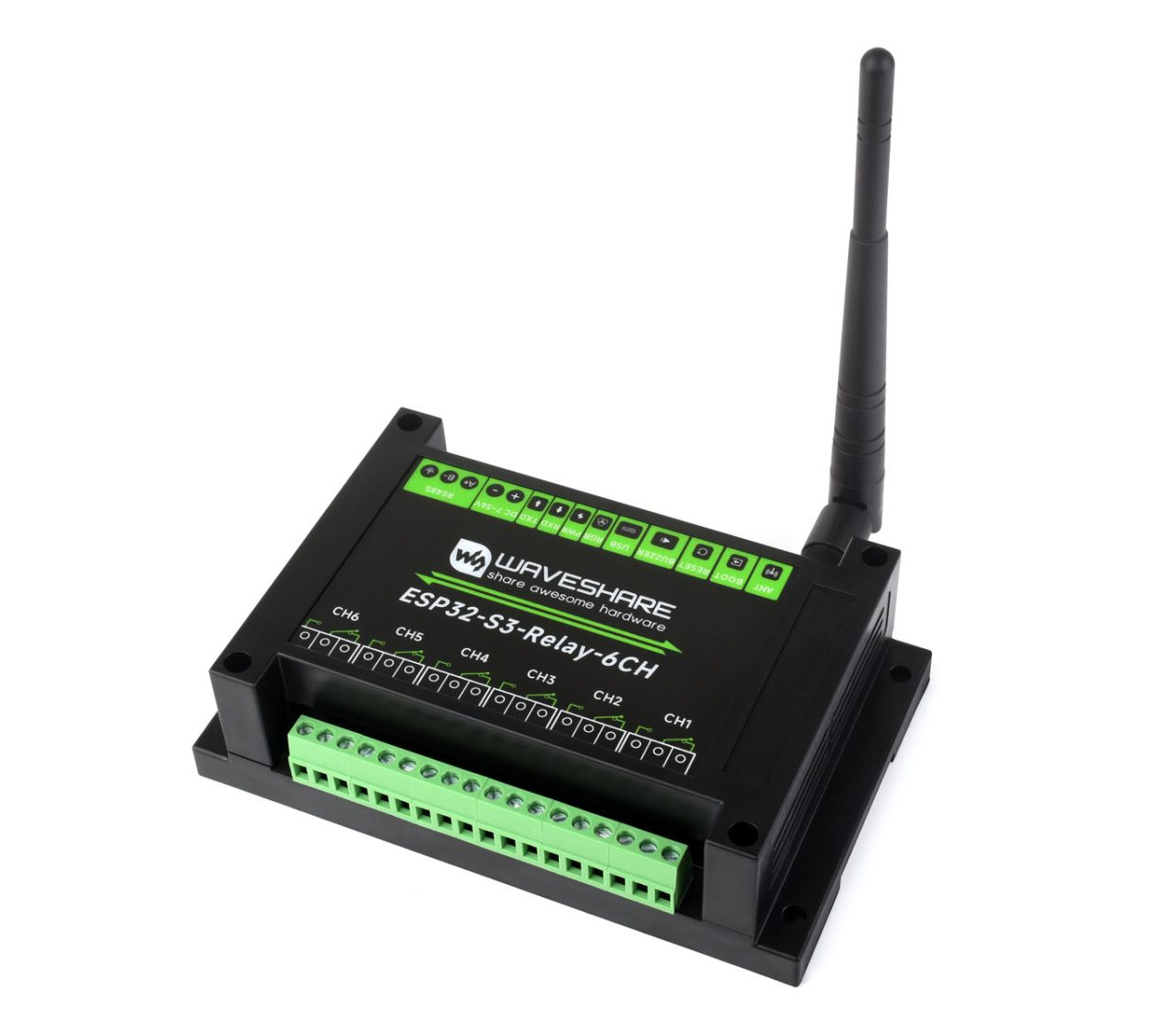
Waveshare RP2350-Relay-6CH is a Raspberry Pi RP2350-based industrial 6-channel relay module with an isolated RS485 interface, 7 to 36V DC input via a terminal block, and support for Raspberry Pi Pico HATs. Each relay is isolated and can handle 250VAC/30VDC up to 10A, a USB-C port is used for firmware updates, and the module also includes a buzzer, a few LEDs, as well as Reset and BOOT buttons, with everything housed in a DIN-Rail enclosure. Waveshare RP2350-Relay-6CH specifications: Microcontroller – Raspberry Pi RP2350B CPU Dual-core Arm Cortex-M33 @ 150 MHz with Arm Trustzone, Secure boot OR Dual-core RISC-V Hazard3 @ 150 MHz Either two cores can be used. Memory – 520 KB on-chip SRAM Package – QFN-80 Relay – 6x relays Contact rating – ≤10A 250VAC/30VDC Contact form – 1NO 1NC via screw terminals Optocoupler isolation USB – USB Type-C port for power, data, and firmware flashing Serial Isolated RS485 […]
Kappa4310Rasp – A Modbus RTU HAT for Raspberry Pi based on IS4310 Slave stack chip
The Kappa4310Rasp is a Raspberry Pi-compatible Modbus RTU HAT designed to evaluate the IS4310 Modbus RTU Slave stack chip. This allows engineers to simulate sensor and actuator interactions using a push-button and RGB LED without requiring a custom board or soldering. The board features an RS-485 interface with two RJ45 connectors for daisy-chaining Modbus networks. The board communicates with the Raspberry Pi over I²C and supports 500 Holding Registers along with Function Codes 3 (Read Holding Registers), 6 (Write Single Register), and 16 (Write Multiple Registers). The HAT operates at 3.3V and includes jumpers to enable or disable onboard I²C pull-ups. Additional features include dedicated Tx/Rx indicator LEDs, a power LED, GPIO-connected RGB LEDs, and a push-button for real-time interaction. Kappa4310Rasp board specifications: Modbus RTU stack chip – IS4310 (I²C interface, 500 Holding Registers) Protocol support – Function Codes 0x03 (Read), 0x06 (Write Single), 0x10 (Write Multiple) Communication – RS485 […]