

Rockchip has unveiled the RK3688 AIoT SoC with Armv9.3 Cortex-A7xx cores delivering up to 250K DMIPS (RK3588 delivers 93K DMIPS), a 1 TFLOPS GPU, and a 16 TOPS NPU.
The new processor succeeds the Rockchip RK3588 octa-core Cortex-A76/A55 first announced in 2019, and also features a 128-bit LPDDR4/4x/5 memory interface, and a UFS 4.0 storage interface.
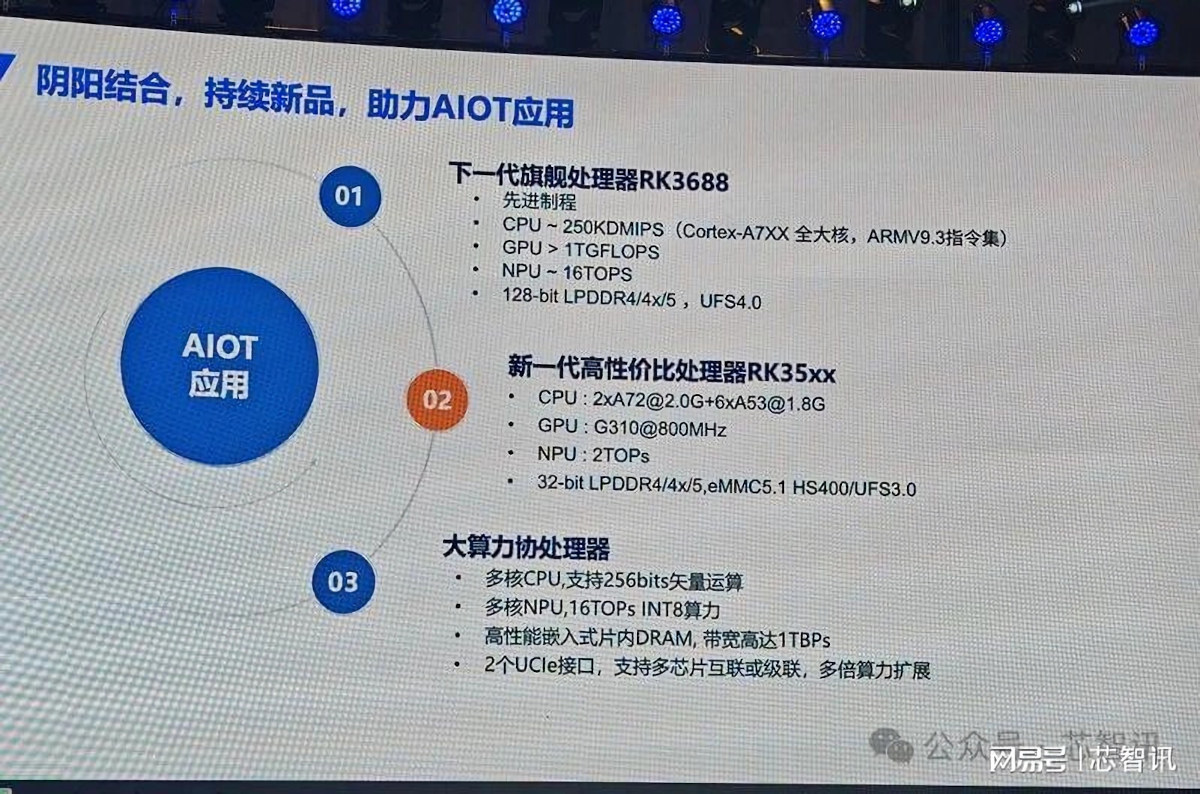
That’s about all we know about the RK3688 right now, but we can also deduct it’s probably based on a new, yet-to-be-announced Arm Cortex-A7xx core, possibly named Cortex-A730 or Cortex-A735, because no Arm cores have been announced with the Armv9.3 architectures. The Arm Cortex-A725 CPU core unveiled last May still relies on Armv9.2, and I’d expect new Arm cores to be introduced within the next few months unless Rockchip made a mistake in the presentation slide above.
Two other platforms were also announced at the same time starting with a new entry-level/mid-range RK35XX octa-core processor with two Cortex-A72 cores and six Cortex-A53 cores, an Arm Mali G310 GPU, a 2 TOPS NPU, plus LPDDR4/4x/5, eMMC 5.1, and UFS 3.0 memory and storage interfaces.
The third part is an unnamed high-performance co-processor featuring a CPU handling 256-bit vector instructions, a 16 TOPS NPU, and high-performance on-chip DRAM with a bandwidth of up to 1TB/s (or is that 1Tbps?). The chip also features two UCIe interfaces for multi-chip interconnection so I suspect it is for datacenters.
Back to the RK3688 processor. I first found it through a post on X by Radxa who plans to design the ROCK 6 SBC based on the new Armv9 SoC. Min.news also published the slide and some basic details about it and mentioned the processor is expected to launch next year. However, based on my experience covering semiconductor news, it may be an overly aggressive schedule, and I would only expect it in 2026. Time will tell.
Thanks to Paul for the tip.

Jean-Luc started CNX Software in 2010 as a part-time endeavor, before quitting his job as a software engineering manager, and starting to write daily news, and reviews full time later in 2011.


Support CNX Software! Donate via cryptocurrencies, become a Patron on Patreon, or purchase goods on Amazon or Aliexpress. We also use affiliate links in articles to earn commissions if you make a purchase after clicking on those links.


Nice, first step toward memory bandwidth increase by switching to 128 bits. It will catch up with x86 where only the mid-range has dual channel now, the entry-level has dropped it. This will definitely be needed to absorb the increase of AI-based tools (and the advertised NPU tends to confirm this quest).
Will it be the same failure as the RK3399 and what is looking the same for the RK3588?
It is an insult to bring something out new when the investment in supporting the previous generation has not been met.
If nobody were to take Rockchip and it’s board manufacturers up then they might be forced to provide a more fully functioning product very quickly.
This is not going to happen though because it is a new shiny thing to entice the people.
But based upon recent history, perhaps more might wait until there is maturity in the software before wasting their money.
> board manufacturers
Which ‘board’ manufactures are you talking about? SBC makers?
let’s hope for AV1 encode / decode via the GPU
You mean VPU I’m guessing.
Yes 🤦🏾♂️
AV1 is already decoded by VPU. The issue is that it cannot go until 8K but just 4K max. As is not usefull to have video in 8K HEVC, the only way to see a video in such size.
Interesting as thankfully a step up from another variant.
No word about pcie interface 🙁
Would be awesome to have at least 8x pcie3.0 so something like ROCK 5B+ would get two fast m.2 slots, second one for 10Gb nic, or maybe they will jump to that too?
What market segment are they targeting with this? Chromebooks, STB, NAS, etc.?
I view it as an upgrade to the RK3588 for applications that may benefit from higher performance, which means all of the above plus Edge AI gateways, surveillance applications, etc.
Anyway, use cases will continue to evolve by the time the chip really appears. The 3588 took 3 years to appear on a board, and is still not fully supported in mainline after 5 years. (and the cores were already known at the announcement time). I strongly doubt we’ll see a board with that chip in less than 3 years. By then, there will be even more expectations from the AI side (e.g. face detection for video surveillance, off-line LLMs etc) and probably that 5G/10G will have become the norm on domestic networks. We’ll see if it still manages to respond to such expectations when boards arrive.
Has anyone ever found an explanation for the bizarre RK3588 rollout? If I recall it was a 2020 planned release, specs announced. Then everything goes quiet for over a year (?) and with *no* explanation they present the ‘improved’ RK3588 except now it’s got a different gpu and ships with binary blobs for it, needed even for Panfrost drivers.
…
So… What was wrong with the chip you wanted to release first, Rockchip? Or what other reason was there for the delay and relaunch?
Emulation, of course! 😀